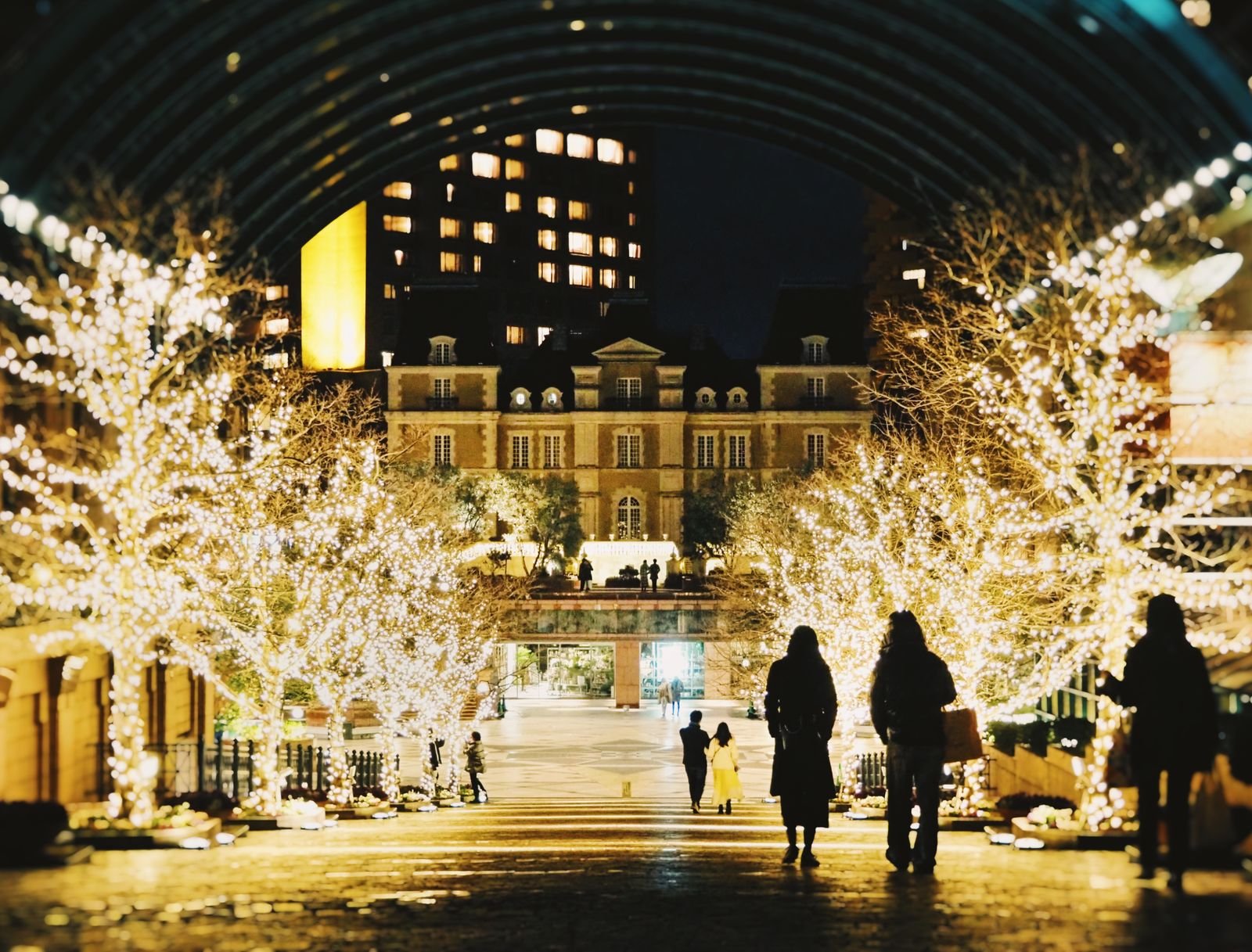
Christmas in Japan is a light-and-cake festival rather than a family holiday, and New Year (Oshogatsu) is the real event of the season. We cover both here: what the Christmas traditions are, where the best illuminations are, what shuts down from December 29 to January 3, and how to handle hatsumode, the first shrine visit of the year. For weather, ski conditions and general December planning, see our Japan in December guide.
Christmas in Japan: What Actually Happens
Christmas is not a public holiday. December 25 is a working day, and trains, shops and offices run as normal. What Japan has built instead is a set of food and date-night traditions.
KFC on Christmas Eve. The “Kentucky for Christmas” campaign began in 1974 and has since become a national habit. Families pre-order Christmas party buckets, often weeks ahead, and branches have queues on December 24. If you want one, order online or in-store early in December. Prices for the Christmas sets vary by year, so check the KFC Japan site.
Strawberry Christmas cake. The standard Japanese Christmas cake is a light sponge layered with whipped cream and topped with strawberries. Bakeries, department store food halls (depachika) and convenience stores sell them from early December, usually with pre-order deadlines. Individual slices are easy to buy on the day if you do not want a whole cake.
Christmas Eve as a date night. December 24 is a couples’ evening. Restaurants with a view, French and Italian places and hotel dinners fill up, and special set menus replace the usual carte. We suggest reserving two to four weeks ahead, and booking hotel dining before you arrive if you are travelling as a couple. Many Japanese families celebrate quietly at home with chicken, cake and a few presents for children.
December 26 flips the mood. Christmas decorations come down almost overnight and New Year decorations go up. Kadomatsu pine and bamboo arrangements appear at doorways, and supermarkets switch to New Year foods.
Best Christmas Illuminations in Japan
Illuminations (irumineshon) are the headline reason to travel in the Christmas period. Most are free to walk through, and many run from late November to December 25, with some extending into winter. Dates are confirmed each autumn, so check the official organiser before you go.
- Tokyo Midtown (Roppongi): the Midtown Christmas lights run from late November to December 25 in 2026 (reported as November 26 to December 25, 5pm to 11pm, free), with an ice rink opening in December. See our Tokyo guide for neighbourhoods and transport.
- Marunouchi, Roppongi Hills and Caretta Shiodome (Tokyo): large, free displays through late December. Marunouchi’s tree-lined Naka-dori avenue near Tokyo Station is the easiest to combine with a day in central Tokyo.
- Sapporo White Illumination and Munich Christmas Market (Hokkaido): Odori Park fills with lights and Christmas market stalls from late November, with the main Odori sites normally running to December 25. Exact 2026 dates were still unconfirmed when we wrote this, so check the organiser. Our Sapporo guide covers where to stay and how to get around in snow.
- Hakodate Christmas Fantasy (Hokkaido): a giant waterfront tree and nightly harbour fireworks from December 1 to 25. Full details are on our Hakodate Christmas Fantasy 2026 page.
- Kobe Luminarie: not in December any more. Since 2024 it runs in late January and early February (2026: January 30 to February 8; 2027 reported as January 29 to February 7). Light arches fill the old foreign settlement near Motomachi and Higashi Yuenchi Park. See our Kobe guide and confirm dates on the official site.
- Nabana no Sato (Mie): one of the largest illumination parks in Japan, open through the winter. It is a longer trip from Nagoya and Kyoto, so it suits travellers with a rental car or a free day.
For help getting around Tokyo’s illuminations in one evening, a guided Tokyo night tour removes the planning, and our best Tokyo tours roundup compares options.
New Year in Japan (Oshogatsu)
Oshogatsu is Japan’s most important holiday, comparable to Christmas in Western countries. Families return to their home towns, businesses close and the whole country slows down.
Omisoka (December 31). The evening is for toshikoshi soba (noodles eaten to “cross over” to the new year), TV specials and temple visits. At midnight, temples across Japan ring the bell 108 times (joya no kane), one for each earthly desire in Buddhist tradition. Well-known places include Zojo-ji near Tokyo Tower and Chion-in in Kyoto, and some temples let visitors ring the bell. In Kyoto, Yasaka Shrine holds the Okera Mairi ritual on New Year’s Eve, where people light a rope from sacred fires and carry it home.
Countdown events. Tokyo has big gatherings including Shibuya and a number of hotel and observation-deck countdowns, and Osaka has them around Dotonbori and Universal Studios Japan. Many are ticketed or crowd-managed. Reserve restaurants and bars early and expect early closing or fixed-price menus.
New Year foods. Osechi ryori is the traditional set of boxed dishes, ozoni is a mochi soup, and the food is prepared in advance so cooks can rest. Some department stores and restaurants sell osechi sets to order, which are worth booking well ahead.
New Year Closures: What Shuts and What Stays Open
The practical window is roughly December 29 to January 3. Government offices stop for this period by official custom, and many private businesses follow.
| Open | Often closed or reduced |
|---|---|
| Convenience stores (7-Eleven, Lawson, FamilyMart), 24-hour ATMs | Banks, post office counters, ward offices |
| Chain restaurants and fast food, many ramen chains | Small family-run restaurants, izakaya, local markets |
| Major hotels and their restaurants | Small museums, some galleries |
| Shrines and temples (often open all night Dec 31) | Many shops and department stores on Jan 1 (often reopen Jan 2 with sales) |
| JR and metro lines, with holiday timetables | Some regional trains and buses, reduced service |
Department stores often reopen on January 2 or 3 with “lucky bag” (fukubukuro) sales, which are popular with locals. Hot spring towns and ski resorts stay busy through the break, though some small ryokan have fixed multi-night packages. See our Japan public holidays guide for the full list of dates and closures. Withdraw cash before December 29, and see our money guide.
Hatsumode: The First Shrine Visit
Our Hatsumode 2027 event page has dates and shrine notes for the coming New Year.
Hatsumode takes place from midnight on January 1 and throughout the first three days, though many people visit any time in the first two weeks of January. Visitors buy fortunes (omikuji), lucky charms (omamori) and sometimes replace the previous year’s charm.
Typical large hatsumode sites:
- Meiji Jingu, Tokyo: consistently one of Japan’s most visited shrines at New Year, receiving several million visitors across the first three days. Expect queues to the main hall of an hour or more at peak times.
- Senso-ji, Asakusa, Tokyo: an alternative with a market atmosphere. See our Senso-ji guide.
- Fushimi Inari, Kyoto: crowded in the daytime on January 1 to 3. Our Fushimi Inari guide has route and timing advice for the rest of the year.
- Naritasan Shinshoji (Chiba) and Kawasaki Daishi (Kanagawa): among the busiest in the Tokyo region.
- Ise Jingu (Mie): a long-standing pilgrimage for the new year.
Tips for visiting without the worst crowds: go in the early morning of January 2 or 3, visit on January 4 or later when queues drop sharply, or choose a neighbourhood shrine instead of a headline site. Dress warmly, carry some coins for offerings (5 yen is considered lucky) and expect crowd-control rules, including one-way routes and no stopping on the approach.
Travel Logistics Over the Holiday
- Shinkansen and flights: peak departures are around December 28 to 30 and returns January 2 to 4. Reserved seats sell out, so book as early as tickets open. Our Shinkansen guide explains reservations, and an unreserved seat on a busy train may mean standing.
- Hotels: Tokyo and Kyoto rates rise around New Year, and the days around December 24 are pricey in couple-friendly hotels. Browse hotels in Tokyo, Kyoto or Sapporo before you commit to dates.
- Eating: plan at least one hotel or chain meal per day from December 30 to January 3, and keep a convenience store backup. Fixed-price New Year menus at restaurants are common.
- Staying connected: an eSIM for Japan saves queuing at an airport counter after a long flight, and travel insurance is worth considering for winter weather. See our eSIM guide.
- Cold-weather plans: Tokyo is dry, and Hokkaido is deep winter. See our Japan in December and Japan in January guides for temperatures, snow and onsen.
For official information on events and transport, check the Japan National Tourism Organization and GO TOKYO before you travel.
Plan Your Trip
If you want to see lights and avoid the New Year crush, arrive between December 15 and 24, see the Christmas Eve illuminations and leave before December 28, or fly in for January 4 onward when closures end and hotels get cheaper. If you want the cultural side, book a New Year stay early and treat the closed days as a slow break.
- Tokyo tours: Tokyo night tours and activities
- Kyoto tours: Kyoto temples and food tours
- Hotels: Tokyo · Kyoto · Osaka
- Hokkaido: Hakodate hotels · Sapporo tours