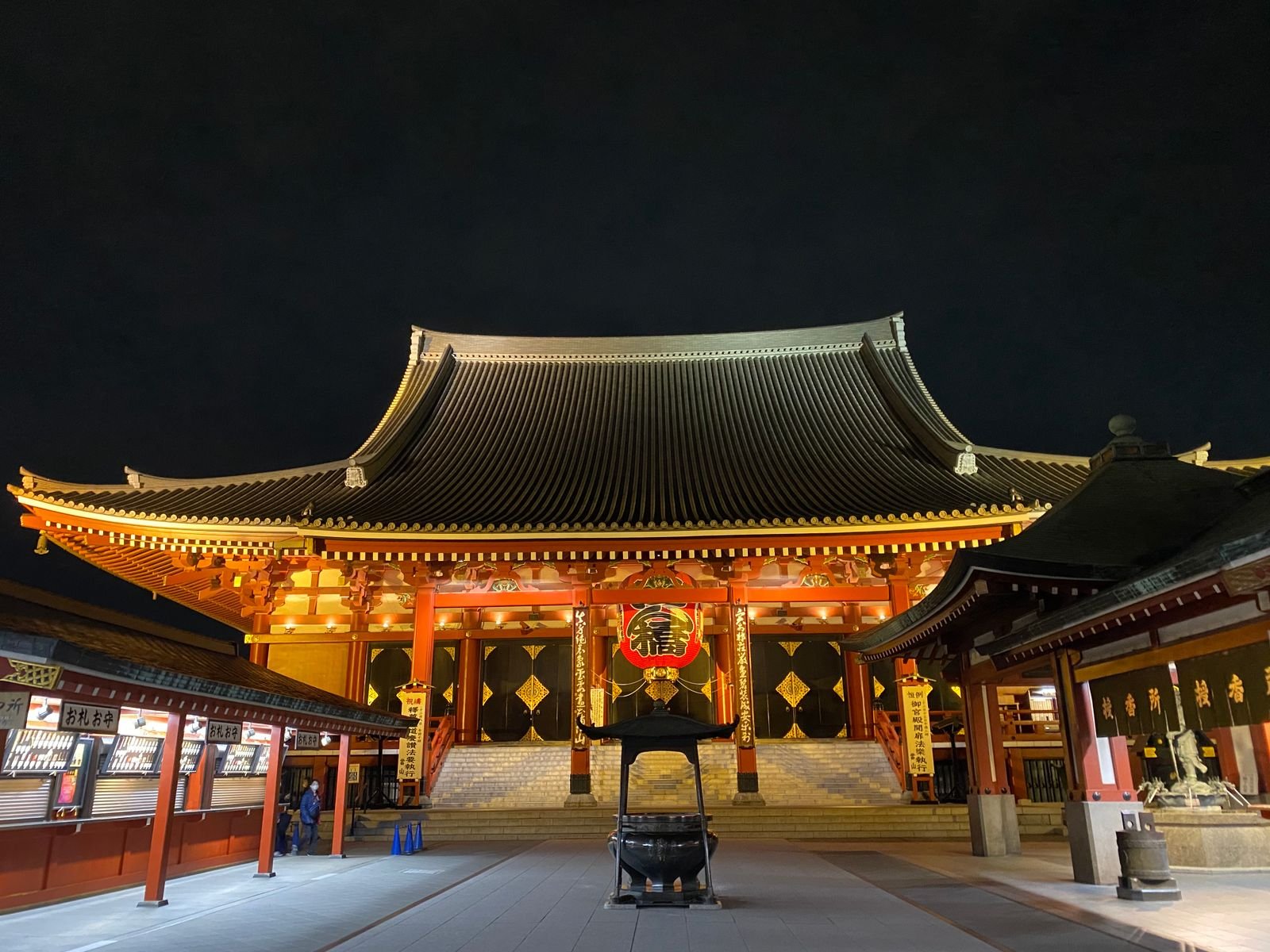
The seven best free things to do in Tokyo are Senso-ji temple, Meiji Shrine, the Tokyo Metropolitan Government Building observation deck, Yanaka’s old streets, Zojo-ji temple with its Tokyo Tower backdrop, Shibuya Crossing and the Tsukiji Outer Market. All cost nothing to enter as of 2026, and most open early or late, so they fit around paid plans.
Tokyo has a reputation for being expensive, but its most distinctive sights are mostly outdoors, spiritual or street-level, and free. We have walked all seven, and the list below runs roughly in the order a first-time visitor could link them. For the wider picture, see our 25 best things to do in Tokyo and the Tokyo city guide.
1. Senso-ji and Nakamise-dori, Asakusa
Senso-ji is Tokyo’s oldest temple, and the grounds stay open 24 hours a day with no entry fee. The main hall opens at 6:00 (6:30 from October to March) and closes at 17:00. You pass under the Kaminarimon gate, then walk the 250-metre Nakamise-dori lane of snack and souvenir stalls to reach the Hozomon gate and the hall. Reach Asakusa Station on the Ginza, Asakusa or Tobu Skytree lines.
Local tip: Come before 8:00 or after dark. The stalls are shuttered in the evening but the lit hall and pagoda are almost empty, which is when most photographs of the site are taken. Our Senso-ji and Asakusa guide covers the route, and a guided Asakusa walk adds context if you want history rather than just photographs.
2. Meiji Shrine, Harajuku
Meiji Shrine sits inside 70 hectares of planted forest beside Harajuku and Yoyogi. Entry to the shrine is free; only the separate inner garden carries a fee (approximately ¥500). The gravel approach under the large cypress torii takes about ten minutes on foot and feels removed from the city around it. Opening hours run from sunrise to sunset, so they shift through the year. Take the JR Yamanote Line to Harajuku or the Tokyo Metro to Meijijingumae. The shrine’s official site lists seasonal hours and events.
Local tip: Weekend mornings often include a Shinto wedding procession along the main path. Watch quietly from the side and do not step into the line.
3. Tokyo Metropolitan Government Building observation deck, Shinjuku
The twin towers of the Tokyo Metropolitan Government Building hold a free observatory at 202 metres. The North Tower deck is open 9:00 to 22:30 and closes on the 2nd and 4th Mondays; the South Tower closes at 17:30. Views reach across Shinjuku’s skyscrapers, and Mt Fuji is visible on clear winter mornings. Walk from Tochomae Station on the Toei Oedo Line, or about 10 minutes from Shinjuku Station.
Local tip: A free deck still draws a short queue at the security check around sunset. Arriving 45 minutes before dusk lets you see day, golden hour and the lit skyline in one visit. Paid alternatives such as Shibuya Sky cost approximately ¥2,000 as of 2026, so this is the main money-saver on the list.
4. Yanaka, old Shitamachi Tokyo
Yanaka survived the 1923 earthquake and the wartime firebombing, so its narrow lanes, wooden shopfronts and small temples remain. Walking costs nothing. Start at Nippori Station, take the Yanaka Ginza shopping street (nibble a croquette for a few hundred yen if you wish) and drift through the temple lanes and the public Yanaka Cemetery. Allow two hours. Our Yanaka neighbourhood guide gives a route, and the Tokyo neighbourhoods overview shows how it compares with Asakusa and Shimokitazawa.
Local tip: Many small shops close on Mondays or Tuesdays, so a mid-week morning gives the most atmosphere with the least crowd.
5. Zojo-ji Temple with the Tokyo Tower view, Shiba
Zojo-ji, founded in 1393 and moved to its current site in 1598, is a Jodo temple with a 1622 gate (Sangedatsumon) that counts among the oldest structures in Tokyo. Entry is free and the grounds are open from 6:00 to 17:30. The red-and-white Tokyo Tower rises directly behind the vermilion halls, which is one of the best free compositions in the city. Use Daimon Station (Toei Oedo and Asakusa lines) or Shibakoen Station.
Local tip: Stand on the temple’s central path facing the main hall in the early morning for the cleanest view of the tower rising behind the roof.
6. Shibuya Crossing
Shibuya Crossing is the busiest pedestrian scramble most visitors will ever see, and it is free to cross or watch. Walk it once at street level, then watch from the station-side windows and walkways above it. Allow 20 minutes. It pairs naturally with Meiji Shrine, about 25 minutes away on foot via Harajuku. For a paid angle, the rooftop at Shibuya Scramble Square costs money, which is why this entry stays at street level.
Local tip: Come after dark, especially in rain, when reflections and umbrellas fill the junction. Each green phase moves large groups at once, so a second crossing gives better photographs than the first.
7. Tsukiji Outer Market
The wholesale market moved to Toyosu in 2018, but the Tsukiji Outer Market lanes of seafood, tamagoyaki and street snacks still operate and cost nothing to walk. You pay only for what you eat, from a few hundred yen for a skewer to approximately ¥2,000 to ¥4,000 for a sushi set. Stall hours vary, but most trade from early morning to early afternoon, and many close on Sundays and some Wednesdays. Tsukiji Station (Hibiya Line) is the closest stop.
Local tip: Go at about 8:00 for the best selection and thinner crowds than the 10:00 to 12:00 peak. A Tsukiji food tour helps if you want a guide to explain what you are eating. For the former auction hall, read our Toyosu Fish Market guide.
How to link the free sights into days
A free day around Asakusa and Yanaka works in the morning and early afternoon on one train line. A west-side day can chain Meiji Shrine, Shibuya Crossing and the Shinjuku deck at sunset. Tsukiji and Zojo-ji sit near each other on the Oedo and Hibiya lines. If you want a ready-made plan, our 3 days in Tokyo itinerary uses several of these stops, and Tokyo tours cover the paid sights. For somewhere to base yourself, see where to stay in Tokyo and compare rooms on Booking.com.
Prices and hours above are approximate and checked as of 2026, but temple and observatory hours change with season and maintenance, so confirm on the day via the official sites or JNTO.