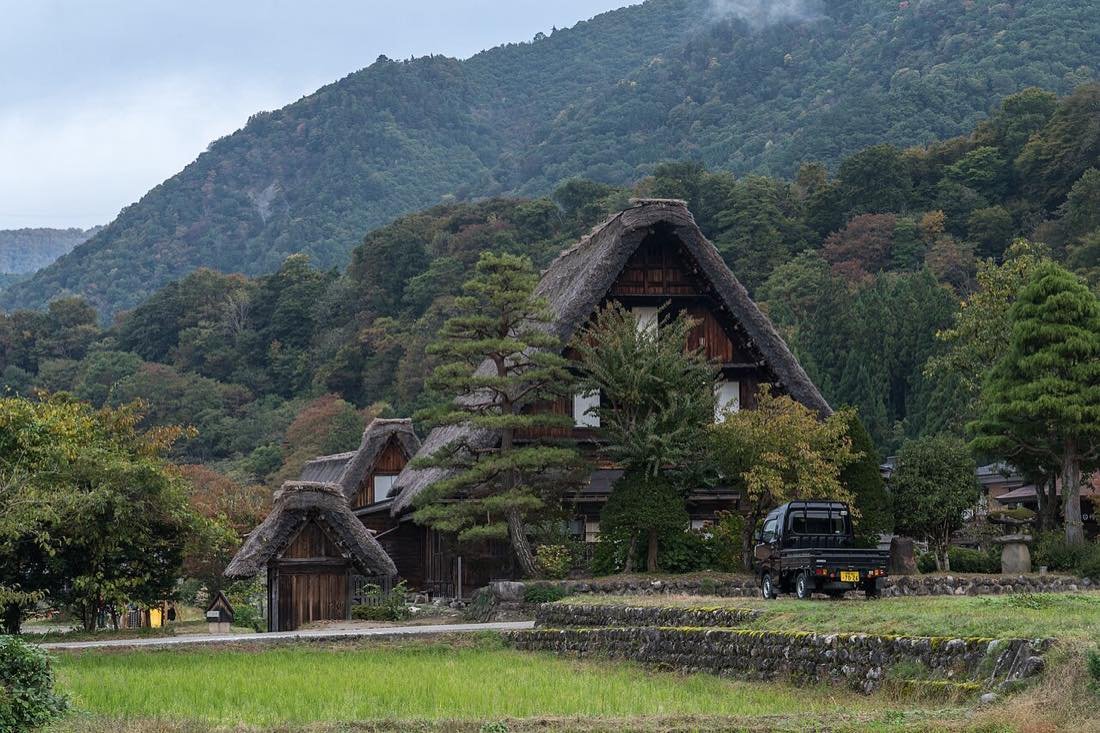
Shirakawa-go is the Japanese Alps village of steep thatched farmhouses that appears on most winter-Japan posters. Ogimachi, its main settlement, sits in the Shogawa River valley in Gifu Prefecture and keeps about 59 gassho-zukuri houses, built with roofs angled like hands pressed in prayer so that heavy snow slides off. It was inscribed by UNESCO in 1995 together with Gokayama in neighbouring Toyama. This guide covers the bus from Takayama and Kanazawa with current fares, how the 2027 winter light-up works, the viewpoints, an overnight stay and the quieter Gokayama villages.
Top Tours at a Glance
If you would rather skip bus timetables, a guided day trip handles transport and timing. Options on GetYourGuide include:
| Tour | Duration | Highlights |
|---|---|---|
| Shirakawa-go day trip from Takayama | 5-6 hrs | Ogimachi, a gassho house interior, free time |
| Shirakawa-go and Takayama old town | 8-9 hrs | Village plus Sanmachi Suji streets |
| Kanazawa to Shirakawa-go day tour | 9 hrs | Return from Kanazawa, lunch stop |
Durations are typical and vary by operator. Browse Kanazawa tours if you are starting on the coast.
Getting to Shirakawa-go
There is no train. The only public transport is the Nohi Bus, which links Takayama Bus Terminal, Shirakawago Bus Terminal and Kanazawa Station, plus Toyama and Takaoka. The operator lists 16 round-trip services a day, and some are reserved-seat services marked “R” on the timetable. Book through Japan Bus Online or the Nohi Bus reservation line, and see the official Nohi Bus route page for current departures.
| Route | Journey time | One way to 30 Nov 2026 | From 1 Dec 2026 |
|---|---|---|---|
| Takayama to Shirakawa-go | about 50 min | ¥2,800 | ¥2,900 |
| Kanazawa to Shirakawa-go | about 1 hr 15-25 min | ¥2,800 | ¥2,900 |
| Takayama to Kanazawa through fare | about 2 hr 15 min | ¥4,200 | ¥4,400 |
Fares are adult prices as of 2026 and Nohi Bus revises fares and timetables on 1 December. Buses can run well behind schedule in snow or when the village car park queues back onto the road, so never plan a tight onward connection. Travelling from Takayama is the easier trip, covered in our Takayama day-trips guide, and from the coast see Kanazawa day trips.
By car. Driving is possible on the Tokai-Hokuriku Expressway, but the village car park fills early on weekends and during winter events. Studless tyres are required in winter.
What to See in Ogimachi
Allow two to four hours in the village. Most visitors stay on the main lane, so walking the paddies and side paths behind the houses is where it gets quiet.
- Wada House. The largest gassho house open to the public, still lived in by the family. You can climb to the upper floors where silkworms were once raised. Entry is a few hundred yen.
- Gasshozukuri Minkaen. An open-air museum of relocated gassho buildings with craft demonstrations. Note that it closes on Thursdays from December to March.
- Kanda House and Nagase House. Two more preserved interiors, each with a small entry fee, if you want to compare how families lived across different generations.
- The paddies and Deai Bridge. The suspension bridge at the village entrance gives a first view of the roofs across the river and a short, flat walk.
Ogimachi viewpoint
The classic panorama comes from the Ogimachi Castle Ruins Observation Deck above the village. On foot it is a 15 to 20 minute climb along the trail behind Wada House. A shuttle bus also runs up from the village (about 5 minutes) on a published timetable, with a fare to pay. Go early or at dusk, when the day-tour buses have left and the light is lower.
Winter Light-Up 2027
On four winter evenings the farmhouses are lit from inside and the snow-covered roofs glow against the dark valley. The 41st light-up is scheduled for 11, 17, 24 and 31 January 2027, 17:30 to 19:30, and it is by advance reservation only with no sales on the day. See the Shirakawa-go Tourist Association for confirmation before you plan around a date.
How booking works for 2027:
- Observation deck tickets are not sold alone. You get one with a room booked in Shirakawa Village on the event date or with a light-up tour from a participating bus operator.
- The accommodation lottery has closed. Applications ran from 1 to 31 October 2026 and winners were notified on 10 November. Additional rooms open first come, first served on 26 November 2026 at 13:00 JST.
- Tours. The operators’ own sales opened in October, and travel-agency tours are listed from 2 December 2026 at 13:00.
- Parking. A second round for private-car parking opens on 1 December 2026 at 13:00, online only, at ¥7,000 for one to five people.
Expect temperatures between about -10C and 0C. Tripods are banned on the deck, and the event can be cancelled in severe weather. Visitors without a ticket are turned away from the entry gate from 15:30. If you miss out, the village is still worth a daytime visit on a snowy weekday in January or February.
Staying Overnight in a Gassho Minshuku
About two dozen gassho houses run as minshuku (family-run guesthouses), and an overnight stay changes the experience: after the last coach leaves around 17:00 the village empties, and you get the lamplit lanes and fog in the morning to yourself. Rooms are tatami with futon, usually with shared bathrooms, and dinner and breakfast are served in the main room around the hearth. Budget roughly ¥12,000 to ¥18,000 per person with two meals (as of 2026), more on light-up nights. Heating is basic and walls are thin, so pack layers in winter. These rooms sell out months ahead, so book as early as possible. For more comfortable beds the better option is to base yourself in a town and browse Takayama hotels, or see our Kanazawa area guide.
Beyond Ogimachi: Gokayama
Gokayama’s Ainokura and Suganuma are smaller than Ogimachi, with fewer tour groups and working farms around the houses. Suganuma is a stop on the Nohi route from April to November, boarding or alighting only on certain runs, so check the timetable. Nohi Bus also runs a Takayama day tour that covers Ainokura and Shirakawa-go together, departing 08:30 and returning at 15:50 (¥9,000 adult as of 2026). Combining Gokayama independently needs an early start and careful connections.
Practical Tips
- Check the last bus before you climb to the viewpoint, and carry cash since small houses and cafes may not take cards.
- Bring waterproof boots between December and March. The lanes are packed snow and ice.
- Best seasons are January and February for snow, late April to May for planting, and October to November for colour.
- Combine it with the old town in Takayama or with the wider Chubu region.
Photo: Alexkom000 / Wikimedia Commons, CC BY 4.0.