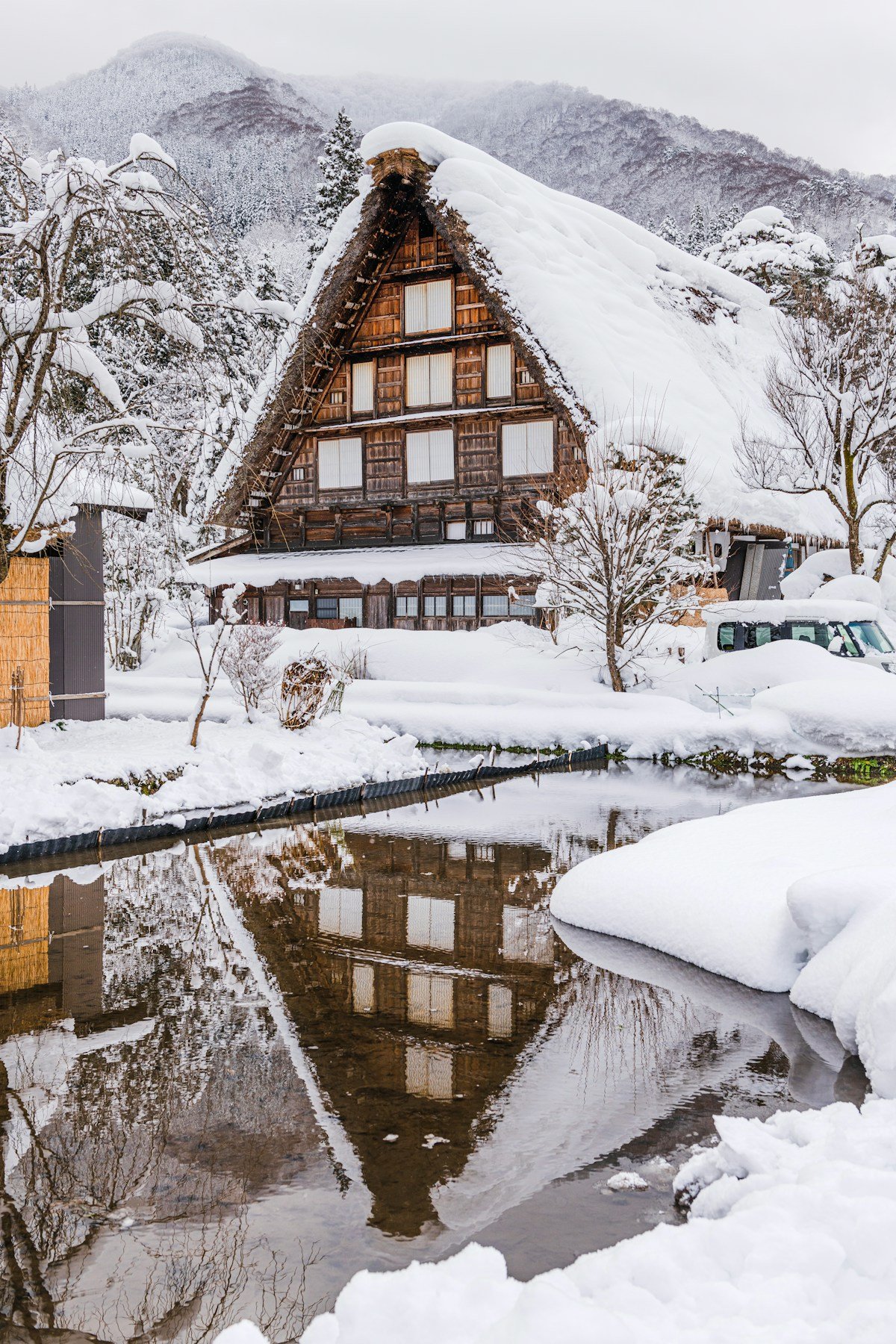
Takayama’s position at the heart of the Hida mountains makes it one of the best bases for day trips in central Japan. UNESCO World Heritage thatched villages, Japan’s finest mountain valley, one of the country’s best-preserved castles, and a renowned hot spring town are all within two hours. Here is what is worth the journey.
Shirakawa-go
Shirakawa-go is the most famous day trip from Takayama and the one most visitors prioritise. The UNESCO World Heritage village of Ogimachi contains around 110 surviving gassho-zukuri farmhouses - steep thatched A-frame structures designed to shed heavy mountain snow and accommodate silkworm cultivation on the upper floors. The name gassho-zukuri means “hands in prayer,” a reference to the roof angle’s resemblance to pressed palms.
Getting there: Buses from Takayama Bus Terminal to Ogimachi (Shirakawa-go), approximately 40 minutes, ¥1,600 one way as of 2026. Nohi Bus operates the route; buses run roughly every 1–2 hours. No train serves this route - the bus is the only public transport option.
What to see:
The Wada House (¥300, 9am–5pm) is the largest surviving gassho-zukuri farmhouse in the village and provides the most complete interior experience - four floors open to visitors, including the silkworm spaces on the upper floors and the historic household items on the lower levels.
The Myozen-ji open-air museum (¥400, 9am–5pm) groups several farmhouses around a traditional temple, giving a sense of the village as it functioned rather than as individual isolated museum pieces.
The Shiroyama observation point - a 10-minute walk from the main village on a clearly signed path - provides the elevated view over the entire settlement that appears on every Shirakawa-go poster. It is free and the view is best in early morning when tour group buses have not yet arrived.
During the winter illumination events (held on select evenings in January and February), the farmhouses are lit from below and the snow-covered roofs glow against the dark sky. These events are extremely popular - visitor numbers are managed, and registration is required in advance through the Shirakawa-go tourism website.
Allow: 2–4 hours in the village. An early bus, the Wada House, the observation point, lunch at a local restaurant (the village has several small restaurants serving gassho-zukuri-themed cuisine including local trout and persimmon dishes), and a mid-afternoon return bus is a comfortable half-day.
Hida Folk Village (Hida no Sato)
Hida Folk Village - Hida no Sato - is an open-air museum within walking distance of central Takayama (20 minutes on foot from the station, or 5 minutes by bus). It collects 30 traditional Hida farmhouses relocated from villages that were abandoned or flooded in the 20th century, arranged in a convincing valley setting with streams and forested hillsides.
Entry: ¥700, open 8:30am–5pm.
Unlike Shirakawa-go, which is a living village, Hida Folk Village is an organised museum experience. Staff conduct demonstrations of traditional crafts - smithing, straw weaving, papermaking, and pottery - throughout the day (demonstrations listed at the entrance). The interiors of the larger farmhouses are fully open, showing the multi-storey layout and original furnishings. In winter, the steep thatched roofs accumulate heavy snow and the village takes on a particularly dramatic appearance.
The village works well as a pre-bus-departure activity if you are planning to go to Shirakawa-go on the same day - it fills the morning while you wait for an afternoon bus connection.
Matsumoto and Matsumoto Castle
Matsumoto is a city of 250,000 people approximately 2 hours east of Takayama, built around one of Japan’s best-preserved original feudal castles. The castle dates from the 1590s and is designated a National Treasure - its black-lacquered tower complex reflects in the surrounding moat, creating the most distinctive castle silhouette in the country outside Himeji.
Getting there: Wide View Hida express from Takayama, approximately 2 hours, ¥3,020 one way as of 2026. Several services daily. The castle is a 15-minute walk from Matsumoto Station.
What to see: Matsumoto Castle (¥700, 8:30am–5pm) has six floors of interior accessible by steep wooden ladders, with original features including gun ports, arrow slits, and the moon-viewing balcony added in the 1630s for aesthetic purposes. English audio guides are available.
The Nawate-dori and Nakamachi shopping streets near the castle have a preserved old-town character, with sake shops, craft stores, and cafes in traditional kura (storehouse) buildings. A half-day in Matsumoto covers the castle and old town comfortably before the return train.
Gero Onsen
Gero Onsen is approximately 45 minutes south of Takayama by Wide View Hida express (¥1,910 one way as of 2026) and is one of Japan’s three officially designated great hot springs (alongside Arima in Kobe and Kusatsu in Gunma). The thermal water is alkaline sodium bicarbonate - mild, colourless, and noted for its effect on skin.
The resort town is compact, sitting in a river gorge. Yunoshimakan and Suimeikan are the two large traditional ryokan with the most elaborate bath complexes, both offering day-use bathing (¥1,000–¥2,000 as of 2026, towels typically included). Several smaller bathhouses in the town offer day-use baths for ¥400–¥800.
The riverside Gero Onsen Matsunoi outdoor footbath is free. The town also has an open-air foot spa at the bus terminal.
A half-day in Gero covers a soak, a meal at one of the riverside restaurants (trout, river fish, and mountain vegetables are standard), and a return to Takayama by early evening.
Make the most of your time around Takayama: Guided day trips from Takayama handle the logistics - transport, guide, and timing - so you can focus on the experience. For airport arrivals and departures, Kiwitaxi offers fixed-price airport transfers with no meter surprises.
Kamikochi
Kamikochi is Japan’s premier alpine valley and one of the most dramatic landscapes in the country - a high basin at 1,500 metres surrounded by the Hotaka mountain range, with the Azusa River threading glacial pools and meadows through its centre. Private vehicles are prohibited; all access is by bus.
Getting there from Takayama: Take the Nohi Bus from Takayama Bus Terminal to Hirayu Onsen (approximately 50 minutes, ¥1,700 as of 2026), then transfer to the Alpico bus for Kamikochi (30 minutes, ¥1,160 as of 2026). The combined journey takes about 1 hour 20 minutes. An alternative route goes via Matsumoto if you want to link both destinations.
Entry: No entry fee for the valley itself. A ¥300 nature conservation fee is charged at certain access points in high season.
What to see: The classic short walk goes from the Kappa Bridge (the most photographed point - a suspension bridge framing the Hotaka peaks) through riverside meadows to Myojin Pond (2 hours round trip, flat terrain). A longer extension reaches Tokusawa or Yokoo, the trailhead for serious mountain climbs into the North Alps.
The valley is open late April to mid-November; it is closed in winter and the access roads are snow-blocked. Peak season is late July and August - crowds are significant. June and October are better for atmosphere and visibility.
Allow: A full day including travel. The Kamikochi bus fare, nature fee, and a lunch at the Kamikochi Imperial Hotel terrace (sandwiches and coffee from ¥1,200) adds up to approximately ¥6,000 for the day including return transport.
See the Takayama travel guide for the city itself, and food to try in Takayama for the Hida beef, sake, and mountain specialties you should try before or after any of these day trips.
Where to stay: Search hotels in Takayama on Booking.com
See also: Takayama travel guide · Things to do in Takayama · Kanazawa travel guide · Nagano travel guide · Chubu region guide · Japan Rail Pass guide