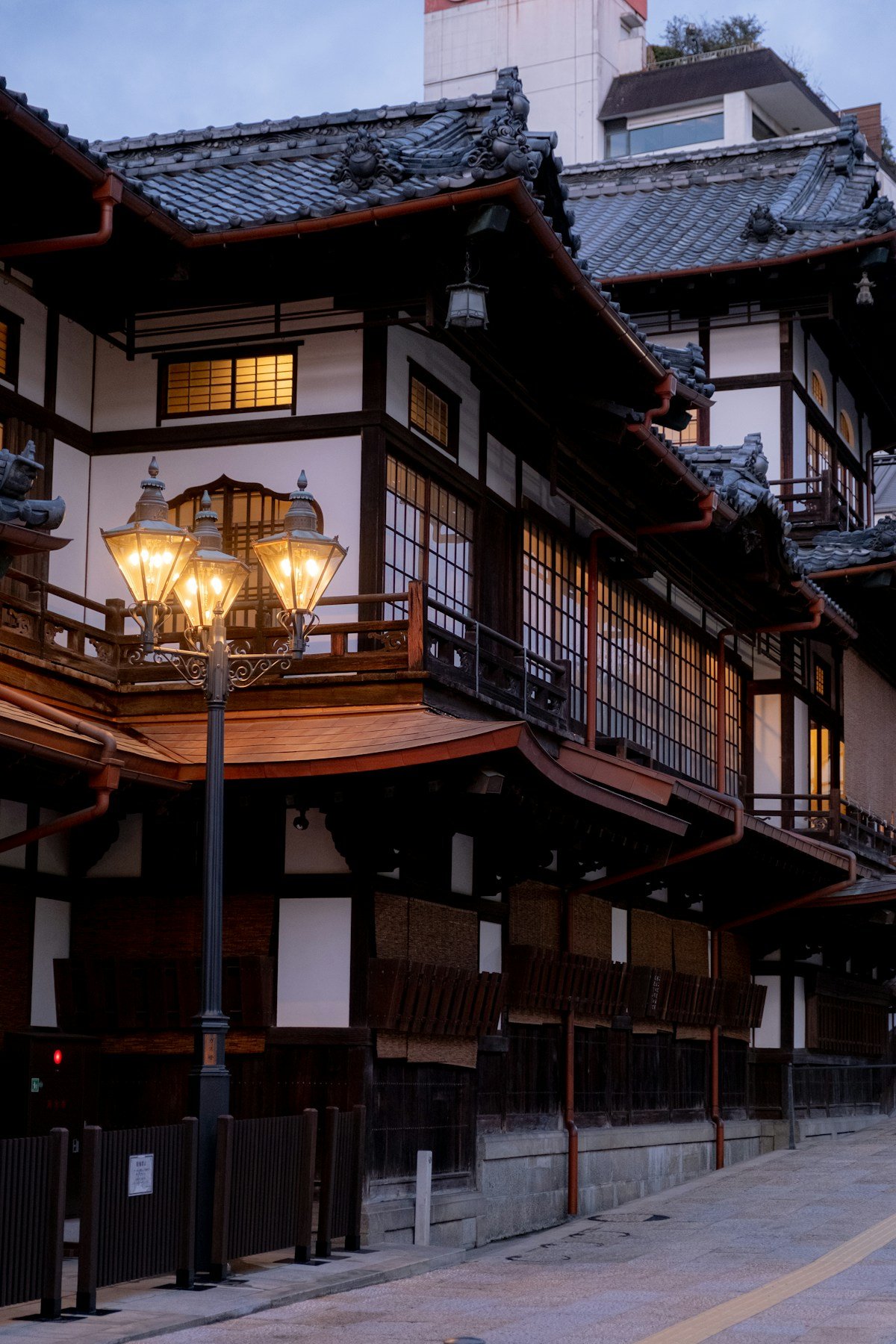
Takayama rewards a minimum of two nights. The morning markets require an early start, the sake tastings are best done without time pressure, and Shirakawa-go alone justifies a half-day. These 18 activities cover both the essential sightseeing and the quieter experiences that make Takayama feel like a place with genuine depth rather than a heritage attraction.
1. Sanmachi Suji Sake and Merchant Street Walk
Walk all three lanes of Sanmachi Suji (free, most rewarding before 9am and after 5pm). The Edo-period merchant townhouses are original - notice the varying styles of latticed shutters, the earthen walls, and the sugidama cedar-bough balls hanging above brewery entrances. These cedar balls are hung when new sake is brewed, traditionally green when fresh in December and browning over the following year.
The most satisfying way to cover the district is slowly, stopping at the three main sake breweries. Hirase (the oldest brewery in Takayama), Funasaka (largest sake selection), and Watanabe all welcome walk-in visitors. Pour your own from display bottles at some; at others, staff will guide the tasting. A small cup of standard sake costs ¥100 to ¥300; premium local varieties are ¥400 to ¥600.
2. Takayama Jinya Government Building
The Takayama Jinya (¥440) is consistently underrated relative to Sanmachi Suji, and considerably more illuminating as a historical document. As the only surviving Edo-period regional government building in Japan, it shows the physical infrastructure of shogunate administration: the rice tax collection points, the tatami-floored rooms where officials received petitions, the court for criminal proceedings, and the tools and methods used to extract confessions. The English audio guide is thorough. Allow 45 to 60 minutes.
3. Jinya Mae Morning Market
The Jinya Mae Morning Market (free, 6am–noon) runs in the street directly in front of the Jinya building. It is smaller and less visited than the Miyagawa market, which makes it more authentic. Around 15 to 20 stalls typically operate, selling mountain vegetables, pickled radish and turnip, local miso paste (try the finger-tasting offered freely at most miso stalls), and sometimes hand-sewn textile goods.
Arrive at 7am for the best atmosphere - genuine transactions between stall holders and local shoppers rather than tourist browsing. By 9am the market has more visitors than sellers.
4. Miyagawa Morning Market
The Miyagawa Morning Market (free, 6am–noon) runs along the east bank of the Miyagawa River with around 50 stalls. It is the larger of the two markets and attracts a mix of locals and visitors. Produce includes mountain herbs, fresh vegetables, dried mushrooms, and wasabi. Crafts include lacquerware, textiles, and sarubobo traditional cloth dolls - the primary Takayama souvenir, with red fabric bodies and no facial features.
Buy vegetables and prepared foods early; the freshest produce sells by 8am.
5. Hida no Sato Folk Village
The Hida Folk Village (¥700, open 8:30am–5pm) should occupy at least 2 hours. The 30 relocated gassho-zukuri farmhouses are arranged in a convincing valley landscape, and the scale of the buildings - some 5 storeys tall under their thatched roofs - is more impressive in person than photographs suggest. The upper floors housed silkworm cultivation; the ground floors are furnished as living spaces; and the lowest cellars processed and stored food through the long mountain winters.
Craft demonstrations run throughout the day: smithing in one building, paper-making in another, straw-weaving in a third. Staff are knowledgeable and patient with questions. In winter, the snow-covered roofs are the most visual spectacle - the steep pitch necessary to shed Takayama’s heavy snowfall creates a dramatic profile against the winter sky.
6. Takayama Festival Float Exhibition Hall
Two of the 11 festival yatai floats are on permanent display at the Takayama Festival Float Exhibition Hall (¥1,000, open 9am–5pm). The floats are displayed in rotation - which two are shown changes seasonally. At 1pm daily, staff demonstrate the karakuri mechanical puppet mechanism: dozens of strings operated by a team behind the float animate a small puppet figure through a sequence of acrobatic moves. The technical ingenuity of the system, entirely mechanical and without electronics, is impressive.
The exhibition hall’s context panels explain the history of each float - most were built in the 17th and 18th centuries, with lacquerwork, metalwork, and tapestries updated by successive generations of craftspeople.
7. Hida Beef Kushiage Skewer
The most accessible way to taste Hida beef without committing to a full restaurant meal is the kushiage skewer (¥500 each) sold at small grills near Sanmachi Suji and around the morning market area. A single skewer of Hida beef, grilled over charcoal, is enough to understand the quality of the beef - the fine fat distribution produces a flavour more delicate and cleaner than lower-grade wagyu.
Several stalls near Jinya Mae market open from 9am. Look for stalls with visible grills rather than pre-cooked sitting on display.
8. Takayama Ramen at Masuda-ya
Takayama-style shoyu ramen is distinct from any other regional style: a light, clear soy broth made from chicken stock, with thin straight noodles, char siu pork, and green onions. The soup is less intense than Tokyo shoyu ramen and completely unlike the heavy pork broths of Hakata. Masuda-ya (¥900 per bowl, typically opening 11am, cash only) is one of the most respected shops for the local style. Expect a short queue at lunchtime.
9. Sake Brewery Tour at Funasaka
Funasaka Sake Brewery (free entry, tasting from ¥100) is the most visitor-accessible of Takayama’s working breweries. The front shop displays the full range of the brewery’s sake and allows self-serve tasting from small pourers of standard grades. Staff will open premium bottles for comparison if asked. A small cup of the most prized local sake costs around ¥400.
The best time to visit is November to February, when active brewing is visible through the shop interior - the smell of fermenting rice and the sounds of production add to the experience.
10. Shirakawa-go UNESCO Village Day Trip
Buses to Shirakawa-go run from Takayama Bus Terminal roughly every 1 to 2 hours (40 minutes, ¥1,600 each way). The main village of Ogimachi has around 110 surviving gassho-zukuri farmhouses set against forested mountains.
The Wada House (¥300) is the largest farmhouse open to visitors, with four accessible floors including the working areas. The observation point above the village (10-minute walk, free) provides the classic elevated view across the settlement. Allow 3 to 4 hours for a comfortable visit.
The village is most photogenic in late January and early February, when deep snow sits on the steep thatched roofs. Evening illuminations on selected winter Saturdays are booked months ahead and extremely popular.
11. Gokayama Remote Gassho Villages
Gokayama (approximately 2 hours by bus from Takayama, ¥2,000 one way via Shirakawa-go) has two UNESCO-listed gassho-zukuri villages - Ainokura and Suganuma - that receive a fraction of Shirakawa-go’s visitor numbers. Ainokura (free walking, folk museum ¥200) is the more complete village, with a handful of working farmhouses and a small community of permanent residents who live and farm in the traditional setting.
The journey from Takayama via Shirakawa-go makes a natural combination - take the morning bus to Shirakawa-go, spend 2 hours there, then connect onward to Gokayama and return to Takayama late afternoon.
12. Hida Kokubun-ji Temple
The Hida Kokubun-ji temple (¥100) in central Takayama is one of the oldest temples in the Hida region, with a three-story pagoda dating from the 16th century. Its primary draw is the ginkgo tree in the temple grounds - approximately 1,250 years old, with a trunk circumference requiring several people to encircle. In late October to early November, the ginkgo turns bright gold and drops its leaves in a concentrated fall that draws local photographers.
13. Kusakabe Mingeikan Folk Art Museum
The Kusakabe Mingeikan (¥700) is a late 19th-century merchant house preserved with its original contents - lacquerware, household items, merchant account books, and craftwork. The building itself, constructed in 1879, is architecturally significant: a combination of traditional Hida construction techniques with elements borrowed from Kyoto merchant architecture.
The museum is quieter than the main Sanmachi Suji area despite being adjacent to it. Allow 45 minutes.
14. Cycling Around Takayama
The city centre is relatively flat and easily navigated by bicycle. Rentals are available near the station (¥500 per half day, ¥800 per full day). A cycling circuit from the station through Sanmachi Suji, to the morning market, along the Miyagawa River, and back via Higashiyama temple walk takes around 2 hours without stopping.
The Higashiyama temple walk (free, 3.5 kilometres) passes 14 temples and 8 shrines through the eastern hills - a pleasant forest circuit that avoids the busier central streets.
15. Lacquerware Workshop
Traditional Hida lacquerware (shunkei-nuri) uses translucent lacquer over wood to show the wood grain beneath - a technique specific to the Takayama area. Workshops in the city offer hands-on sessions (¥2,500–¥4,000, approximately 90 minutes) where you apply lacquer to a pre-shaped wooden object - typically a small bowl or box - and polish the layers. The finished piece takes several days to dry fully and is typically posted to your home address.
16. Okuhida Onsenkyo Hot Spring Area
Five onsen villages cluster in the Okuhida valley at the foot of the Norikura volcano, approximately 1 hour 20 minutes by bus from Takayama (bus ¥1,800 each way). The villages - Shin-Hotaka, Fukuchi, Tochio, Hirayu, and Kamitakami - share access to some of the best outdoor hot spring bathing in Japan.
Shin-Hotaka has the most dramatic setting - the Shin-Hotaka Ropeway (¥3,200 return) lifts to 2,156 metres with views of the Northern Alps. Day-use bathing at various facilities costs from ¥700. Several outdoor baths (rotenburo) overlook the Okuhida river valley - bathing in 41°C water with snow-dusted peaks directly in view is worth the journey from Takayama.
17. Sake in November to February Brewing Season
Takayama’s sake breweries begin the new brewing cycle in November, when winter cold provides the ideal fermentation temperatures. Between November and February, the breweries on Sanmachi Suji are most active - the smell of freshly fermenting rice permeates the lane, and the cedar sugidama balls hung in December are at their freshest and greenest. Several breweries open their inner brewing areas to visitors on designated days - ask at the tourist information office adjacent to the station for the current season’s schedule.
18. Higashiyama Temple Walk
The Higashiyama temple walk (free, 3.5 kilometres, 1 to 2 hours) follows a signed path through the forested hills east of the city, passing 14 Buddhist temples and 8 Shinto shrines. Unlike the more visited areas of the city, the path passes through quiet residential streets, cemetery grounds, and cedar forest. The walk is particularly pleasant in autumn foliage season (mid-November) and in winter when snow covers the temple roofs.
Book ahead for popular experiences: Tours and activities in Takayama include guided options, skip-the-line tickets, and immersive cultural experiences.
Best of Takayama by Season
| Season | Highlight Activities | Key Dates |
|---|---|---|
| Spring | Sanno Festival floats, cherry blossoms | April 14–15 (festival) |
| Summer | Folk Village demonstrations, cycling, Okuhida hiking | June–August |
| Autumn | Hachiman Festival, ginkgo at Kokubun-ji, Shirakawa-go | October 9–10 (festival); foliage mid-Nov |
| Winter | Snow on folk village, sake brewing season, Okuhida onsen | December–February |
| All year | Sanmachi Suji sake, morning markets, Jinya | Daily |
Where to stay: Search hotels in Takayama on Booking.com
See also: Takayama travel guide · Where to stay in Takayama · Best restaurants in Takayama · Day trips from Takayama · Onsen guide Japan · Chubu region guide