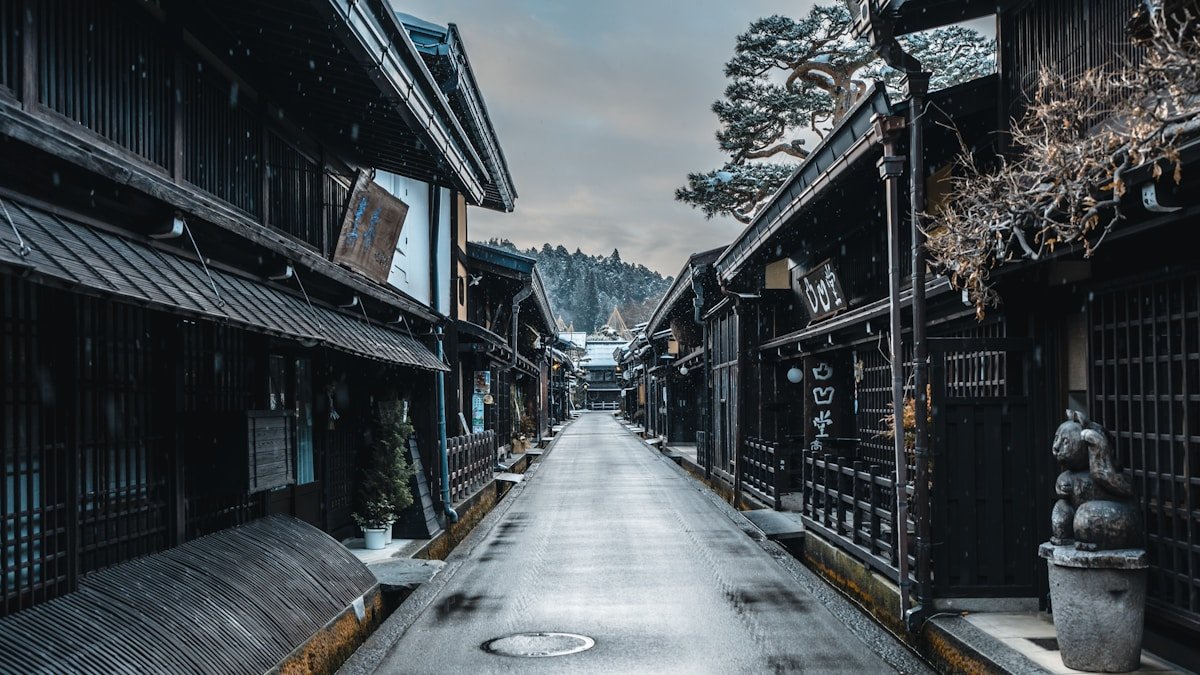
Takayama Travel Guide: Edo-Era Streets and Alpine Japan
Takayama travel guide covering Sanmachi Suji sake streets, Takayama Festival, Hida folk village, Shirakawa-go, and mountain food culture.
Guides for Takayama
Takayama occupies a mountain valley in Gifu Prefecture at an elevation of around 560 metres, flanked by the Hida Mountains. With a population of just 88,000, it is a small city, but its historic core is among the best-preserved urban landscapes from the Edo period anywhere in Japan. Unlike many heritage areas where the historical character is maintained through careful pastiche, Takayama’s Sanmachi Suji district contains working sake breweries, active craft workshops, and morning markets that have operated continuously since the 18th century.
The city is sometimes called “Little Kyoto of the Hida,” but the comparison does it a disservice. Kyoto’s heritage is courtly and Buddhist - temple complexes, imperial gardens, refined ceremony. Takayama’s heritage is mercantile and mountain-alpine - sake production, woodworking, lacquerware, and the rugged self-sufficiency of a community that spent winters cut off by snow from the rest of Japan. The aesthetic, the food, and the rhythms of the city are their own.
Sanmachi Suji Historic Street
Sanmachi Suji (free walking) is three parallel lanes of Edo-period merchant townhouses in the eastern part of the city centre. The buildings are original - not reconstructed - and date predominantly from the 17th to 19th centuries. Low wooden facades with latticed windows, earthen walls, and overhanging eaves create a streetscape that gives an accurate sense of what a prosperous Edo-period merchant town looked like.
The most distinctive feature of Sanmachi Suji is the sake breweries. Several operate directly on the main lanes, identifiable by the sugidama - spherical balls of cedar boughs - hung above the entrance when new sake is ready for sale (traditionally green and fresh in December, browning through the year). Walk-in tasting is welcomed at Hirase, Funasaka, and Watanabe breweries. A small glass of premium sake costs ¥100 to ¥300. Funasaka’s tasting room has the most welcoming layout for visitors unfamiliar with Japanese sake service.
The lanes are most atmospheric before 9am and after 5pm, when day-trippers are absent. The morning market and first wave of tourists typically arrive around 9:30am; by noon Sanmachi Suji can be crowded during peak season. An early morning walk when shopkeepers are opening and the cedar bough balls are being dusted off is worth the early start.
Takayama Jinya
The Takayama Jinya (¥440, open 8:45am–5pm) is the only surviving Edo-period regional government building in Japan - every other regional government office was destroyed or demolished before or during the Meiji period. Constructed in 1615, it served as the local administrative headquarters of the Tokugawa shogunate for 176 years.
The building’s interior illuminates the mechanics of Edo-period governance: rice storage barns that held the tax rice collected from farmers, tatami rooms for official business, a separate room for questioning suspected criminals, and - displayed rather bluntly - the tools used in judicial torture. The level of historical detail and the quality of interpretation (English audio guide available) make this one of the most historically substantive sites in the region.
Hida Folk Village
The Hida no Sato (Hida Folk Village, ¥700, open 8:30am–5pm) is an open-air museum containing 30 traditional Hida farmhouses relocated from villages that were flooded or abandoned during the 20th century. Most are gassho-zukuri (steep thatched A-frame farmhouses) that would otherwise have been lost.
The village setting is convincing - the houses are arranged in a valley surrounded by trees, with streams running between them, and staff conduct demonstrations of traditional crafts: smithing, papermaking, straw work, and weaving. The interior of the larger farmhouses is accessible, showing the multi-floor layout in which the upper levels housed silkworm cultivation while the lower floors were used for living and work.
Winter is the most photogenic time to visit - heavy snow accumulates on the steep thatched roofs and the village takes on the appearance of the Edo-period original. A covered section near the entrance houses smaller craftwork exhibits that can be seen in poor weather.
Takayama Festival
The Takayama Festival runs twice annually: Sanno Festival (April 14–15) and Hachiman Festival (October 9–10). It is registered on Japan’s UNESCO Intangible Cultural Heritage list and is consistently ranked among the three most beautiful festivals in Japan alongside Gion Matsuri in Kyoto and Chichibu Night Festival.
The festival’s centrepiece is 11 ornate yatai floats - wheeled platforms carrying elaborate mechanical puppet theatres and decorative structures reaching 8 metres in height. The floats are pulled through the city streets by teams in period costume. At intervals, the karakuri mechanical puppets - operated by as many as 20 people using hidden string mechanisms - perform acrobatic and theatrical routines on top of the floats.
The October festival also includes an evening lantern procession when all 11 floats are illuminated by paper lanterns and pulled through the city streets in the dark. This evening procession is the most visually spectacular element of either festival.
Accommodation books out completely for festival dates, often a year or more in advance. If you plan to attend, book the moment accommodation becomes available - typically the moment the previous year’s festival ends. Prices during festival period rise 50 to 100 percent above normal rates.
Morning Markets
Two morning markets operate daily in Takayama. The Jinya Mae market (in front of the Takayama Jinya building) is the older and more authentic of the two - a row of stalls selling fresh vegetables, pickled foods, local miso, and hand-crafted items. It runs from approximately 6am to noon and is primarily patronised by locals. Stall holders are typically elderly women who have been selling here for decades.
The Miyagawa Morning Market runs along the east bank of the Miyagawa River, with around 50 stalls offering produce, lacquerware, preserved foods, and tourist crafts. It also runs 6am to noon and attracts more visitors than the Jinya Mae market, but remains genuinely oriented around local produce rather than purely tourist merchandise.
Arriving at either market by 7am provides the best atmosphere - genuine purchases being made, stall holders chatting, and produce still fresh. By 9:30am both markets are noticeably more crowded.
Hida Beef
The Hida region’s wagyu cattle, raised in the clean mountain air of the Gifu highlands, produces some of Japan’s highest-grade beef. Hida beef reaches grades A4 and A5 (the highest classification) with a fine fat marbling that is distinct from Kobe or Matsusaka beef from lower elevations.
The most accessible form for visitors is kushiage - a single skewer of Hida beef, grilled over charcoal, sold at stalls near Sanmachi Suji for around ¥500 each. This is sufficient to understand the quality of the beef without committing to a full meal.
For a proper meal, Hida beef steak sets at local restaurants cost ¥5,000 to ¥15,000 depending on cut weight and grade. Shabu-shabu and sukiyaki at specialist restaurants (¥4,000–¥8,000 per person) are less expensive ways to eat significant quantities of the beef.
Shirakawa-go Day Trip
Shirakawa-go is a UNESCO World Heritage village of gassho-zukuri thatched farmhouses, 40 minutes north of Takayama by bus (¥1,600 each way, buses roughly every 1–2 hours). The main village of Ogimachi has around 110 remaining gassho-zukuri farmhouses, of which several are open to visitors.
The Wada House (¥300) is the largest surviving farmhouse in the village and offers the most complete interior experience - four floors including the working silkworm spaces and the household’s living quarters. The observation point above the village (10-minute walk from the main street, free) provides the postcard view over the entire settlement.
Shirakawa-go is most beautiful in January and February, when several metres of snow accumulate on the steep thatched roofs and the village is illuminated on designated evenings. Day-trippers arrive in volume from 10am onwards - arriving on the first morning bus and leaving on the early afternoon service avoids the worst crowds.
Guided Takayama and Shirakawa-go day tours from Nagoya or Kanazawa cover both destinations in a single circuit, with English commentary on the gassho-zukuri construction techniques and the UNESCO designation.
Getting to Takayama
From Nagoya: Wide View Hida limited express directly to Takayama (2 hours 30 minutes, ¥5,610). This is the most convenient access point.
From Tokyo: Shinkansen to Nagoya (1 hour 40 minutes, ¥11,290) then Wide View Hida (2 hours 30 minutes, ¥5,610) - total around ¥17,000 and 4 hours 10 minutes.
From Osaka: Shinkansen to Nagoya then Wide View Hida - total around 3 hours 30 minutes and ¥8,250.
From Matsumoto: JR wide view Hida (2 hours, ¥3,020) - a useful connection for a circuit including Nagano, Matsumoto, and Takayama.
Within Takayama, the main historic districts are walkable from the station in 15 minutes. Bicycles can be rented from shops near the station (¥800–¥1,200 per day).
Takayama is the gateway to the Japanese Alps in the Chubu region. For a broader overview of central Honshu travel, see our Chubu region guide.
See also: Chubu region guide · Kanazawa travel guide · Nagano travel guide · Onsen guide Japan · Ryokan guide Japan · Three weeks in Japan itinerary
Planning your trip to Takayama? Tours and activities in Takayama cover guided experiences, cultural immersion, and the top sights with local expertise. Flights to Japan vary significantly by season - compare early to secure the best fares. Sort out travel insurance for Japan before you book, and pick up an Airalo eSIM for Japan to have mobile data the moment you land.
Search hotels in Takayama on Booking.com
Explore Takayama
Things to do in Takayama · Where to stay in Takayama · Best restaurants in Takayama · Takayama food guide · Day trips from Takayama
Upcoming Events in Takayama
Hatsumode - New Year Shrine Visits
Hatsumode 2027, 1–3 January. Japan's most important annual tradition - millions visit shrines and temples in the first three days of the new year.
Nearby Cities
Frequently Asked Questions
- How do you get to Takayama from Tokyo?
- Take the Shinkansen from Tokyo to Nagoya (1h40m), then the Wide View Hida limited express from Nagoya to Takayama (2h30m). Total journey time is around 4 hours 10 minutes and the total fare is approximately ¥15,000–¥17,000.
- When is the Takayama Festival?
- Takayama Festival runs April 14 to 15 (spring, Sanno Festival) and October 9 to 10 (autumn, Hachiman Festival). It is designated among Japan's three most beautiful festivals. Book accommodation at least one full year ahead for festival dates - the town fills completely.
- Is Takayama worth the journey from Kyoto or Osaka?
- Yes. The journey from Osaka takes around 3 hours 30 minutes via Nagoya (¥8,250). Takayama has a completely different character from the Kansai region - alpine mountain setting, Hida craftsmanship, and sake culture alongside the Edo streetscape.
- What is gassho-zukuri architecture?
- Gassho-zukuri refers to the steep thatched A-frame farmhouses of the Hida mountain region. The name means 'hands in prayer' - the steep roof angle resembles hands pressed together. The design sheds heavy snow and the large roof space houses silkworm cultivation. Shirakawa-go village is the most famous example.
- Can you do Shirakawa-go as a day trip from Takayama?
- Yes easily. Buses run from Takayama Bus Terminal to Shirakawa-go roughly every 1 to 2 hours (40 minutes, ¥1,600 each way). A half-day is sufficient for the main village. Consider an overnight stay in a gassho-zukuri farmhouse for the full experience.
Book an experience
Top experiences in Takayama
Explore the best tours and activities in Takayama, with instant confirmation and free cancellation on most bookings.