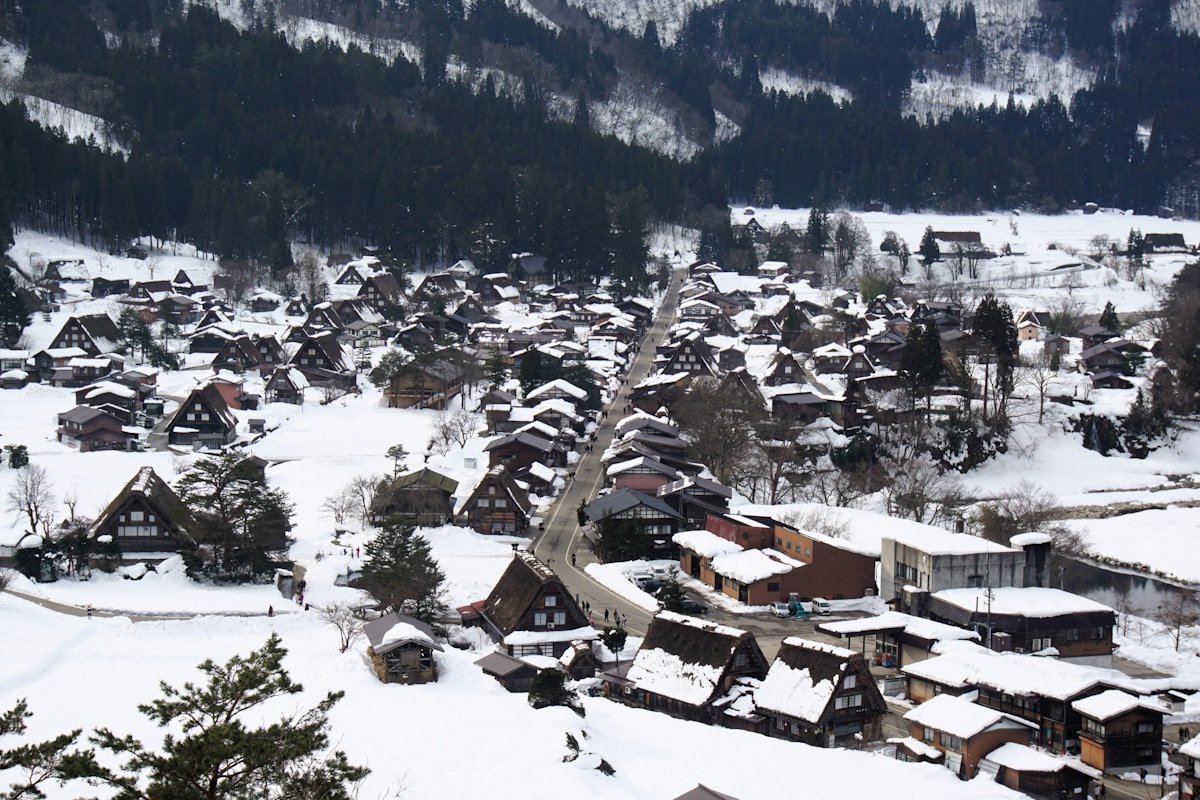
Kanazawa’s position in the centre of Japan’s Sea of Japan coast makes it an excellent base for exploring the surrounding region. Within 2 hours, you can reach one of Japan’s most photographed UNESCO villages, one of the country’s most unspoilt coastal peninsulas, and several historic towns with their own distinct craft traditions. None of these require a car, though having one opens up the more remote stretches of the Noto coastline.
For planning your stay in Kanazawa, see the Kanazawa travel guide.
1. Shirakawa-go - UNESCO Thatched-Roof Village
Travel time from Kanazawa: 75 minutes by direct Nohi Bus (¥1,900 one way, ¥3,400 return as of 2026) Best for: Traditional architecture, mountain scenery, winter snow landscapes Recommended time: Half day (3–4 hours in the village)
The Shirakawa-go UNESCO World Heritage Area protects a collection of traditional Japanese farmhouses built in the gassho-zukuri style - a distinctive steep-thatched roof design engineered to shed the heavy snowfall that buries the Shogawa River valley each winter. The main settlement, Ogimachi, contains approximately 59 surviving gassho farmhouses, of which around a dozen are open to visitors.
Wada House (和田家): The largest and best-preserved gassho house open to the public. Five storeys of functional attic space used historically for silkworm cultivation; lower floors arranged as a working farmhouse. Admission approximately ¥300.
Kanda House (神田家): A smaller private house with a more intimate atmosphere. The silkworm trays, farm tools, and winter snow equipment are displayed in their original positions. Admission approximately ¥600.
Shiroyama Viewpoint: A 15-minute walk from the village centre to an elevated vantage point overlooking the full valley and its cluster of thatched rooftops. This is the image used in most Shirakawa-go photography - particularly dramatic from October to March when mist fills the valley in the morning or snow covers the rooftops.
Practical notes:
- Nohi Bus seats must be reserved in advance at kanazawa Station, particularly October–November and January–February
- Winter evening light-up events (January–February) draw large crowds and require separate event tickets booked well in advance
- The village is car-free in its central section; parking is at designated lots at the entrance
2. Noto Peninsula - Rugged Sea of Japan Coastline
Travel time from Kanazawa: 1.5–2 hours by car (expressway to Nanao), or 1 hour to Nanao by Noto Railway Best for: Unspoilt coastal scenery, rural Japan, oyster farming, terraced rice paddies Recommended time: Full day with a car
The Noto Peninsula juts 100km northward into the Sea of Japan like a thumb, with its west coast (Noto Satoyama) facing the open ocean and its east coast (Noto Satoumi) sheltered by the Toyama Bay. The interior is a landscape of cedar forest, small farming villages, and ancient shrines with little tourist infrastructure - this is part of its appeal.
Wajima (2.5 hours from Kanazawa by car): The peninsula’s largest town and the centre of Japan’s Wajima lacquerware tradition. The morning market (Asaichi, operating daily from around 08:00) sells lacquerware, dried seafood, vegetables, and local pickles in an open-air street market along the main approach. Lacquerware shops line the surrounding streets - prices range from ¥1,500 for small pieces to several hundred thousand yen for museum-quality work.
Senmaida Rice Terraces: Approximately 1,004 small rice paddies cut into a steep slope above Shiroyone Beach. The paddies are lit by solar-powered lanterns from dusk from mid-March to mid-November - a surreal sight after dark. Free to visit; viewing platform accessible from the coast road.
Notojima Island: Connected to the mainland by bridge, the island hosts the Notojima Aquarium (¥2,080 adults, as of 2026) - one of the better regional aquariums in Japan, with whale sharks and a large dolphin programme - alongside cycle paths and hot spring baths (Notojima Onsen).
Getting there by public transport: Noto Railway to Anamizu (1 hour 20 minutes from Kanazawa, ¥1,300), then infrequent local buses. Without a car, the itinerary is limited to the Nanao–Anamizu corridor. Car rental in Japan from Kanazawa Station starts from approximately ¥8,000 per day.
3. Takaoka - Great Buddha and Zen Gardens
Travel time from Kanazawa: 45 minutes by JR Ainokaze Toyama Railway to Takaoka Station (¥860 as of 2026) Best for: Buddhist architecture, traditional crafts, half-day extension Recommended time: Half day (3–4 hours)
Takaoka is a small city in neighbouring Toyama Prefecture with an unexpectedly rich cultural heritage. Its copperware and lacquerware traditions date back to the Edo period, and its Zen temple is one of the most complete historic temple complexes in Japan.
Takaoka Daibutsu (Great Buddha): One of Japan’s three great Buddha statues (alongside Kamakura and Nara). The Takaoka version is often overlooked - it sits in a quiet park near the station, free to visit, and is flanked by smaller historic bronzeware pieces. Admission free.
Zuiryuji Temple: A 17th-century Zen temple with an immaculate formal garden and a seven-structure complex (sanmon gate, butsuden hall, hatto lecture hall) that retains all original buildings. Admission approximately ¥500. The formal raked gravel approach and the mountain backdrop make it one of the finest Zen gardens visible to casual visitors in Japan.
Kanaya-machi Merchant District: A preserved Edo-era merchant street lined with wooden storehouses (dozomachi) and traditional lacquerware shops. Entry is free; the district is a 10-minute walk from the station.
4. Fukui - Dinosaur Museum and Echizen Crabs
Travel time from Kanazawa: 45 minutes by Haruboku Shinkansen to Fukui Station (¥3,570 as of 2026, JR Pass valid) Best for: Families, natural history, food Recommended time: Full day
Fukui Prefecture is home to one of Japan’s finest natural history museums and one of the country’s most celebrated crab regions.
Fukui Prefectural Dinosaur Museum: Japan’s largest dinosaur museum, with over 40 complete dinosaur skeletons, extensive interactive displays, and a quarry excavation site accessible by shuttle bus from the museum (¥800 entry for the outdoor quarry, separate from museum). Museum admission approximately ¥720 adults. Recommended for adults and children alike - this is a world-class collection.
Echizen crab (kani): Fukui’s winter speciality (November–March). Snow crab caught in nearby Echizen waters is among the most prized in Japan. A full crab lunch set in Fukui City runs approximately ¥8,000–¥20,000 depending on size and quality. Even outside season, Fukui has a strong general seafood and soba tradition.
Make the most of your time around Kanazawa: Guided day trips from Kanazawa handle the logistics - transport, guide, and timing - so you can focus on the experience. For airport arrivals and departures, Kiwitaxi offers fixed-price airport transfers with no meter surprises.
Getting Around for Day Trips
| Destination | Best transport | Time from Kanazawa | Approx cost (1 way, 2026) |
|---|---|---|---|
| Shirakawa-go | Nohi Bus (reserved) | 75 minutes | ¥1,900 |
| Noto (Nanao) | Noto Railway | 60 minutes | ¥1,100 |
| Wajima | Car rental | 2.5 hours | ¥8,000+/day |
| Takaoka | JR Ainokaze | 45 minutes | ¥860 |
| Fukui | Haruboku Shinkansen | 45 minutes | ¥3,570 |
Where to stay: Search hotels in Kanazawa on Booking.com
See also: Kanazawa travel guide · Things to do in Kanazawa · Where to stay in Kanazawa · Kyoto vs Kanazawa · Chubu region guide