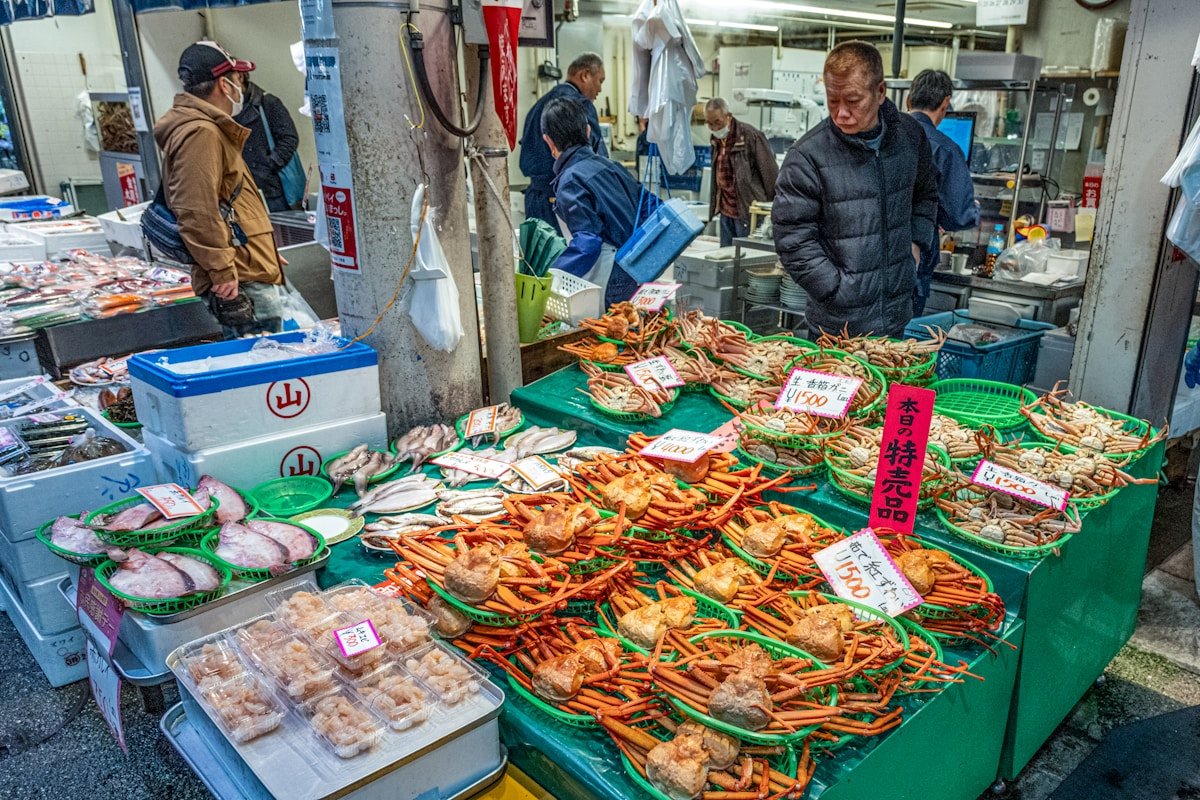
Kanazawa’s restaurant landscape reflects the city’s unusual history: never bombed, never heavily industrialised, and continuously maintained by a local economy that valued craft and cuisine. The result is a food scene where small, serious restaurants dominate over chains, where many chefs have trained in the kaiseki tradition, and where the everyday quality of ingredients - fish arriving from the bay, vegetables from Kaga fields - is higher than in most Japanese cities of comparable size.
For more on Kanazawa’s signature dishes, see the Kanazawa food guide.
Sushi
Kanazawa sushi is built around seasonal Sea of Japan fish and is widely considered some of the best-value high-quality sushi in Japan. The key eating window for seafood is October–March (snow crab and winter yellowtail), but quality is high year-round.
Mori Mori Sushi (回転寿司 もりもり): A revolving sushi chain based in Kanazawa that has expanded nationally but retains strong local sourcing. Plates from ¥160 (basic salmon, egg) to ¥600 (premium cuts). The seasonal snow crab leg plate (¥380–¥600 per plate, November–March) offers genuine value. Branches near Omicho Market and at Kanazawa Station. Queue times 20–60 minutes at peak periods - the app allows you to join the queue remotely.
Counter sushi at Omicho Market: Several small counter restaurants operate inside the market and adjacent streets. These are the recommended choice for visitors who want a more atmospheric experience than a chain. Lunch sets ¥2,000–¥4,000. Ask to sit at the counter rather than a table for the best experience - you can watch the chefs work and ask about the seasonal fish.
Sushi Kuni: A mid-range counter near the Higashi Chaya district, known for a lunch omakase of 10 pieces plus soup at approximately ¥3,800 (as of 2026). Reservation recommended. English menu available.
Kaiseki and Traditional Kanazawa Cuisine
Kaga ryori (Kaga-region traditional cuisine) is the umbrella term for Kanazawa’s high-end food tradition - a kaiseki style shaped by the Maeda daimyo’s court culture from the 17th century onward. It emphasises Kaga vegetables, local fish, and delicate presentations.
Kanazawa traditional kaiseki (Higashiyama and Kenroku-en area restaurants): Multi-course dinner kaiseki from approximately ¥8,000–¥20,000 per person. Lunch kaiseki at several establishments from ¥4,000–¥8,000. Reservations essential. Jibuni stew (duck or chicken with fu in dashi) is a standard course component.
Jibuni-focused restaurants in the Katamachi district: Several casual restaurants serve jibuni as a à la carte dish or as part of a set lunch (¥1,800–¥2,800 with rice, soup, and pickles). These are accessible without reservations for lunch.
Izakaya and Casual Eating
Katamachi and Korinbo: The main evening eating strip. Dozens of izakaya from standard national chains (Torikizoku, Watami) to small independent counters. Budget ¥2,500–¥4,000 per person with drinks at a mid-range independent izakaya.
Furu-sake (Old Sake bar): A small bar in the Katamachi area serving Ishikawa Prefecture sake by the glass from ¥600. The kind of place that does not appear in tourist guides but is exactly where Kanazawa locals end evenings. No food beyond light snacks, but essential for sake exploration.
Kappo-style restaurants: A Kanazawa-specific format - counter restaurants where the chef prepares multiple small dishes to order, positioned between an izakaya and a kaiseki. Typically ¥4,000–¥8,000 per person with drinks. Look in the back alleys of Katamachi.
Noodles and Quick Meals
Kanazawa ramen: A local style less publicised than Fukuoka or Sapporo ramen - typically a soy-based broth with chicken, sometimes enriched with crab stock during the winter months. Shop prices from ¥850–¥1,100.
Soba (buckwheat noodles): Several soba specialists operate in the traditional districts. Cold zaru soba (¥900–¥1,300) is the benchmark dish in summer; warm soba in dashi broth in winter.
See Kanazawa through its food: Food and cultural tours in Kanazawa often include market visits, tastings, and dishes you’d never find independently.
Budget Guide (as of 2026)
| Meal type | Venue style | Cost per person |
|---|---|---|
| Revolving sushi lunch | Mori Mori | ¥1,500–¥2,500 |
| Counter sushi lunch | Omicho Market | ¥2,000–¥4,000 |
| Jibuni set lunch | Katamachi restaurant | ¥1,800–¥2,800 |
| Izakaya dinner with drinks | Katamachi izakaya | ¥2,500–¥4,000 |
| Lunch kaiseki | Traditional restaurant | ¥4,000–¥8,000 |
| Dinner kaiseki (Kaga ryori) | High-end restaurant | ¥8,000–¥20,000 |
| Kappo counter dinner | Independent counter | ¥4,000–¥8,000 |
Take a Guided Food Tour of Kanazawa
Kanazawa’s food reputation rests on Kaga ryori - a regional kaiseki cuisine that emphasises freshness and visual presentation above all else, developed over four centuries as the Kaga domain’s answer to Kyoto’s cooking traditions. The Omicho market, one of Japan’s finest covered fresh food markets, supplies most of the city’s restaurants with snow crab (zuwaigani, in season November–March), nodoguro (blackthroat seaperch), and seasonal vegetables. A guided market walk and food tour is particularly valuable here because the quality gap between the tourist-facing restaurants and the counter spots known to locals is unusually wide.
Guided food tours in Kanazawa take you beyond tourist-obvious spots - local guides know which stall has the freshest nodoguro, where to find the best Kaga ryori, and how to navigate an all-Japanese menu.
See also: Kanazawa travel guide · Things to do in Kanazawa · Kanazawa food guide · Kyoto vs Kanazawa · Chubu region guide
Search hotels in Kanazawa: browse stays in Kanazawa