Nara is one of Japan’s most well-positioned cities for day trips. The ancient capital sits between Osaka and Kyoto on the Kintetsu and JR rail networks, with fast connections in multiple directions. Beyond those two major cities, the Yamato region that surrounds Nara holds some of Japan’s oldest temples, most spectacular cherry blossom scenery, and most significant archaeological sites - all within 90 minutes by train.
This guide covers five day trip destinations from Nara, each with specific transport details and costs.
Osaka - 35 Minutes by Kintetsu
Osaka is the easiest and most popular day trip from Nara. The Kintetsu Namba Line runs direct from Kintetsu Nara Station to Osaka-Namba in approximately 35 minutes on the Limited Express (from ¥1,130 including ¥450 Limited Express surcharge as of 2026) or approximately 50 minutes on the regular express (from ¥680 as of 2026, no surcharge). The JR alternative departs from JR Nara Station and reaches JR Osaka Station in approximately 45–55 minutes, changing once at Tennoji (from ¥810 as of 2026).
For most Osaka tourist areas, the Kintetsu route is more convenient. Osaka-Namba puts you immediately in the heart of Dotonbori - the canal-side dining and entertainment district known for its giant mechanical crab signs and wall-to-wall takoyaki and kushikatsu stalls. From Dotonbori, Kuromon Ichiba Market (known locally as “Osaka’s Kitchen”) is a 10-minute walk northeast through Nipponbashi. The covered market runs approximately 600 metres and sells fresh seafood, wagyu beef, pickles, and street snacks - tuna sashimi skewers from approximately ¥200, grilled scallops from approximately ¥400.
Osaka Castle is a 15-minute metro ride from Namba (Chuo Line to Tanimachi 4-chome). The castle tower museum costs ¥600 entry as of 2026, with the surrounding park and moats free to explore. The eight-storey reconstruction houses exhibits on Toyotomi Hideyoshi’s campaign to unify Japan in the 1580s.
Shinsaibashi shopping arcade runs 600 metres between Namba and Shinsaibashi metro stations - a covered pedestrian street with department stores, international brands, and local boutiques. The parallel Amerikamura district caters to streetwear and vintage clothing. Afternoon in this area, then back on the Kintetsu to Nara, is a workable half-day combination.
Kyoto - 35–50 Minutes by JR
Kyoto is only 35–50 minutes from Nara on the JR Nara Line (from ¥720 as of 2026), making it an obvious pairing - many visitors use Nara as a base and day-trip into Kyoto, or vice versa. The connection runs directly between JR Nara Station and JR Kyoto Station without changing.
The most visited Kyoto sights from a Nara base are Fushimi Inari Taisha and Arashiyama. Fushimi Inari - the mountain shrine covered in thousands of vermilion torii gates - is two stops from Kyoto Station on the JR Nara Line itself (Inari Station), meaning you can stop there on the way to or from Nara without backtracking. Entry is free; the full hike to the mountain summit and back takes approximately 2–3 hours.
Arashiyama, on Kyoto’s western outskirts, requires a 30-minute tram ride from Kyoto Station (Keifuku Randen Line). The bamboo grove, Tenryu-ji garden (¥500 garden entry, ¥800 including temple buildings as of 2026), and the Hozu River boat landing are the main draws. The district is busiest in cherry blossom and autumn foliage seasons.
Gion, Kyoto’s geisha district, is a 15-minute bus ride from Kyoto Station. The preserved machiya townhouses along Hanamikoji-dori are most atmospheric in the early evening; daytime brings large crowds. Combining Fushimi Inari in the morning, Gion at midday, and returning to Nara by late afternoon is achievable in one day.
Yoshino - 1 Hour 30 Minutes by Kintetsu
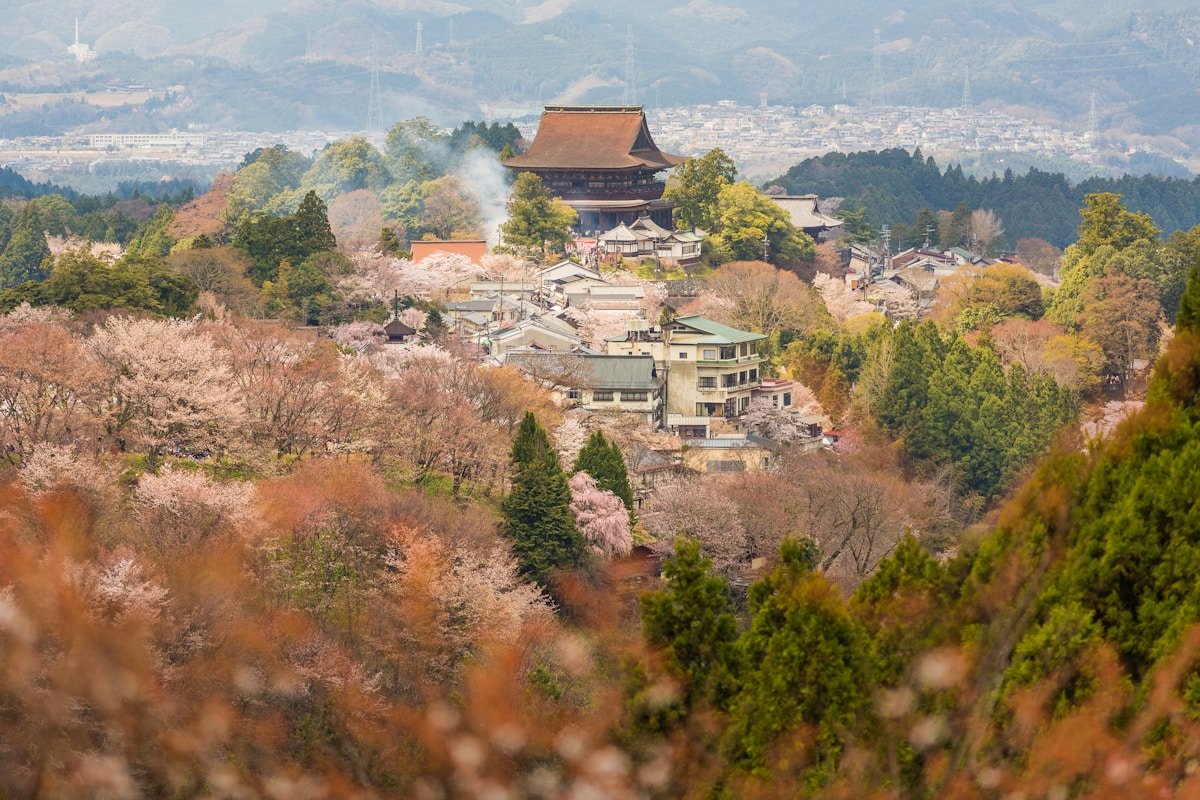
Yoshino is the most visually dramatic day trip from Nara and one of the most celebrated cherry blossom sites in all of Japan. Over 30,000 wild Somei Yoshino and Shiromountain cherry trees cover the steep slopes of Mount Yoshino, arranged by altitude into four named zones: Shimo-senbon (lower), Naka-senbon (middle), Kami-senbon (upper), and Oku-senbon (inner). The blooms typically open in sequence from late March through mid-April, with lower zones peaking first and the inner zone trailing by one to two weeks.
The journey takes approximately 1 hour 30 minutes. From Kintetsu Nara Station, take the Kintetsu Osaka Line to Yamato-Yagi (approximately 30 minutes), then change onto the Kintetsu Yoshino Line to Yoshino Station (approximately 55 minutes). Total fare from ¥970 as of 2026. Alternatively, some trains run as semi-express services requiring a transfer at Kashiharajingu-mae - allow extra time if connections are tight during blossom season, when trains run at higher frequency but also at much higher capacity.
From Yoshino Station, a ropeway (¥450 one-way, ¥800 return as of 2026) rises to the Naka-senbon zone in approximately 3 minutes. The 10-minute walk via the approach road is a reasonable alternative in clear weather and passes through the first vendor stalls selling Yoshino cedar crafts and sakura-flavoured sweets.
Kinpusen-ji, the vast mountain temple at the entrance to the Naka-senbon zone, is the religious focal point of Yoshino. The Zao-do main hall houses three 7-metre wooden statues of Zao Gongen - they are only displayed to the public during specific periods in spring and autumn (entry ¥800 as of 2026 when open). Mikumari Shrine, a 30-minute walk above Naka-senbon, is a quieter site historically associated with water management and child-rearing prayers.
Outside blossom season, Yoshino remains worth visiting for its cedar forest paths, the views across the Kinki mountain range, and the cluster of traditional minshuku guesthouses that have operated the same tofu and mountain vegetable menus for generations. Entry to the mountain is free at all times; individual temple and shrine fees apply.
Asuka - 30 Minutes by Kintetsu
Asuka was Japan’s imperial capital from 538 to 710 CE - predating both Nara (710–784) and Kyoto (794–1868). When the capital shifted north to what is now Nara, Asuka was largely left in place, and the small farming village that surrounds the ruins today gives the area an atmosphere of genuine antiquity that the more developed temple districts of Nara can’t replicate.
The journey from Kintetsu Nara Station takes approximately 30 minutes, changing at Kashiharajingu-mae onto the Kintetsu Yoshino Line to Asuka Station (from ¥380 as of 2026). Rental bicycles are available from several shops adjacent to Asuka Station from approximately ¥600 per hour or ¥1,500 per day as of 2026 - the terrain is gently rolling farmland and a bicycle is the most practical way to cover the widely-spaced sites.
Asuka-dera, founded in 588 CE, is Japan’s oldest surviving Buddhist temple. Its principal image, the Asuka Daibutsu - a seated bronze Buddha dated to 609 CE - remains in place, though the surrounding buildings have been reconstructed several times (entry approximately ¥350 as of 2026). Ishibutai Kofun is an exposed megalithic burial mound from the early 7th century: the stone chamber, which likely held the remains of the powerful courtier Soga no Umako, is open to enter (entry ¥270 as of 2026). The flat stone slabs that form the chamber walls each weigh approximately 30–75 tonnes.
Takamatsuzuka Tumulus, a smaller burial mound from the 7th–8th century, is significant for the colourful murals discovered inside in 1972 - Chinese-influenced figures of court ladies and astronomical diagrams. The original murals are conserved off-site; a reconstruction is viewable at the adjacent museum (from approximately ¥250 as of 2026). The Asuka Historical Museum (¥300 as of 2026) provides good context on the full Asuka period before cycling between sites.
Hasedera and Muro-ji - 45–60 Minutes by Kintetsu
For those who want to move beyond the standard Nara–Osaka–Kyoto circuit, the two mountain temples of Hasedera and Muro-ji make a rewarding half-day combination in the hills east of Nara.
Hasedera, reached from Hase Station on the Kintetsu Osaka Line (approximately 40 minutes from Kintetsu Nara Station, from ¥480 as of 2026), is built across a steep hillside above a valley of peony gardens. The temple is famed for its 399-step covered wooden staircase (kairo) and a 10-metre gilded wooden Kannon statue. Entry is approximately ¥600 as of 2026; the peony garden blooms in late April to early May and is especially popular.
Muro-ji, a further 15 minutes east by bus from Murouguchi-Ono Station (Kintetsu Osaka Line), is a mountain temple founded in the early Heian period and historically open to women when the nearby Koyasan was not. The five-storey pagoda, one of Japan’s smallest at just 16 metres, stands in a cedar forest on a steep stone staircase. Entry approximately ¥600 as of 2026. The atmosphere is quiet regardless of season - visitor numbers are substantially lower than at Nara’s main temples.
Make the most of your time around Nara: Guided day trips from Nara handle the logistics - transport, guide, and timing - so you can focus on the experience. For airport arrivals and departures, Kiwitaxi offers fixed-price airport transfers with no meter surprises.
Practical Notes
IC Cards: A Suica or ICOCA card covers JR trains and most bus routes in the region. Kintetsu trains accept IC cards for standard fares but Limited Express surcharges must be paid separately at the ticket counter or via Kintetsu’s app. Load at least ¥3,000–¥5,000 for a day of travel.
Luggage storage: Coin lockers are available at both Kintetsu Nara Station (B1 level, from ¥400 as of 2026) and JR Nara Station (ground floor, from ¥400). Using lockers allows you to travel light on day trips from a Nara base.
Timing: Yoshino is heavily congested during peak cherry blossom weekends in early April. Arriving on a weekday, or taking the first train before 9:00, significantly reduces crowding on the mountain paths. Asuka has no equivalent peak - it is uncrowded year-round.
For more on what to do within Nara itself, see our guide to things to do in Nara. For where to eat after returning from a day trip, see our best restaurants in Nara guide. An overview of the city, including the deer park, Todai-ji, and transport into Nara, is on the Nara city guide page.
Where to stay: Search hotels in Nara on Booking.com
See also: Nara travel guide · Things to do in Nara · Kyoto travel guide · Osaka travel guide · 1 week in Japan itinerary · Nara vs Kamakura · Kansai region guide