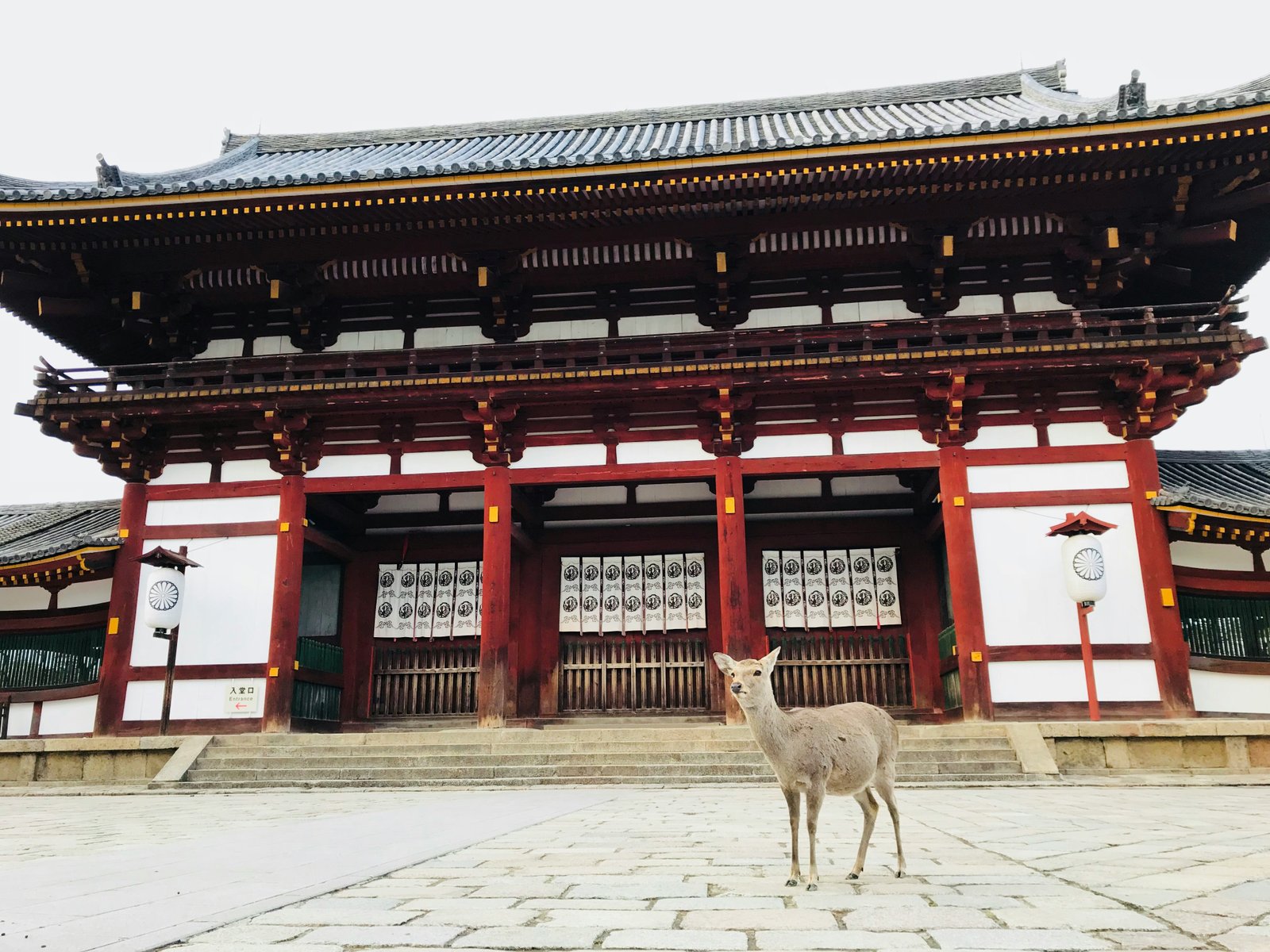
Nara Travel Guide: Deer, Temples, and Japan's First Capital
Nara travel guide covering free-roaming deer, 8 UNESCO temples, Todai-ji's Great Buddha, Kasuga Taisha shrine, and the ancient Naramachi quarter.
Guides for Nara
Nara holds a distinctive place in Japan’s history. From 710 to 784, it served as Japan’s first permanent capital - Heijo-kyo, the Capital of Peaceful Completion - and the political, religious, and artistic ambitions of that brief period left a physical legacy that is, by some measures, unmatched anywhere else in the country. Eight of those buildings and sites are now UNESCO World Heritage Sites. One of them, Todai-ji, contains the world’s largest wooden building and a 15-metre bronze Buddha. And running freely through the 660-hectare park that surrounds it all are approximately 1,200 sika deer, considered sacred messengers of the gods.
Nara’s Historical Context
The move to Heijo-kyo in 710 was driven by the imperial court’s desire for a permanent, Chinese-style capital grid - Nara’s street plan was directly modelled on Tang dynasty Chang’an. The period from 710 to 794 (now called the Nara Period) saw an unprecedented concentration of Buddhist temple construction, much of it state-sponsored and intended to demonstrate political legitimacy through religious patronage.
The Daibutsu - the Great Buddha - was commissioned by Emperor Shomu in 743 as a national project: every province in Japan contributed metal, labour, and prayers to its construction. When completed in 752, it was the largest bronze casting in human history. It remains the largest bronze Buddha in Japan.
The capital moved to Kyoto in 794, but the temples that defined the Nara Period remained, were maintained, rebuilt after fires, and are still active religious sites today. Walking among them is one of the closest experiences available in Japan to encountering a living ancient city.
Nara Park and the Sacred Deer
Nara Park (Nara Koen) covers 660 hectares in the centre of the city, incorporating most of the major temple and shrine sites, the deer habitat, and forest and meadow areas. Entry is free.
The 1,200 sika deer (shika) that roam the park are designated as natural monuments and theoretically sacred - they are not pets or zoo animals, though centuries of proximity to humans have produced a species of deer with notably direct social expectations of visitors carrying food. The deer shika senbei (rice cracker packets, ¥200/pack) sold at vendor stands throughout the park are the designated treat and one of the park’s primary attractions.
The deer bow to request crackers - this learned behaviour is real and documented - though the bowing is conditional and the deer are equally capable of assertive nudging and light headbutting when they sense crackers in pockets or bags. The technique is to keep crackers visible, feed one at a time, and be alert to deer approaching from behind.
Practical notes on the deer:
- Deer are wary of umbrellas and will sometimes bolt at unexpected openings - keep umbrellas sheathed in the park if possible
- Deer shed antlers naturally (bucks in spring) and have them cut ceremonially each October at the Shika no Tsuno Kiri event
- Do not feed deer anything other than the designated senbei crackers
- Deer are most concentrated near the Tobihino feeding field south of Todai-ji in the morning
Todai-ji - The Great Buddha Hall
Entry: ¥800 adult, ¥400 child (ages 6–12, as of 2026) | Hours: 7:30am–5:30pm (to 4:30pm Nov–Feb)
Todai-ji’s Daibutsu-den is the world’s largest wooden building - 57 metres wide, 50 metres tall, 48 metres deep. The scale is deliberately theatrical; approaching across the outer courtyard, the building grows in a way that few structures in the world manage. The Nandaimon (Great South Gate) at the entrance, with its pair of Kongorikishi guardian statues (8.4 metres tall, carved in 1203 by the sculptor Unkei and his team), is one of the finest sculptural achievements of Japanese Buddhism.
Inside, the Daibutsu (Great Buddha) is 15 metres tall and casts from approximately 437 tonnes of bronze. The original casting in 752 involved a construction project that mobilised around 2.6 million workers - at a time when Japan’s total population was perhaps 4–6 million. The current statue is mostly original, though the head was replaced following an earthquake in 855 and the figure has been through several significant restoration campaigns.
The wooden pillar near the back-right of the hall with a small square hole through it is a popular test: the hole is said to be the same size as one of the Daibutsu’s nostrils, and wriggling through it is supposed to guarantee enlightenment. It actually works - children can pass through easily; adults of slender build can manage with some effort.
Guided Nara tours from Osaka or Kyoto typically combine Todai-ji with the deer park, Kasuga Taisha, and Naramachi in a single circuit, with context for Nara’s significance as Japan’s first permanent capital.
Arrive before 9am to have the hall largely to yourself. By 10am the school groups begin arriving and the interior becomes very crowded.
Kasuga Taisha Shrine
Entry: Grounds free; Treasure Hall ¥500 | Hours: 6am–6pm (to 5pm in winter)
Kasuga Taisha was founded in 768 CE as the tutelary shrine of the Fujiwara clan - the most powerful aristocratic family of the Nara and Heian periods - and has been rebuilt every 20 years in the traditional shikinen-sengu cycle, producing a building that looks perpetually new despite its 1,200-year history.
The approach through the kasugayama primeval forest (listed as a UNESCO World Heritage Site as one of Japan’s oldest protected forests) is one of the most atmospheric in Japan - a long stone-lantern-lined path through dense cedar, zelkova, and Japanese cypress trees. Around 3,000 stone and bronze lanterns line the approach and fill the inner compound. They are lit twice a year - the Mantoro (Ten Thousand Lanterns) festivals in February and August - when the effect in the inner compound is extraordinary.
The Treasure Hall displays rotating selections from the shrine’s collection, including lacquered armour, sacred deer-antler decorations, and ancient Bugaku dance costumes.
Kofuku-ji
Entry: Individual halls ¥300–¥800; Central Golden Hall ¥700; grounds free | Hours: 9am–5pm
Kofuku-ji was the Fujiwara clan’s family temple and one of the most powerful temple complexes of the Nara period. Its famous five-storey pagoda (50.1 metres, the second tallest in Japan) rises above Sarusawa Pond in one of the most frequently photographed compositions in Nara. The pond reflection at dawn or dusk is excellent.
The National Treasure Museum (¥700) holds one of the most significant collections of Buddhist sculpture in Japan, including the Ashura statue - an eight-armed, three-faced guardian figure from 734 CE that is considered a masterpiece of Japanese Buddhist art.
Isui-en Garden
Entry: ¥1,200 | Hours: 9:30am–4pm (closed Tuesday)
Two interconnected gardens - a front garden dating from the early Edo period and a larger rear garden from the Meiji era - linked by a teahouse. The rear garden uses shaккei (borrowed scenery) technique, framing views of Wakakusa Hill and the rooftops of Todai-ji as deliberate compositional elements. In spring, the wisteria over the teahouse and the azalea hillside are in full bloom simultaneously.
One of the most visited gardens in Nara but significantly less crowded than the Kyoto equivalents.
Yoshikien Garden
Entry: ¥250 (free for foreign nationals in some periods - check at gate) | Hours: 9am–5pm (closed Monday Dec–Feb)
Three small garden types in one compact space: a moss garden, a pond garden, and a tea garden. The ¥250 admission is among the best-value garden experiences in Japan. The scale is intimate rather than grand. Worth 30 minutes alongside the Isui-en visit - they are adjacent.
Naramachi Historic Quarter
Entry: Free | Hours: Shops and some museums 10am–5pm (vary by establishment)
Naramachi is the preserved merchant district south of Nara Park, developed from the Edo period through the Meiji era on the ruins of the ancient Gangoji temple complex. The narrow lanes of machiya townhouses, craft workshops, and dyers’ shops retain their historic character. Several machiya have been converted to small museums - the Naramachi Koshi-no-Ie (traditional merchant house, free) and the Naramachi Museum (¥100) are worth a visit.
Traditional indigo dyeing workshops (from ¥1,500) and weaving studios offer hands-on craft experiences. The lanes are particularly quiet in the early morning when only a few local shops are open and the area looks as it was intended.
Getting to Nara
From Kyoto: JR Nara Line from Kyoto Station (platforms 8–10), 45 minutes, ¥760 each way. JR trains run every 15–30 minutes. Kintetsu Limited Express from Kintetsu Kyoto Station, 35 minutes, ¥760 (slightly faster, same price). The Kintetsu approach arrives at Kintetsu Nara Station, which is slightly closer to Nara Park than JR Nara Station.
From Osaka: JR Yamatoji Line from Osaka Station or Tennoji Station to JR Nara Station, 45–55 minutes, ¥890. Kintetsu Nara Line from Osaka-Namba or Kintetsu Osaka-Uehonmachi, 35–50 minutes, ¥890 depending on service type.
Once you are in town, our guide to getting around Nara covers trains, buses and walking routes in more detail.
Timing changes the experience a lot here, so our best time to visit Nara month-by-month guide is worth a look before you book.
In summer the city’s parks and temples glow during a lantern festival. See our Nara Tokae Lantern Festival event guide for dates and viewing tips.
Nara as Day Trip vs Overnight
The case for a day trip: Nara’s main sights - Todai-ji, Nara Park, Kasuga Taisha, Kofuku-ji - can be covered in 5–6 hours. Add Naramachi and Isui-en Garden and a full day is comfortable. The last train back to Kyoto runs past 10pm.
The case for staying overnight: the deer park at dawn - before 8am - is completely different from the mid-morning version. Todai-ji at 7:30am with mist on the ground and almost no other visitors is one of the better experiences in the Kansai region. The lantern lighting at Kasuga Taisha in the evening (the regular lighting of inner sanctuary lanterns, not the festival) is atmospheric in a way the daytime visit is not. And the general character of Nara - quieter, slower, more compact than Kyoto - rewards an overnight rather than a rushed transit.
Nara vs Other Cities
Deciding between Nara and Kamakura - Japan’s two great day-trip temple towns? Our Nara vs Kamakura comparison covers which to prioritise depending on your base city and interests.
Nara is part of the Kansai region. For an overview of western Honshu travel, see our Kansai region guide.
Planning your trip to Nara? Tours and activities in Nara cover guided experiences, cultural immersion, and the top sights with local expertise. Flights to Japan vary significantly by season - compare early to secure the best fares. Sort out travel insurance for Japan before you book, and pick up an Airalo eSIM for Japan to have mobile data the moment you land.
Search hotels in Nara on Booking.com
Explore Nara in Depth
Things to do in Nara · Where to stay in Nara · Best restaurants in Nara · Nara food guide · Day trips from Nara · Japan Golden Route itinerary · 1 week in Japan itinerary · Getting around Nara · Best time to visit Nara
Official sources worth checking before you go: Japan National Tourism Organization, UNESCO listing for ancient Nara.
See also: Kansai region guide · Kyoto travel guide · Osaka travel guide · Best tours in Japan · Japan Golden Route itinerary · Japan cherry blossom guide · Onsen guide Japan
Upcoming Events in Nara
Hatsumode - New Year Shrine Visits
Hatsumode 2027, 1–3 January. Japan's most important annual tradition - millions visit shrines and temples in the first three days of the new year.
Nearby Cities
Frequently Asked Questions
- Are the deer in Nara safe to interact with?
- Generally yes, but deer are wild animals. They can headbutt, bite, and push if they smell or see shika senbei crackers (¥200/pack). Keep crackers out of bags and pockets when not actively feeding. The bowing behaviour is real but do not expect it to be consistent. Children should be supervised closely.
- How far is Nara from Kyoto and Osaka?
- From Kyoto, the JR Nara Line takes 45 minutes (¥760 each way) or the Kintetsu Limited Express takes 35 minutes (¥760). From Osaka, JR or Kintetsu services run 35–50 minutes for ¥890. Both routes are covered by standard rail passes.
- Is Nara worth staying overnight or is it a day trip?
- Nara makes an excellent day trip from Kyoto or Osaka. Staying overnight rewards early morning access to Todai-ji and the park before other visitors arrive, and the evening lantern atmosphere at Kasuga Taisha is exceptional. If your schedule allows one night, it adds meaningful depth.
- How many UNESCO World Heritage Sites does Nara have?
- Eight - collectively registered in 1998 as 'Historic Monuments of Ancient Nara'. They include Todai-ji, Kasuga Taisha, Kofuku-ji, Gangoji, Yakushi-ji, Toshodai-ji, the Kasugayama Primeval Forest, and the Heijo Palace site.
- What is the entry fee for Todai-ji?
- Entry to the Daibutsu-den (Great Buddha Hall) is ¥800 for adults, ¥400 for children aged 6–12 (as of 2026). Children under 6 enter free. The outer gate area (Nandaimon) is free to approach. The surrounding Nara Park is also free.
Book an experience
Top experiences in Nara
Explore the best tours and activities in Nara, with instant confirmation and free cancellation on most bookings.