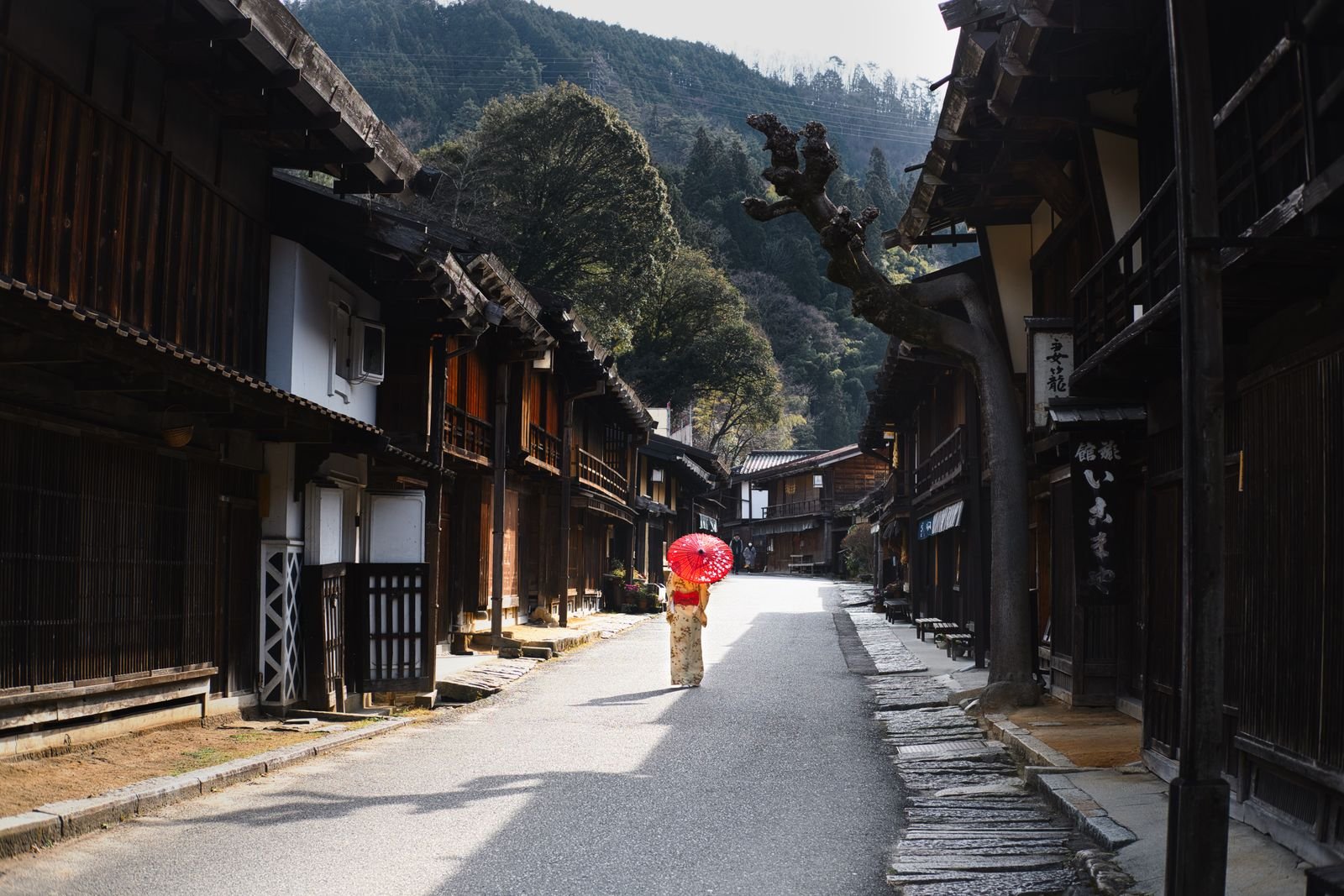
The Nakasendo was one of the five great highways of Edo-period Japan, linking Edo (Tokyo) and Kyoto through the mountains rather than along the coast. The Magome to Tsumago section is the part most travellers walk: about 8 km of stone paving, cedar forest, waterfalls and farm hamlets between two preserved post towns in the Kiso Valley. We think it is the most rewarding half-day walk in central Japan, and it is easy to reach from Nagoya, Takayama and Matsumoto. This guide covers how to get there, how to forward luggage, where to sleep and what to expect on the path.
The Nakasendo at a Glance
| Distance | About 8 km, Magome to Tsumago |
| Time | 2.5 to 3.5 hours walking |
| Difficulty | Easy to moderate; one climb to Magome Pass, then mostly downhill |
| Direction | Magome to Tsumago is the easier direction |
| Best months | Late April to May, October to mid-November |
| Cost | Free trail; bus fares, luggage forwarding and any overnight stay |
The Nakasendo (“road through the mountains”) ran about 530 km with 69 post stations. Magome and Tsumago were the 43rd and 42nd, and after the railway bypassed the valley they fell into decline, which is what saved them. Local residents began restoring the streets in the 1960s and Tsumago adopted a rule against selling, renting or demolishing historic buildings. Both towns are now protected Important Preservation Districts for Groups of Traditional Buildings.
Getting to Magome and Tsumago
Both towns sit in the Kiso Valley, roughly 1.5 hours from Nagoya.
To Magome (the usual start):
- Take the JR Chuo Line limited express (Shinano) from Nagoya to Nakatsugawa, about 1 hour.
- From Nakatsugawa Station, take a local bus to Magome, about 25 minutes. Fares have been quoted at around 600 to 800 yen; buses run roughly every one to two hours and are cash-only. The last bus back from Magome leaves in the late afternoon, so check the timetable on arrival.
To Tsumago (the usual finish):
- At the end of the walk, take the local bus from Tsumago to Nagiso Station (about 10 minutes, roughly 300 to 400 yen), then a JR train back toward Nagoya or on to Matsumoto.
- Nagoya to Nagiso takes about 1 hour 20 to 1 hour 45 depending on the service.
Our day-trip breakdown, with transfer times and costs, is in the Nagoya day trips guide. If you are coming from Takayama, the usual route runs back through Nagoya (see our Takayama guide for onward planning). The wider region is covered in the Chubu region guide.
Because the two towns are on different stations and bus lines, plan your direction in advance. We recommend starting in Magome, since it is higher and the trail loses height towards Tsumago, and finishing in Tsumago, where the bus to Nagiso is short and frequent enough to catch.
The Walk, Section by Section
Magome (start). Magome climbs a steep, stone-paved street lined with timber inns, craft shops and soba houses. There is a small observation point at the top with views toward Mount Ena on clear days. Allow 45 minutes to look around before you start.
Magome Pass. The trail leaves town on a paved lane, then climbs through forest to Magome Pass, the high point of the walk at roughly 800 m. The climb is short, about 30 to 40 minutes, and it is the hardest part of the route.
Forest and waterfalls. Beyond the pass the path drops along stone steps and old trail through cedar and cypress. You pass the Odaki and Medaki waterfalls, a trailside teahouse used as a rest stop, and several hamlets with working farmland. Bear bells hang at points along the trail; ring them as you go.
Otsumago and Tsumago. The last stretch comes down through Otsumago, a quiet hamlet, then into Tsumago itself. Traffic is restricted on the main street during the day, and overhead wires, signs and car parking have been kept away from the old frontage. The Waki-honjin (the inn for visiting nobles) and the local museum are the main sights, with a small combined entry fee.
Wear proper footwear, because the stone sections are slippery after rain. Carry water and some cash, since not every café accepts cards. There are toilets at both ends and at points along the way, but services are limited between the pass and Otsumago.
Luggage Forwarding
The walk is easier with a light day pack. A seasonal luggage forwarding service moves bags between Magome and Tsumago, with the price about 1,000 yen per piece as of 2026. Drop bags at the Magome tourist information counter in the morning, with a cut-off around 11:30, and collect them in Tsumago in the afternoon. The service has recently operated from around the end of March to the end of November. Dates and prices change, so check with the tourist information office before you rely on it.
Where to Stay
Overnighting is the way to see both towns without the crowds. Traditional minshuku and ryokan serve set dinners and breakfasts and use futon bedding. As of 2026, plan on roughly 10,000 to 15,000 yen per person with two meals, and book well ahead for April, May, October and November. Rooms are limited, many smaller inns take bookings by email or phone, and some do not accept walk-ins.
If you prefer a city base, Nagoya makes the easiest launch point for a day trip; see our where to stay in Nagoya options for hotels near the station. You can also stay in Takayama or Matsumoto and add the Kiso Valley on the way through.
Guided Tours and Self-Guided Options
Most walkers go independently, but a few tour options remove the logistics:
- Guided day walks from Nagoya, usually combining train transfers, a guide on the trail and a hot-spring or lunch stop. Browse Nakasendo and Kiso Valley tours.
- Multi-day walks link several post towns (for example Magome to Narai) with luggage transfers between lodgings. These suit people who want more than one day on the Nakasendo.
- Nagoya tours with a wider scope, including Inuyama and Gifu, are listed under Nagoya tours.
Practical Tips
- Start early. The first bus and train out of Nagoya or Nakatsugawa get you on the trail by mid-morning, giving a full afternoon in Tsumago.
- Carry coins. Buses in the valley take cash, and trail-side stalls often do not take cards.
- In rain, shorten the plan. The forest section is still walkable, but stone steps get slick.
- Check for bear notices at the tourist information office in summer and autumn.
- If you plan to walk both ways, do Tsumago to Magome only if you accept the extra climb. Otherwise take the bus back.
For official route and access information, see the Japan Guide Magome-Tsumago trail page. For other multi-day walking routes elsewhere in Japan, our Kumano Kodo tours guide covers the Kii Peninsula pilgrimage trails.