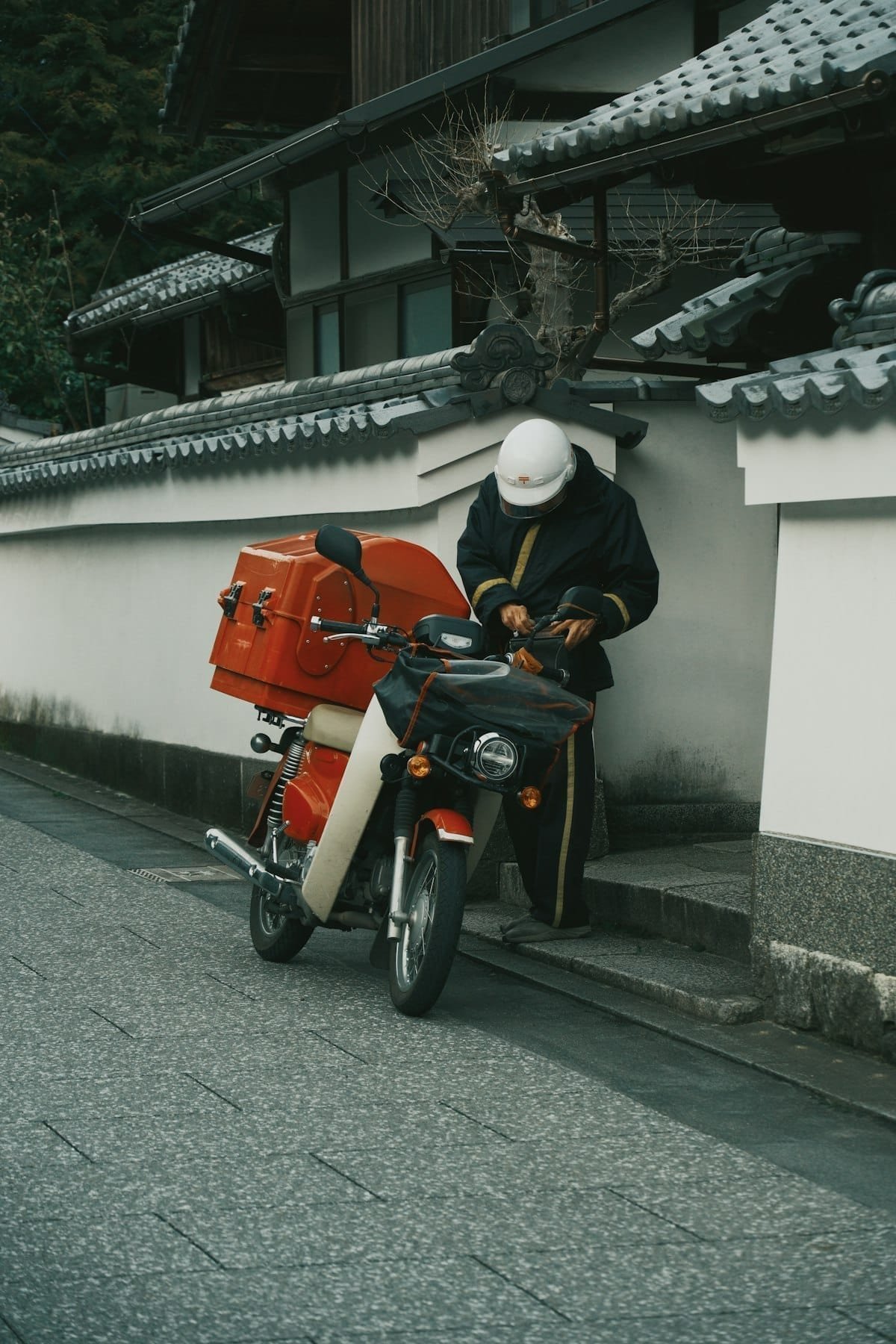
Dragging a suitcase through a crowded Tokyo Metro carriage, up and down narrow ryokan stairs, or between bullet-train platforms is one of the few ways to make Japan travel unnecessarily hard. Takkyubin - Japan’s nationwide door-to-door luggage forwarding service - exists precisely to solve this. For a modest fee, a courier picks up your bags and delivers them to your next hotel, often overnight. It is reliable, affordable, and widely used by locals and tourists alike.
This guide explains how takkyubin works, which providers to use, what it costs, and how to forward luggage from airports, hotels, and convenience stores.
What Is Takkyubin?
Takkyubin (宅急便) literally means “home delivery express” and refers to Japan’s express parcel delivery network. The word is a registered trademark of Yamato Transport but is used generically - much like “Hoover” in British English - to describe the broader service.
The premise is simple: you drop off your luggage (or arrange a pickup), specify a delivery address and date, pay at the counter, and your bag arrives at the destination within one to two days. Most major hotels in Japan accept incoming takkyubin deliveries and will hold your bags at reception until you arrive.
For travellers moving between cities on the Shinkansen, this is transformative. Rather than wrestling oversized cases into overhead racks on a crowded train, you travel light and your luggage meets you at the next stop.
Major Providers
Yamato Transport (TA-Q-BIN / Black Cat)
Yamato Transport is the market leader. Their black cat logo appears on bright yellow delivery trucks across Japan, and their TA-Q-BIN service is the default choice for most travellers.
Coverage: Nationwide, including remote islands and ski resorts
Drop-off points: Over 25,000 locations - 7-Eleven, FamilyMart, and Yamato service centres
Delivery speed: Next-day within most of Japan; two days for remote areas
Tracking: Real-time online tracking via the Yamato website (English available)
English support: yamato-hd.co.jp/en/ - English booking and tracking portal
Airport service: Available at Narita (Terminal 1 and 2), Haneda (all terminals), Kansai, Chitose, and most major airports
Yamato introduced an English-language QR code system at major airports that lets you book a delivery without speaking Japanese. Staff at airport counters are accustomed to foreign visitors.
Sagawa Express
Sagawa is Japan’s second-largest courier and a strong alternative to Yamato, particularly in western Japan and rural areas.
Coverage: Nationwide
Drop-off points: Sagawa branches plus convenience stores in partnership agreements
Delivery speed: Next-day for most routes, same-day possible in some urban areas
Tracking: Online via the Sagawa website (Japanese-language interface; Google Translate works)
English support: More limited than Yamato; airport presence is smaller
Best for: Travellers already comfortable with Japanese, or those in areas with a nearby Sagawa branch
Japan Post (Yu-Pack)
Japan Post’s Yu-Pack service offers a postal parcel option rather than a dedicated courier.
Coverage: Every address in Japan, including P.O. boxes and remote rural areas - the widest reach of any provider
Drop-off points: Post offices nationwide
Delivery speed: One to three days depending on destination
Tracking: Available via Japan Post website (English option)
Best for: Sending to addresses without a Yamato or Sagawa presence; mailing items home internationally
Limitation: Drop-off restricted to post offices, which have shorter hours than convenience stores
Price Ranges
Prices are calculated by size (the sum of length + width + height, measured in centimetres) and by destination region. As of 2026, typical Yamato TA-Q-BIN rates for standard suitcases:
| Size (cm total) | Tokyo → Kyoto | Tokyo → Sapporo | Tokyo → Osaka |
|---|---|---|---|
| 60 size (≤60cm) | ¥1,210–¥1,540 | ¥1,650–¥2,090 | ¥1,210–¥1,540 |
| 80 size (≤80cm) | ¥1,540–¥1,870 | ¥2,090–¥2,640 | ¥1,540–¥1,870 |
| 100 size (≤100cm) | ¥1,870–¥2,310 | ¥2,530–¥3,080 | ¥1,870–¥2,310 |
| 120 size (≤120cm) | ¥2,200–¥2,750 | ¥2,970–¥3,630 | ¥2,200–¥2,750 |
| 140 size (≤140cm) | ¥2,530–¥3,190 | ¥3,410–¥4,180 | ¥2,530–¥3,190 |
| 160 size (≤160cm) | ¥2,970–¥3,740 | ¥3,960–¥4,840 | ¥2,970–¥3,740 |
Prices as of 2026. Exact rate depends on origin/destination zone. Check the Yamato website for a precise quote.
A standard carry-on suitcase typically falls into the 80 or 100 size. A large checked suitcase is usually 120 or 140 size. Most bags weigh well under Yamato’s 30 kg weight limit, which is generous - oversize or overweight fees are rare for typical travel luggage.
Sagawa rates are broadly comparable to Yamato - within ¥100–¥200 of each other on most routes. Yu-Pack rates from Japan Post run slightly cheaper for very small sizes but are competitive rather than dramatically different.
How to Send Your Luggage
Drop-Off at a Convenience Store (Easiest)
- Go to any 7-Eleven or FamilyMart and ask for the delivery slip at the counter (yamato nit-tsuki-hyo in Japanese, or simply show this guide on your phone)
- Fill out the slip with your destination address, delivery date, your name, and phone number. Most slips now have English prompts
- Ask the staff to measure your bag if you are unsure of the size
- Pay cash at the counter - credit cards accepted at some locations
- Keep the receipt - it has your tracking number
Drop-Off at Your Hotel
Many hotels will arrange takkyubin on your behalf. Ask at reception the evening before checkout - they can call Yamato or Sagawa to arrange a morning pickup, and you simply hand your bag over before you leave. The hotel may charge a small handling fee (¥100–¥500).
Airport Drop-Off
At most major airports, the Yamato or Sagawa counter is in the arrivals hall. You can drop your luggage there immediately after landing and head to your hotel empty-handed, with your bags arriving the following morning. At Narita and Haneda, the counters are open from approximately 7:00 to the last evening flight.
Alternatively, book a pickup from your home address before departure - your bags land in Japan without you ever carrying them through the airport.
Hotel Pickup (Advance Booking)
For hotel-to-hotel forwarding: ask reception to arrange a same-morning pickup, or call Yamato directly (0120-01-9625 - Japanese; the English line is on their website). Specify the delivery date - one day ahead is standard, but two days ahead is safer if you want the bags at the destination before you arrive.
Hotel-to-Hotel Forwarding: The Popular Routes
Tokyo → Kyoto
The most common forwarding route. Drop your bags at the hotel before your Shinkansen departure and they arrive at your Kyoto hotel the next morning. For travel departing on Day 1, your bags arrive on Day 2 - plan accordingly and keep one night’s essentials in a day bag.
Typical cost: ¥1,500–¥2,500 for a standard suitcase (80–120 size), as of 2026.
Most Kyoto hotels and ryokan accept deliveries. When booking, confirm the hotel will hold your luggage if you arrive before check-in - most do.
Kyoto → Tokyo (Reverse Route)
Same process in reverse. Particularly useful at the end of a trip: forward your bags to your final Tokyo hotel on your last full day in Kyoto, spend the final day luggage-free exploring, then collect at your Tokyo hotel.
Airport → Hotel (Forward Luggage Ahead of Arrival)
If you know your accommodation before flying, you can ship luggage directly from overseas to your hotel. Japan Post is often the carrier for international packages, though courier services (DHL, FedEx) are faster. Pack your main suitcase early and carry only essentials on the flight - the bags arrive within a day or two of landing.
More practically: on arrival at Narita or Haneda, drop luggage at the Yamato counter in the arrivals hall. Select next-day delivery to your first hotel. Cost: approximately ¥1,500–¥3,000 depending on size and destination, as of 2026.
Ski Resorts: Tokyo → Niseko / Hakuba
Ski equipment forwarding is extremely popular in Japan. Yamato’s Ski Ta-Q-BIN service handles skis, snowboards, and ski bags. A set of skis in a bag (typically 170–200 cm) can be forwarded for ¥2,000–¥4,000 depending on origin and resort destination, as of 2026. Book at least two days in advance during peak ski season (January–February).
Airport Luggage Storage vs Forwarding
Not every situation calls for forwarding. If you are returning to the same city, coin lockers or airport luggage storage may be more practical.
Coin lockers are available at virtually every train station in Japan. Small lockers (carry-on size): ¥300–¥500 per day. Medium lockers (standard suitcase): ¥500–¥700 per day. Large lockers: ¥700–¥900 per day. Most accept IC cards (Suica, Pasmo). Maximum storage: 3 days at most stations before you must retrieve and re-deposit.
Cloak rooms (officially staffed luggage storage) exist at major stations - Kyoto Station and Tokyo Station have large facilities. Typically ¥500–¥800 per item per day, with no size limit. Useful for very large bags that don’t fit lockers.
When to forward vs store:
- Forward if you are moving to a different city and won’t return
- Store if you are doing a day trip and coming back
- Forward if your bags exceed coin locker dimensions
- Store if you need access to your bags during the day
Provider Comparison
| Feature | Yamato TA-Q-BIN | Sagawa Express | Japan Post Yu-Pack |
|---|---|---|---|
| Market position | #1, widest network | #2, strong in west Japan | Postal service |
| Drop-off locations | 25,000+ (7-Eleven, FamilyMart) | Sagawa branches, some convenience stores | Post offices only |
| English support | Strong (website + airport) | Limited | Moderate (website) |
| Airport counters | All major airports | Limited | Post offices near airports |
| Weight limit | 30 kg | 30 kg | 25 kg (Yu-Pack Large) |
| Max size | 200 size (≤200cm total) | 200 size | 170 size |
| Tracking | English online tracking | Japanese (Google Translate works) | English online tracking |
| Best for | Most travellers, airport use | Japanese speakers, western Japan | Very rural addresses, international |
Practical Tips
Book the delivery date carefully. Delivery is not same-day - standard is next business day. If you need bags at your next hotel by check-in, send them two days before you plan to arrive.
Photograph the tracking slip. Do not lose the slip before photographing the tracking number. Staff can look up deliveries by name and address, but a tracking number speeds things up significantly.
Use the hotel address, not a personal name. On the delivery slip, write “c/o [Hotel Name], [Your Name]” - Japanese: ホテル名様方 (Hotel Name-yoho). This flags it as a hotel delivery and staff handle it correctly.
Pack a day bag. When forwarding your main luggage, carry one small bag with toiletries, medication, phone charger, and the next day’s clothing. You will be without your main bag for at least one night.
Fragile items. Yamato and Sagawa both handle bags as luggage - expect normal handling, not special care. Remove fragile items from suitcases before forwarding, or pack them with padding.
Ski season and peak holiday booking. During Golden Week (late April–early May), Obon (mid-August), and ski season, book forwarding 3–5 days in advance. Same-day or next-day bookings may not be available at busy periods.
Credit cards. Cash is the safest payment method. Most convenience stores accept cards for ta-Q-BIN, but some rural Yamato branches are cash-only.
Language barrier. At any 7-Eleven or FamilyMart, you can point to your bag, say “Yamato” and show a photo of your destination hotel address. Staff are accustomed to this. The Yamato airport counter at Narita and Haneda has English-speaking staff during daytime hours.
Booking Resources
- Yamato Transport (English): yamato-hd.co.jp/en/
- Japan Post Yu-Pack: post.japanpost.jp/int/ems/
- Luggage storage locator: Sagawa sgholdings.com/en/
Takkyubin is one of the best logistics systems in the world - genuinely faster and more reliable than postal equivalents in most countries. Use it freely. The ¥1,500–¥2,500 cost per bag is a reasonable price for arriving at every destination without luggage stress.
Plan Your Trip
Takkyubin works best when you know your route in advance. Our getting around Japan guide covers Shinkansen, IC cards, and the logistics of moving between cities - useful context for deciding when to forward bags versus carry them. If you’re planning a multi-city trip, our two-week Japan itinerary and Golden Route guide both factor in the kind of moves where luggage forwarding makes the most sense.
Plan Your Trip
- Flights - Find the best fares to Japan
- Hotels - Search hotels in Japan on Booking.com
- Travel Insurance - Get covered before you go
- eSIM - Stay connected from landing
- Car Rental - Compare prices across providers
- Tours and activities - Browse experiences on GetYourGuide
See also: Takkyubin Japan: costs, konbini drop-off & ski bags · Getting around Japan · Tokyo city guide · Kyoto city guide · Osaka city guide