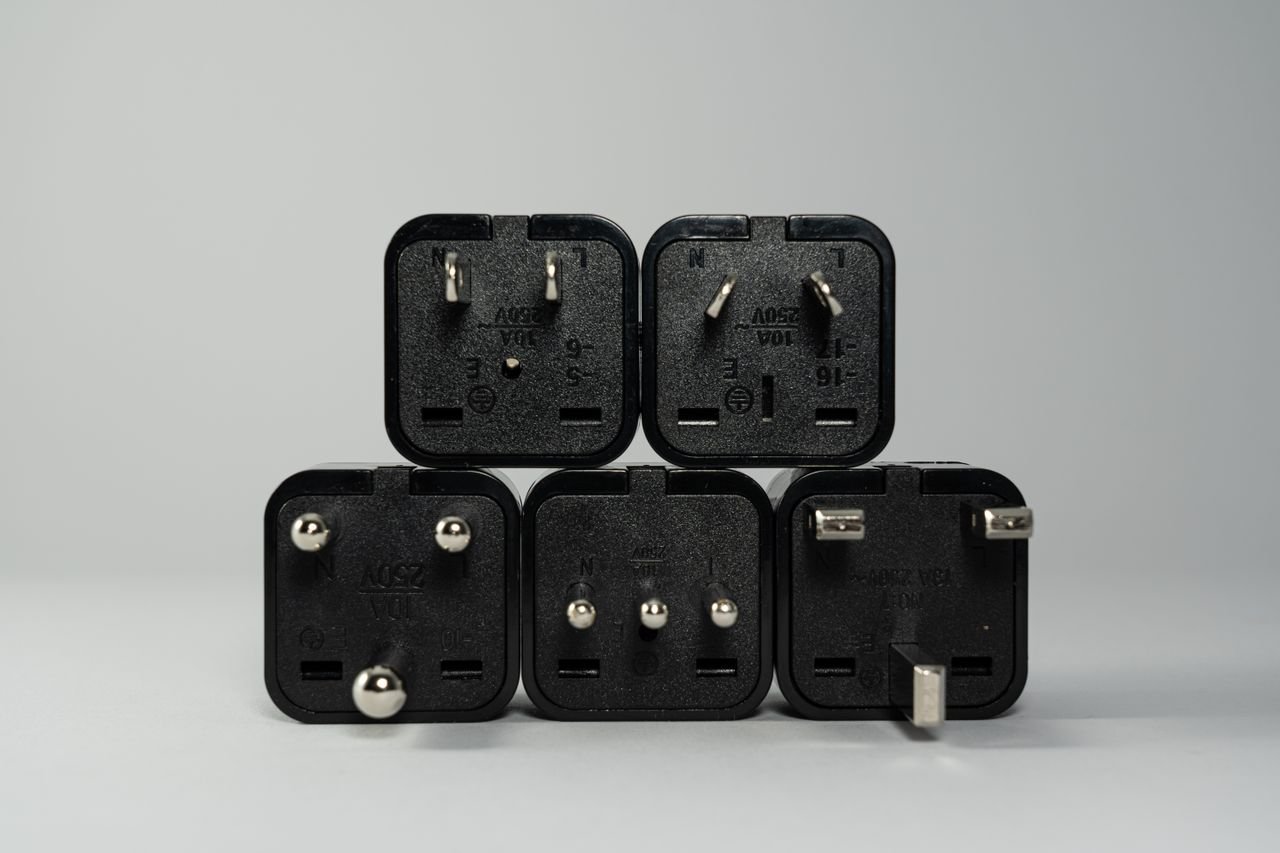
Japan is simple for electronics, with one catch that catches out travellers from Europe, the UK and Australia: the electricity is 100V, not 220-240V. This guide covers plug types, voltage, the odd fact that Japan has two mains frequencies, and which devices actually need attention. If you are still building your bag, our Japan packing list covers the rest.
Plug types in Japan
Japan uses two socket types:
- Type A: two flat, parallel pins, no earth. This is the standard socket in almost every hotel room, apartment, cafe and train station. Some plugs have one blade wider than the other (polarised), and some sockets accept only the narrow-blade version, though most chargers sold for travel have two equal blades.
- Type B: two flat pins plus a round earth pin. Rare, found on some appliances and newer builds.
In practice you will use a Type A outlet 95% of the time. Many older ryokan and business hotels have a single ungrounded outlet by the bed and one near the desk, so plan charging around that.
Who needs an adapter
| Coming from | Plug adapter needed? | Voltage issue? |
|---|---|---|
| USA, Canada, Mexico | No for Type A plugs. Grounded 3-pin plugs need a ground-lift adapter | No, 110-127V is close to 100V |
| UK, Ireland | Yes, Type A adapter | Yes for single-voltage items |
| Continental Europe | Yes, Type A adapter | Yes for single-voltage items |
| Australia, New Zealand | Yes, Type A adapter | Yes for single-voltage items |
| Taiwan | No, Taiwan also uses Type A | No, 110V is close to 100V |
| Mainland China | Usually no, Type A is common, but Type I and C plugs need an adapter | Yes for single-voltage 220V items |
| South Korea, Thailand, India | Yes, Type A adapter | Yes for single-voltage items |
A cheap Type A adapter weighs a few grams. Buy it at home or on arrival at Daiso, Bic Camera, Yodobashi Camera or Yamada Denki, where basic adapters cost approximately ¥300 to ¥1,500 as of 2026. Airport convenience stores at Narita and Haneda also stock them at a premium.
Voltage: 100V explained
Japan’s standard is 100V, lower than most major tourist destinations. What matters is the label on each device:
- Dual-voltage chargers (INPUT 100-240V): phones, tablets, laptops, cameras, e-readers, power banks, electric toothbrush chargers and most Apple, Samsung, Sony and Dell power bricks. These work with a plug adapter alone.
- 230V-only devices: many hairdryers, curling tongs, electric kettles, travel irons and shavers bought in Europe or the UK. They will not work properly at 100V and can overheat. Do not pack a bulky step-up transformer. It is rarely worth the weight.
- 110-120V devices: fine in Japan. They may run slightly slower, which matters for hairdryers and heating elements but not for chargers.
Japanese outlets are rated at 15 amps at 125V in law, but the circuit in a typical hotel room cannot supply high loads. Running a travel kettle and a hairdryer on one power strip may trip the breaker.
50Hz and 60Hz: the east-west split
Japan is one of the few countries with two mains frequencies. Eastern Japan runs at 50Hz and western Japan at 60Hz, a legacy of early generator purchases from German and American suppliers in the 1890s.
- 50Hz: Tokyo, Yokohama, Sendai, Sapporo, Niigata and the Tohoku and Hokkaido regions.
- 60Hz: Nagoya, Kyoto, Osaka, Kobe, Hiroshima and Fukuoka, plus western regions and Kyushu.
The boundary falls in central Japan, roughly through Shizuoka and Nagano prefectures, where it varies by valley. For a visitor this changes nothing: switch-mode chargers, which includes everything electronic you carry, handle both without a thought. It only matters for old clock motors, some turntables and certain medical devices.
What to charge, and where
Modern hotels include USB-A and increasingly USB-C ports in the bedside panel, so you may not need your own plug at all. Most Shinkansen trains on the Tokaido and Sanyo lines, including the N700 series, have sockets at the seats, though older cars may only have them at window seats. For longer days, a 10,000mAh power bank is the better answer, since airlines allow power banks only in the cabin. Our Shinkansen guide explains how to pick a seat.
Convenience stores (7-Eleven, Lawson, FamilyMart) sell USB charging cables, wall chargers and spare batteries at all hours. Many cafes in Tokyo, Kyoto and Osaka, have sockets at some counter seats, though some independent kissaten politely discourage laptop charging, so ask first.
Practical tips
- Pack one multi-port USB-C wall charger with a plug adapter. It replaces three bricks.
- Check hairdryers and straighteners before you pack. Hotels from business chains such as Toyoko Inn and APA supply a hairdryer in the room.
- Bring a short extension strip if you travel with a laptop, camera battery charger and phone. Rooms often have only two sockets. Make sure the strip is rated for 100V.
- Stay connected with a data plan. Charging a phone is only half the job, so see our Japan eSIM guide.
- Keep the adapter in your hand luggage for the first night. Arriving late at a ryokan with a dead phone is avoidable.
Plug in and get going
With the right adapter and a check on voltage labels, power is the least of your worries in Japan. Spend the time you save on a guided Tokyo tour or a Kyoto day trip. For a wider trip checklist, see our Japan travel tips.