Most visitors to Nikko treat the town itself - the Tosho-gu shrine complex and surrounding temples - as the destination and return to Tokyo on the same day. The smarter approach treats Nikko town as a base and extends into Nikko National Park, which surrounds the shrine district and contains some of the best mountain scenery accessible from the Tokyo region. The park’s main attraction from Nikko is the lake and waterfall combination 45 minutes uphill - a completely different landscape from the gilded shrines below.
Kegon Falls and Lake Chuzenji
The Iroha-zaka road climbs from Nikko town to the plateau containing Lake Chuzenji through 29 named hairpin curves - an ascent of 446 metres in 6.5 kilometres, with the road twisting back on itself continuously. The bus ride up takes approximately 45 minutes and is itself an experience worth noting.
Getting there: Tobu Bus from Nikko Station or Tosho-gu area bus stop, approximately 45 minutes, ¥1,150 each way. With the Nikko All Area Pass (¥4,600 for 4 days from Asakusa), bus travel is covered.
Kegon Falls
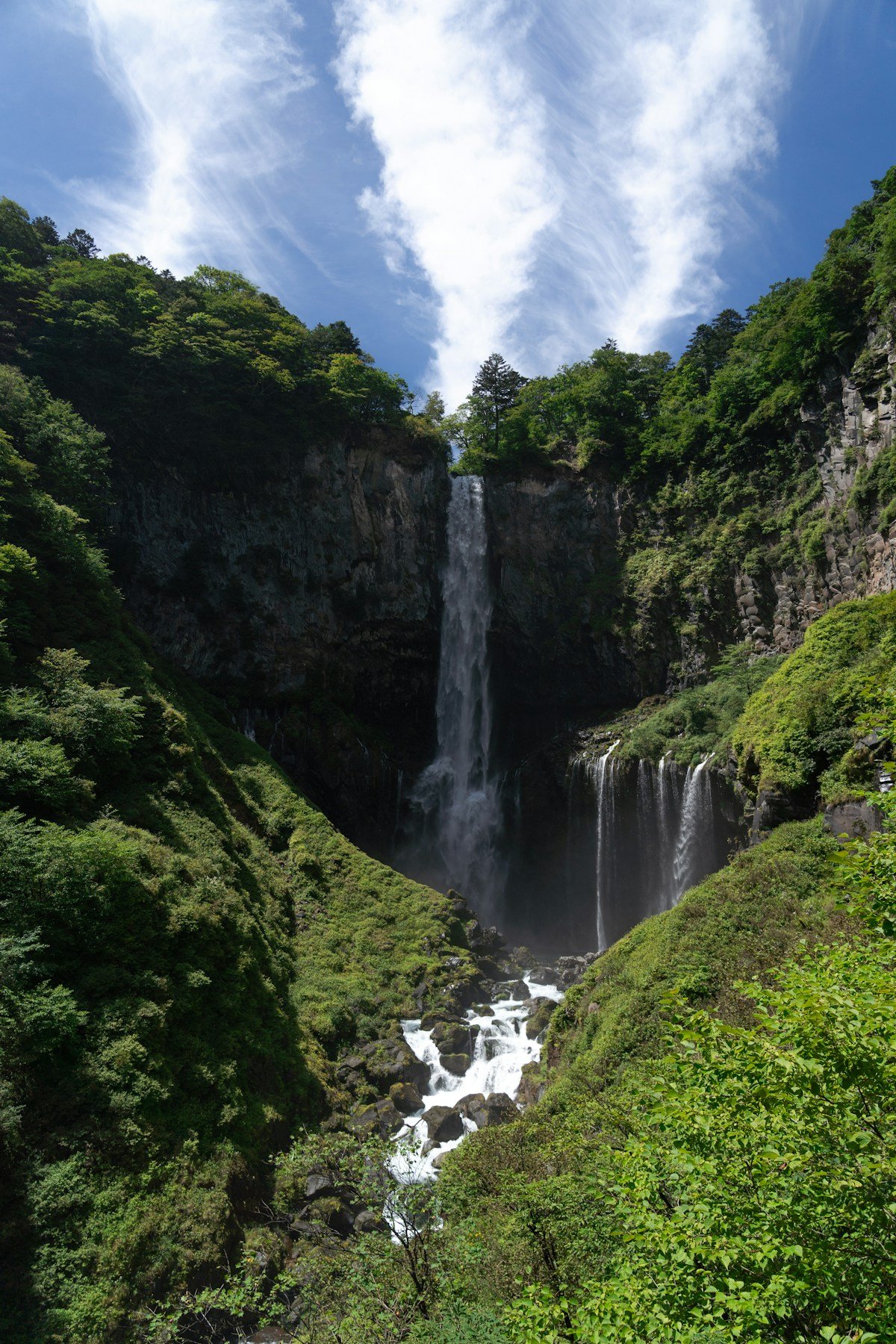
Kegon Falls (¥570 for the elevator to the base observation platform) is the most dramatic waterfall in the Kanto region - a 97-metre single-drop fall fed by the overflow of Lake Chuzenji. The lake sits at 1,269 metres altitude; the water plunges through a basalt canyon before joining the Daiya River.
Free upper viewing platform: A free observation deck above the falls gives a full view of the cascade from the same level as the top of the falls. Good for photographs.
Paid elevator platform: The elevator (¥570) descends inside the cliff to a platform at the base of the falls. From here, the scale is apparent in a way the upper view cannot convey - the falls fills the entire field of vision, and in high water the spray reaches the platform. The elevator ride takes approximately 1 minute; the platform is exposed to wind and water.
Best times: Autumn (mid-October to mid-November) when the surrounding maples and larches turn red and gold around the base of the falls. After heavy rainfall, the secondary smaller falls on either side of the main cascade also flow fully, creating a more complex scene.
Hours: 8am–5pm (April–November), 9am–4:30pm (December–March). Closed for maintenance periods - check in advance.
Lake Chuzenji
Lake Chuzenji sits at 1,269 metres, formed approximately 20,000 years ago when lava from the nearby volcano Nantai-san dammed the valley. The lake is 12 kilometres in circumference, up to 163 metres deep, and fringed by maple, beech, and larch forests.
Lakefront walk (Chuzenji-onsen to Ryuzu Falls, approximately 3 km): The most scenic section follows the northern shore from the main village to Ryuzu Falls at the lake’s northwestern inlet. The walk takes 1–1.5 hours each way and passes through forest with filtered lake views. In late October and early November this section is covered in autumn colour.
Ryuzu Falls: Where the Yuno River enters Lake Chuzenji, it descends over a wide natural rock ledge in a fan-shaped cascade - the name means “dragon head,” describing the shape of the water as it spreads across the rock. Free to view from the road or from a small café on the bank. The maple trees surrounding the falls are among the most photographed in Tochigi Prefecture in autumn.
Chuzenji-onsen (hot spring): Several ryokan and public day-use baths in the village at the lake’s eastern end. A soak in one of the outdoor baths with lake views is worth the detour: Nikko Kanaya Hotel’s lake-view baths are open to day visitors for approximately ¥3,500.
Senjogahara Marshland
The Senjogahara Marshland sits on a highland plateau north of Lake Chuzenji, a former lake bottom that became a raised bog after the terrain shifted. The marshland covers approximately 4 square kilometres and is traversed by a boardwalk trail of approximately 3 kilometres.
Getting there: Bus from Chuzenji-onsen to Ryuzu Falls (approximately 10 minutes, ¥350), then walk west along the trail. Alternatively, combine with the lakefront walk from Chuzenji-onsen to Ryuzu Falls (1.5 hours) then continue on the Senjogahara trail.
The trail is flat and accessible. It passes through open wetland - sedge grass, sundew, and cottongrass in summer; frost-covered stalks in winter - with views of the surrounding forested ridges and, on clear days, the peak of Nantai-san (2,486 metres). The far end of the Senjogahara trail reaches Yutaki Falls (free), another significant cascade, before the trailhead at Yumoto Onsen.
The full Senjogahara trail (one-way, approximately 3km) takes 1.5–2 hours. Return to Chuzenji-onsen by bus from Yumoto Onsen (approximately 30 minutes, ¥790).
Nantai-san (Sacred Mountain)
Mount Nantai (2,486 metres) is the volcano whose eruption formed Lake Chuzenji. It is sacred in Shinto tradition and has been a pilgrimage peak since the 8th century. The Futarasan Shrine at the summit is the mountain’s spiritual focus.
Trail from Chugushi Shrine (Lake Chuzenji’s southern shore): The ascent is approximately 5 kilometres and takes 3–4 hours to the summit, 2.5–3 hours to descend. No technical climbing required, but the trail is steep and rocky in the upper section. A walking stick is useful. Summit shrine entry fee approximately ¥500. The mountain is open July 1 to November 11; outside this window, the summit shrine is closed and snow covers the upper trail.
This is a serious half-day or full-day commitment suitable for fit hikers, not a casual walk.
Make the most of your time around Nikko: Guided day trips from Nikko handle the logistics - transport, guide, and timing - so you can focus on the experience. For airport arrivals and departures, Kiwitaxi offers fixed-price airport transfers with no meter surprises.
Edo Wonderland (Nikko Edomura)
Edo Wonderland (approximately ¥4,800 as of 2026, open 9am–5pm) is a theme park 3 kilometres from Nikko Station recreating a complete Edo-period town with full-scale buildings, period-costumed staff, and entertainment. Ninja shows, samurai demonstrations, mystery house, and interactive craft workshops are included in the admission.
Getting there: Free shuttle bus from Nikko Station runs every 20–30 minutes.
The park is large and takes a full day to explore thoroughly. Unlike many heritage theme parks, the production quality here is genuinely high - the buildings are architecturally faithful to the period, and the shows have real entertainment value rather than the thin content common in tourist attractions. Useful for: families with children, visitors with a strong interest in Edo-period Japan, or those who have spent their first day at the shrines and want something different on day two.
For the shrine complex itself, see our Nikko travel guide. For restaurants, see our best restaurants in Nikko guide.
Where to stay: Search hotels in Nikko on Booking.com
See also: Things to do in Nikko · Where to stay in Nikko · Food to try in Nikko · Hakone vs Nikko · Tokyo day trips guide · Kanto region guide