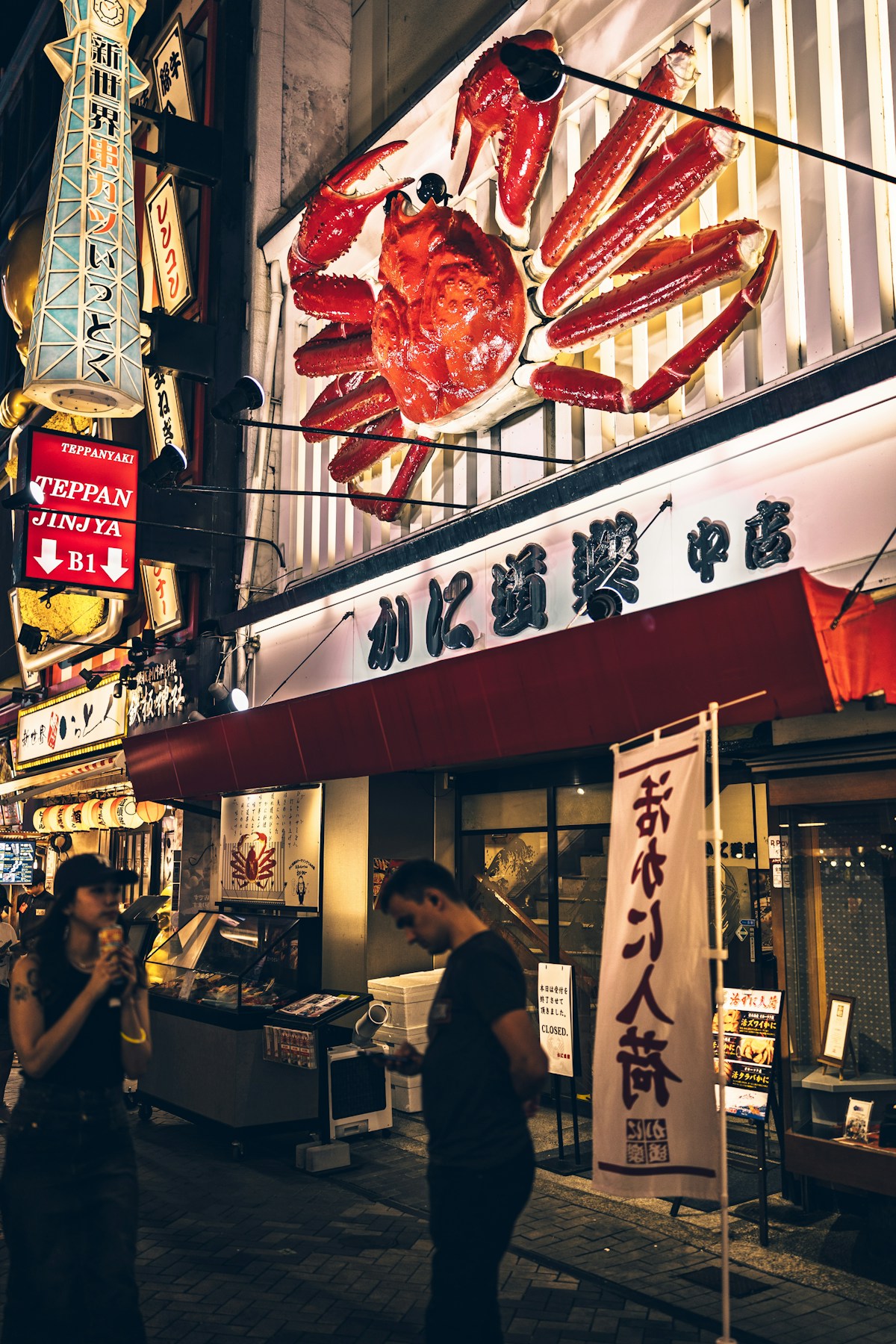
Osaka is Japan’s food capital - a claim that the city makes without irony and backs with evidence. National surveys consistently show Osaka residents spend roughly twice the Japanese average per capita on eating out. The concept of kuidaore - eating yourself into ruin - originated here and is treated as a civic virtue rather than a warning. Where Tokyo eats efficiently and Kyoto eats with ceremony, Osaka eats enthusiastically, loudly, and repeatedly.
The city’s food culture developed from its mercantile history. From the Edo period through the modern era, Osaka was Japan’s commercial hub - a city built on trade, not politics. The merchant class that ran it had money, appetite, and no patience for the reserved restraint of court culture. The result is a city where street food is taken as seriously as restaurant food, where the quality of a takoyaki stall’s octopus sourcing is a legitimate point of local pride, and where asking a stranger for a restaurant recommendation typically produces a detailed conversation and unsolicited opinions on inferior alternatives.
For a full overview of Osaka’s dining neighbourhoods, see our Osaka restaurants guide.
Takoyaki
Takoyaki are small spherical snacks made from a wheat-flour batter cooked in a heated round iron mould, filled with diced octopus (tako), pickled ginger, and spring onion, and topped with takoyaki sauce (similar to Worcestershire), Japanese mayonnaise, dried bonito flakes (katsuobushi), and green aonori seaweed powder. They are served in sets of 8 or 10, typically in a boat-shaped cardboard container.
Making takoyaki requires skill - a small pick is used to rotate each ball during cooking to develop an even crisp shell while keeping the interior liquid and molten. The contrast between crisp exterior and runny inside is the defining quality. A poorly made takoyaki is tough throughout; a good one has a shell that gives way to something close to warm custard.
Dotonbori street stalls - The most concentrated area of takoyaki vendors in the city. Stalls along the Dotonbori canal walk sell 8 pieces for approximately ¥600–¥800. Kukuru is among the more photographed establishments; Aizuya, open since 1933, is considered among the more serious in terms of quality. Both have queues on weekend afternoons.
Wanaka, Namba - Popular with local residents rather than tourists. From ¥550 for 6 pieces. The texture is reliably good.
Okonomiyaki
Okonomiyaki is a savoury pancake made from a batter of flour, grated nagaimo yam, dashi stock, and eggs, mixed with shredded cabbage and a wide range of optional additions (bacon, prawn, squid, cheese, mochi), then cooked on a teppan griddle and topped with okonomiyaki sauce, mayonnaise, katsuobushi, and aonori.
Osaka-style okonomiyaki (kansai-style) mixes all ingredients into the batter before cooking - this distinguishes it from Hiroshima-style, in which the ingredients are layered. The Osaka version is softer and more integrated; the cabbage breaks down further into the structure of the pancake.
Boteju - One of Osaka’s best-known okonomiyaki restaurant groups, with several locations across the city including Namba and Umeda. Okonomiyaki from ¥1,000–¥1,500 depending on fillings. Teppan tables allow you to cook your own or have staff do it. English menus available.
Mizuno, Dotonbori - A long-established independent restaurant that has been cooking okonomiyaki on the same Dotonbori stretch for over 70 years. Standard pancakes from ¥1,100; the yama-imo (mountain yam) variation is worth ordering. Cash only; queues at lunch and early dinner.
Kushikatsu
Kushikatsu are battered and deep-fried skewers of meat, seafood, and vegetables - chicken, pork, prawn, quail egg, asparagus, lotus root, cheese, and dozens of other combinations are available - cooked in vegetable oil and served with a shared thin Worcestershire-style dipping sauce.
The non-negotiable rule: never double-dip. The communal sauce pot is used by everyone at the restaurant; dipping a skewer twice after a bite contaminates the sauce. Every kushikatsu restaurant in Osaka has signs in multiple languages stating this rule. Bread is provided for scooping extra sauce onto the skewer if needed.
Shinsekai is the spiritual home of kushikatsu. The neighbourhood south of the city centre - built in the early 20th century as an amusement district - has the highest concentration of kushikatsu restaurants in Osaka, with the Daruma chain having operated there since 1929.
Daruma, Shinsekai - Skewers from approximately ¥100–¥200 each, depending on ingredient. A typical dinner of 10–15 skewers with beer costs approximately ¥2,000–¥3,000 per person. Multiple branches in Shinsekai; the original on Tsutenkaku-dori is the most atmospheric.
Kin-ryu, Namba - A mid-range independent kushikatsu shop near Dotonbori with higher-quality ingredients and a shorter queue than Shinsekai. Skewers from ¥150.
Fugu
Fugu - blowfish - is Osaka’s most famous high-stakes dish. The fish contains tetrodotoxin in its liver and certain other organs; chefs must hold a government-issued licence to prepare it, and the preparation involves precise removal of toxic parts. When correctly handled, fugu is perfectly safe. When not, the consequences are severe and there is no antidote.
Osaka has historically been Japan’s leading city for fugu consumption, accounting for a significant proportion of national demand. The flesh is typically served as thin-sliced sashimi (tessa), hot pot (tecchiri), or deep-fried (kara-age fugu). The flavour is mild and delicate - umami-forward, with a firm but yielding texture that distinguishes it clearly from white fish. The experience of eating something that requires a licensed professional to safely prepare is part of the point.
Fugu restaurants in Osaka cluster in the Dotonbori, Kitashinchi, and Fukushima areas. A full fugu course at a specialist restaurant costs from approximately ¥5,000–¥8,000 per person at a mid-range establishment. High-end fugu kaiseki can reach ¥20,000 and above. Reservations are recommended and usually possible through restaurant websites or Tabelog.
Kuromon Ichiba Market
Kuromon Ichiba - the 170-stall covered market running between Namba and Nipponbashi - is known as “Osaka’s Kitchen.” Generations of Osaka chefs sourced their ingredients here before supermarkets made wholesale markets partly redundant; the market has adapted by adding a retail and tasting dimension that makes it among the most rewarding food walks in Japan.
The best approach is to graze through the stalls rather than sitting at a single restaurant. Specific items worth seeking:
- Tuna sashimi - Several stalls sell thick-cut slices of hon-maguro (bluefin tuna) from approximately ¥500 per slice. Quality varies; look for the stalls with the most foot traffic from local shoppers rather than tourist groups.
- Fresh oysters - Available year-round, with peak quality November to March. From approximately ¥200 per piece raw; grilled versions with butter ¥300–¥400.
- Wagyu beef - Several stalls sell wagyu skewers and bite-sized cuts cooked to order, ¥300–¥800 per piece.
- Tamago yaki - Japanese rolled omelette, sold in pieces from ¥200–¥400. The Kuromon version tends to be sweeter than Tokyo style.
- Sea urchin (uni) - Available at several stalls, with prices varying by season and quality. From ¥500 per serving.
Budget ¥1,500–¥3,000 for a proper Kuromon tasting circuit. The market is most vibrant between 10:00 and 13:00; many stalls close by 17:00.
Dotonbori Food Street
Dotonbori is Osaka’s most famous entertainment district - the canal-side kilometre of neon signs, giant mechanical crabs, and restaurant facades is one of the most photographed streetscapes in Japan. Eating here is more expensive per unit of quality than elsewhere in the city, but the experience has a legitimate density of energy that is worth engaging with once.
Walk the canal side from Nipponbashi to the Ebisu-bashi bridge - approximately 1km - and use the side streets north and south of the canal for the better value eating. The canal-front restaurants are priced for tourists; one block back, prices drop 20–30 percent for equivalent or better food.
Key side-street options include the Hozenji Yokocho alley - a stone-paved lane connecting Dotonbori to Namba - which has a handful of long-established small restaurants, including the noted kappo restaurant Fujiya 1935 (high-end, reservations required, from ¥20,000).
Grand Front Osaka Depachika
The Grand Front Osaka complex at Umeda Station has a strong basement food floor with multiple restaurants, bakeries, and prepared food stalls. Particularly useful for mid-range meals in the Umeda area without navigating the full complexity of the Isetan or Hankyu department stores nearby. Prepared lunch boxes (¥900–¥1,500) from the basement stalls are among the best-value options in north Osaka.
Budget Eating: Teishoku and More
Osaka’s best budget eating is often invisible to tourists. The teishoku - a set meal of rice, miso soup, main dish (grilled fish, fried pork, stewed vegetables), and pickles - is available at neighbourhood restaurants throughout the city for ¥800–¥1,200 at lunch. Many restaurants that serve teishoku do not have prominent signage in English; the presence of a laminated picture menu in the window or a queue of office workers at 12:30 is the best indicator.
Standing ramen and soba shops (tachikui culture, originally Osaka’s domain) serve bowls for ¥500–¥800 at counters near train stations throughout the city. Nagahori Street and the underground passages at Namba and Shinsaibashi stations have the highest concentration.
See Osaka through its food: Food and cultural tours in Osaka often include market visits, tastings, and dishes you’d never find independently.
Food District Summary
| Area | Speciality | Average Spend |
|---|---|---|
| Dotonbori canal | Takoyaki, street food, tourist restaurants | ¥1,000–¥3,000 |
| Shinsekai | Kushikatsu | ¥1,500–¥3,000 per person |
| Kuromon Ichiba | Seafood, wagyu, market grazing | ¥1,500–¥2,500 |
| Tsuruhashi | Korean barbecue (yakiniku) | ¥2,000–¥4,000 per person |
| Fukushima | Contemporary izakaya, natural wine | ¥3,000–¥5,000 per person |
| Kitashinchi | High-end fugu, kappo | ¥10,000–¥30,000 per person |
| Umeda basement | Department store depachika | ¥900–¥1,800 (prepared food) |
See also: Osaka travel guide · Best restaurants in Osaka · Osaka food guide · Osaka food tours · Japanese food guide