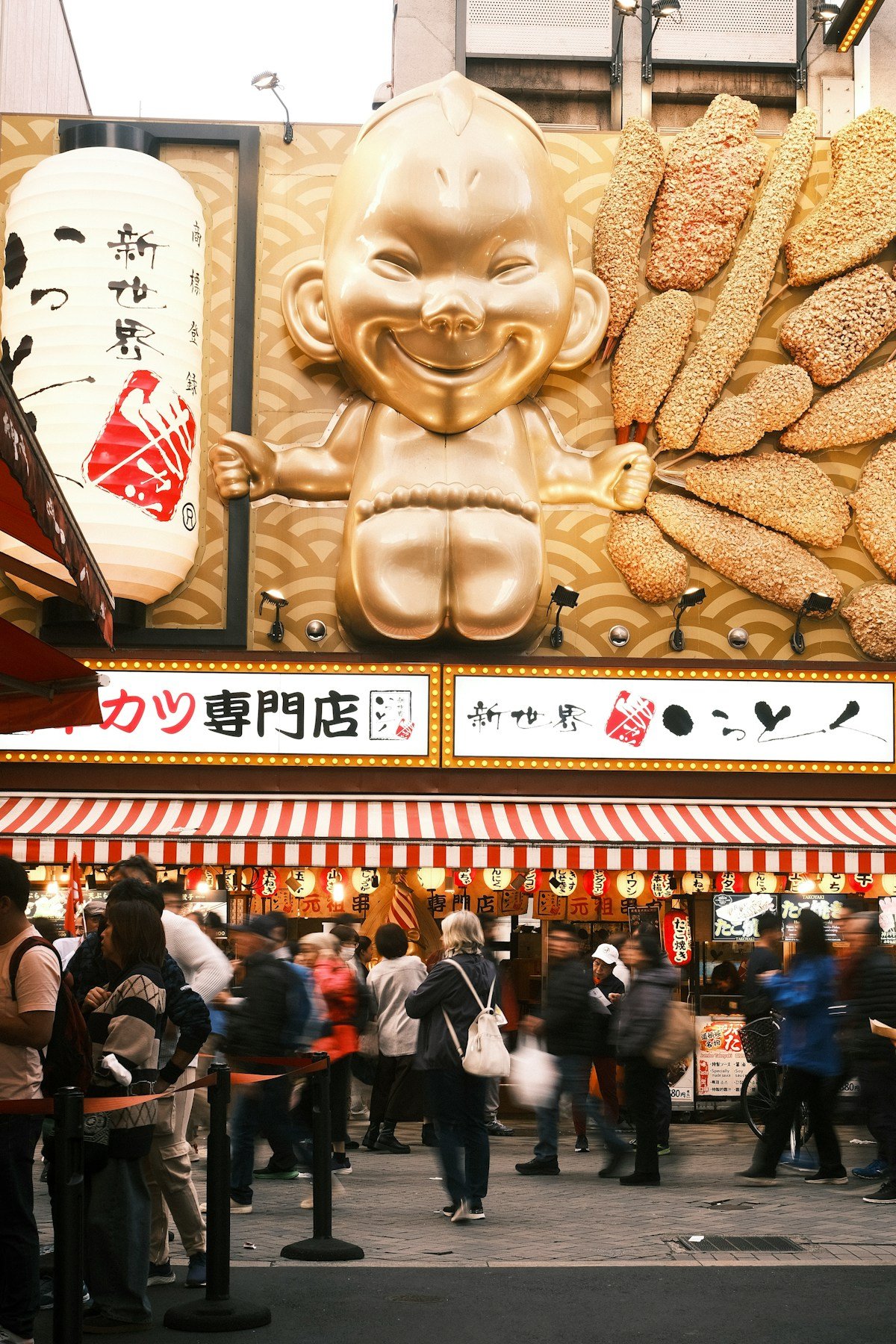
Osaka’s food identity is the strongest of any Japanese city. The concept of kuidaore - eating to excess, spending freely on food as a primary pleasure - is not a marketing phrase but a genuine cultural orientation. Walking through Dotonbori, Kuromon Market, or Shinsekai, the proposition is evident at every corner: something excellent to eat, at almost every price point, prepared with real skill. Here is where to find it.
The Signature Dishes
Takoyaki - Osaka’s Most Famous Export
Takoyaki are golf-ball-sized batter balls containing a piece of octopus (tako), pickled ginger, green onion, and tenkasu (tempura batter pieces), cooked in a specialised iron mould with hemispherical cavities. The outside is crisp; the inside remains soft to the point of running. They’re dressed with okonomiyaki sauce, Japanese mayonnaise, bonito flakes, and dried green seaweed.
Osaka is where takoyaki was created (in the 1930s by Tomekichi Endo), and the best versions here exceed anything available elsewhere.
Wanaka Honten (Sennichimae, near Namba): The most consistently recommended takoyaki in Osaka. Eight pieces for ¥600, with three sauce options. The batter-to-octopus ratio and the crispness of the crust are the marks of a skilled operator. Queue forms by lunchtime; expect 15–20 minutes’ wait on weekends.
Aizuya (Dotonbori): Reputedly the second shop in history to sell takoyaki, operating since 1933. Eight pieces ¥600. The style here is slightly firmer than the Wanaka version - a matter of preference. The Dotonbori location makes it convenient for a midday stop.
Takoyaki Juhachiban (Shinsaibashi): A more recent establishment with a modern approach to takoyaki - various filling options including cheese and kimchi in addition to the standard. Pieces from ¥120 each.
Budget note: A portion of takoyaki (8 pieces, ¥600) is a snack, not a meal. Budget ¥1,500–¥2,000 if eating takoyaki as a primary lunch with additional items.
Okonomiyaki - The Osaka-Style Pancake
Okonomiyaki is a thick savoury pancake made with wheat flour batter, shredded cabbage, and a range of fillings - pork belly, seafood, cheese - cooked on a teppan grill. Osaka-style (Naniwa-style) mixes all ingredients into the batter before cooking; Hiroshima-style layers them.
Mizuno (Dotonbori, since 1945): The most celebrated okonomiyaki restaurant in Osaka. The yamaimo (mountain yam) variety - which makes the batter unusually light and airy - is the signature item at ¥1,650–¥1,800. Queue typically forms before opening (11:30am); the wait can reach 45–60 minutes on weekends. Worth the queue for the classic version.
Fukutaro (Namba Senba area): A neighbourhood-local alternative to Mizuno with shorter queues. Okonomiyaki from ¥1,200, soba-mix variety ¥1,400. The tontama (pork and egg) version is excellent.
Chibo (Dotonbori, chain with multiple Osaka locations): More accessible for groups, quicker, consistently good. Okonomiyaki from ¥1,200.
Kushikatsu - Deep-Fried Skewers of Shinsekai
Kushikatsu is battered and deep-fried skewers of meat, seafood, and vegetable, served with a shared thick Worcester-based dipping sauce. The golden rule of Shinsekai: no double-dipping. Shared sauce is communal; use a cabbage leaf as a scoop if you need more.
Daruma (original location and four branches in Shinsekai area): The chain that made kushikatsu famous nationwide. Skewers from ¥160–¥300 each. A typical meal of 10 skewers with a beer costs ¥1,500–¥2,000. Best varieties: lotus root, quail egg, asparagus, beef, king prawn. The pork and cheese skewer is an Osaka-specific add to the classics.
Yaekatsu (Shinsekai, near Tsutenkaku): A smaller, more local alternative to Daruma. Slightly shorter queues, similar price, comparable quality. The homemade sauce has a slightly different flavour profile - tangier.
Kushi Katsu Tanaka (chain with multiple Osaka locations): A modern chain that has standardised kushikatsu for a broader market. Less atmosphere than Shinsekai but accessible outside the tourist district. Skewers from ¥150.
Kitsune Udon and Osaka Udon
Osaka’s udon style differs from the thick, chewy Kagawa variety - it’s served in a lighter, sweeter broth (kobu and bonito dashi with mirin). Kitsune udon - udon topped with a large, sweetly simmered aburaage (fried tofu pouch) - is a traditional Osaka dish that dates to the late 19th century.
Imai Honten (Dotonbori, near Shinsaibashi): In business since 1947, Imai serves classic Osaka udon in a quiet traditional setting off the Dotonbori main strip. Kitsune udon ¥900, Osaka-style cold udon ¥1,000–¥1,200. The daikon tempura udon (¥1,300) is a winter speciality. No reservations needed for lunch.
Tsurunoya (Umeda area): An Osaka udon institution with a wider menu. Udon sets from ¥850. Good option near Osaka Station for a quick lunch.
Ramen in Osaka
Osaka’s ramen scene is excellent but less defined by a house style than Tokyo (shoyu) or Sapporo (miso). The city has strong chicken-based, tonkotsu, and lighter salt-based (shio) variations.
Kinryu Ramen (Dotonbori, open 24 hours): The most accessible ramen in the Dotonbori area, with a giant dragon sculpture above the door and a no-frills bowl of tonkotsu ramen for ¥750. It’s not the most refined bowl in Osaka but it’s exactly right at midnight after a Dotonbori evening walk.
Menya Joze (Nakatsu area): A small shop doing complex chicken-based tare (seasoning) ramen in both clear and rich versions, ¥1,100–¥1,400. Considered among the finest bowls in Osaka. Queue at opening (11am) or expect a wait.
Furari (Shinsaibashi): Lighter shio ramen in a clean, quiet setting, ¥1,000–¥1,300. Good for those who find tonkotsu too rich.
Ramen comparison:
| Style | Broth base | Richness | Best in Osaka at |
|---|---|---|---|
| Tonkotsu | Pork bone | Very rich | Kinryu Ramen (¥750) |
| Chicken tare | Whole chicken | Medium-rich | Menya Joze (¥1,100) |
| Shio | Salt-seasoned clear | Light | Furari (¥1,000) |
| Spicy miso | Miso + chilli | Rich | Shin-Shin Namba (¥1,100) |
Fugu - Puffer Fish in Dotonbori
Zubora-ya (Dotonbori): Osaka’s most famous fugu restaurant, identifiable by the enormous inflated puffer fish lanterns hanging outside. Fugu is prepared by licensed chefs (the liver and ovaries contain lethal tetrodotoxin) and served as sashimi (tessa), hot pot (tecchiri), or deep-fried (karaage). Set menus run ¥6,000–¥15,000 per person. This is genuinely good fugu at a price point accessible to most visitors.
Street Food Tours
Dotonbori Tasting Circuit (Budget ¥2,000–¥3,000)
A proper Dotonbori street food walk, hitting 5–6 items:
- Takoyaki at Wanaka or Aizuya (¥600 / 8 pieces)
- Taiyaki (fish-shaped sweet pancake with red bean filling, ¥200)
- Okonomiyaki snack portion at a stall (¥400–¥600)
- Crab gratin croquette at Kanidoraku stall (¥350)
- Mochi ice cream (¥200–¥350)
- Freshly squeezed mikan juice (¥400)
Budget ¥2,000–¥2,500 for this circuit. Do it between 5pm and 8pm for the best atmosphere and manageable crowds.
Kuromon Market Circuit (Budget ¥1,500–¥2,500)
Kuromon Ichiba has around 170 stalls and the tasting options change by season:
- Fresh oyster (¥300–¥500 each, grilled or raw)
- Wagyu skewer (¥800–¥1,500)
- Tamago yaki (sweet egg omelette, ¥250)
- Sea urchin gunkan (¥500–¥800)
- Fresh fruit (seasonal, ¥200–¥400)
The market closes by 6pm, so make this a morning or lunch experience.
Neighbourhood Food Guide
| Neighbourhood | Specialty | Price range ¥/person | Best for |
|---|---|---|---|
| Dotonbori | Takoyaki, okonomiyaki, street food | ¥600–¥3,000 | First evening food walk |
| Shinsekai | Kushikatsu, fugu, horumon | ¥1,500–¥4,000 | Atmospheric local dining |
| Kuromon Market | Fresh seafood, tamago yaki, wagyu | ¥500–¥3,000 | Morning fresh food |
| Tsuruhashi | Yakiniku, Korean food | ¥2,500–¥5,000 | Barbecue dinner |
| Nakatsu/Fukushima | Yakitori, craft beer, izakaya | ¥2,000–¥4,500 | Evening local dining |
| Umeda | Department store food halls, mid-range | ¥1,500–¥5,000 | Reliable, air-conditioned |
See Osaka through its food: Food and cultural tours in Osaka often include market visits, tastings, and dishes you’d never find independently.
Evenings in these districts run late, and our Osaka nightlife guide shows how to pair dinner with a bar crawl.
Konbini Culture in Osaka
Japan’s convenience stores - 7-Eleven, FamilyMart, Lawson - maintain exceptional quality across the country and Osaka is no exception. The onigiri (rice balls, ¥120–¥180), sandwiches (¥220–¥350), and hot counter items (nikuman pork buns ¥130, karaage ¥200–¥300) are genuinely good. For breakfast between temples or a late-night snack, konbini food is a practical and non-embarrassing option. The Lawson Machi Café range (drip coffee ¥100, croissant ¥200) functions as a workable morning breakfast at minimal cost.
Where to stay: Search hotels in Osaka on Booking.com
See also: Osaka travel guide · Osaka food guide · Osaka food tours · Things to do in Osaka · Best tours in Osaka