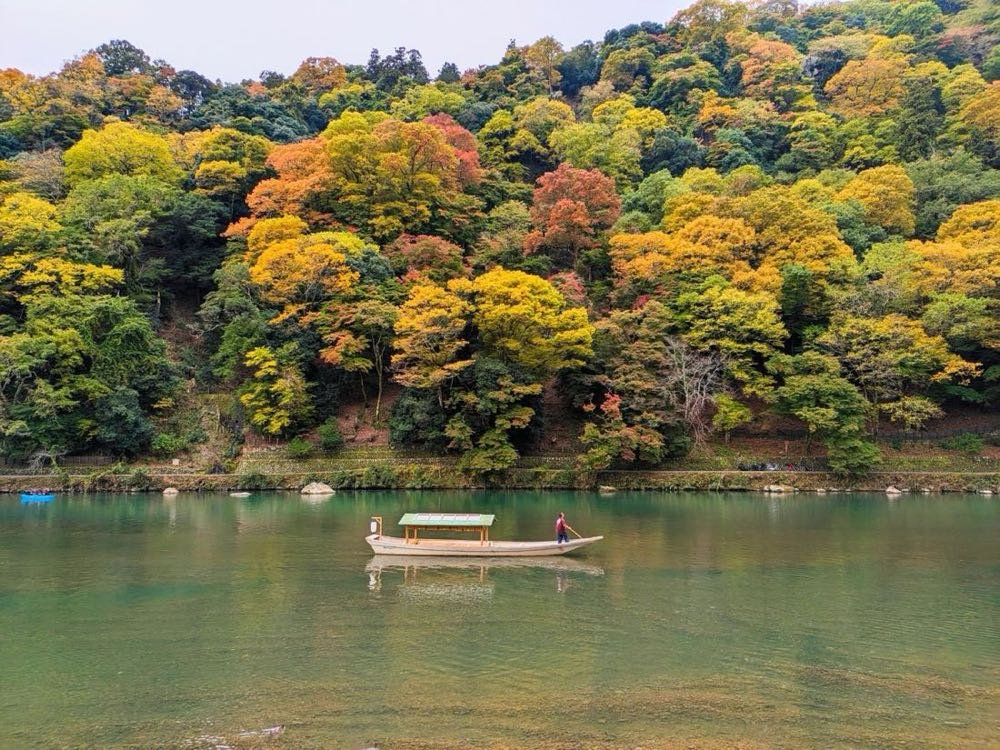
Arashiyama in autumn is one of the most satisfying combinations in Japanese travel: a district that is already beautiful in any season becomes genuinely stunning when the maples turn. The foliage hits Arashiyama slightly later than central Kyoto’s temple circuit - which means if your trip spans the last two weeks of November and into early December, Arashiyama can serve as a second act after the earlier peaks at Tofukuji and Eikando.
When to Visit for Autumn Colour
Arashiyama’s maple canopy typically peaks between November 18th and December 5th, depending on the year. A cooler summer brings the colour forward by a week; a warm one pushes it into December. The Japan Meteorological Corporation’s koyo forecast (updated from early October) gives a year-specific prediction.
The main colour zones:
- Tenryuji garden - the pond garden’s maples usually peak around November 20th to 28th
- Jojakko-ji temple - slightly earlier, often November 15th to 25th; one of the less-visited spots in Arashiyama and excellent for it
- Along the Oi River toward Togetsukyo - the maple trees lining the riverside path colour from mid-to-late November
- The northern approach to the bamboo grove - the zelkova and maple border trees turn November 20th to December 1st
The Bamboo Grove in Autumn
A common misconception: the bamboo in Arashiyama is Moso bamboo (Phyllostachys edulis), which is evergreen. The grove itself looks the same in October as in July. What changes in autumn is everything surrounding it.
At the northern entrance, the grove opens into a T-junction lined with Japanese maple (Acer palmatum). By late November these trees produce a curtain of crimson that frames the bamboo in a way specific to this season. At the southern end, the path emerges near Tenryuji’s north gate where mature zelkova trees produce amber canopies.
To photograph the full autumn effect - green bamboo stalks with red maple framing - arrive before 7:30am. After 9am the path fills quickly. The grove is open 24 hours and free to enter.
Tenryuji Temple Garden
Tenryuji’s Sogenchi garden is designated a Special Historic and Special Scenic Site - the highest dual classification in Japan. The 700-year-old pond garden was designed by Muso Soseki and positions Arashiyama mountain and the Oi River valley as a borrowed landscape backdrop.
In autumn, the maples around the pond create a complete reflection in the water on still mornings. The orange of the maples is deepened by the contrast with the evergreen pines planted around the pond edge.
Entry fees:
- Garden only: ¥500 per adult (¥300 for primary school children)
- Garden + main hall (tatami rooms, Sogenchi view): ¥800 per adult
- Garden + main hall + Hogon-in sub-temple: approximately ¥1,100
Autumn evening illumination: Tenryuji runs special evening viewings on selected days during the peak foliage period, typically late November. These run from sunset to approximately 20:00 and charge around ¥1,000. Tickets are released through the temple’s official site and sell out 2–3 weeks ahead.
Opening hours expand during peak autumn to 08:00–17:30 (and to 20:00+ on illumination evenings).
Jojakko-ji - The Low-Crowd Alternative
Jojakko-ji temple sits on the lower slope of Ogura-yama, five minutes on foot from the bamboo grove’s northern exit. It is rarely as crowded as Tenryuji and offers a different autumn experience: a steeply terraced hillside garden with moss-covered stone steps, a thatched gate, and red maples on multiple levels.
Entry: ¥500 adults. Open 09:00–17:00.
The view from the pagoda at the top of the hill - across the Oi River valley to the opposite forested slope, in full autumn colour - is one of the best elevated koyo views in Arashiyama and widely overlooked.
Okochi Sanso - Mountain Villa and Garden
Okochi Sanso is the former villa of Denjiro Okochi, a samurai film actor who built the garden over 30 years in the early 20th century. The 20,000 square metre hilltop estate looks out over both sides of the Arashiyama ridge - Kyoto city to the east, the Hozu River gorge to the west.
In autumn the garden’s maple and cherry trees produce colour from mid-November. The garden charges ¥1,000 per adult (includes matcha tea in the teahouse). It is a 10-minute climb from the bamboo grove and most visitors miss it entirely. Open 09:00–17:00.
The Hozu River Boat Ride in Autumn
The Hozugawa Kudari runs year-round, but the autumn gorge is the standout season. The flat-bottomed wooden boats descend 16 kilometres from Kameoka through a narrow river gorge whose walls are covered in deciduous woodland. October colours (the upper section) peak earlier; the lower gorge approaches Arashiyama with colour in mid-to-late November.
Details:
- Departure: Kameoka (1 hour from Kyoto by JR San’in Line to Umahori + 10-minute taxi, or direct bus from Arashiyama)
- Duration: approximately 2 hours
- Distance: 16 km, terminating at Arashiyama landing
- Fare: approximately ¥4,100 per adult (October–November peak rate; October is slightly lower)
- Booking: through the Hozugawa Kudari website; weekend dates sell out 2–4 weeks ahead in the autumn peak
The boat ride works particularly well as the start of a day in Arashiyama - arrive at Kameoka in the morning, descend to Arashiyama by midday, then visit Tenryuji and the bamboo grove in the afternoon when crowd levels in those areas are actually declining.
The Sagano Scenic Railway (Torokko)
The Sagano Scenic Railway (嵯峨野観光鉄道) runs a 7.3-kilometre open-sided tourist train through the Hozu River gorge between Sagano-Torokko and Kameoka-Torokko. In autumn, the enclosed gorge tunnels colour - the train passes directly through foliage canopies at low speed.
Fare: ¥880 per adult, one-way. Booking: Essential for October and November weekends. The Sagano Scenic Railway releases tickets online; the autumn booking window fills 3–4 weeks ahead for weekend dates. Schedule: Runs daily except Wednesdays (except when Wednesday falls during special periods). First departure from Sagano approximately 09:02; last departure around 17:02. The round trip is most efficiently done by taking Torokko one direction and the Hozugawa boat in the other.
The Arashiyama Hanatouro Light Festival
The Arashiyama Hanatouro (嵐山花灯路) is an annual outdoor lantern festival held in early December, typically the second and third weeks of the month. Small ceramic lanterns (hanadoro) are placed along 5 kilometres of pathways through the district - the bamboo grove path, the Tenryuji approach, the riverside, and Nonomiya Shrine - from sunset to approximately 20:30.
2026 Hanatouro dates: The festival is typically announced in October. In recent years it has fallen in the December 8–17 window. Check the official Kyoto Tourism website for the confirmed 2026 schedule.
Cost: Entry to the lantern-lit pathways is free. Tenryuji evening admission is additional during the festival period (approximately ¥1,000).
The Hanatouro runs one to two weeks after the main foliage peak, which means the maples are past their full colour. A few trees retain leaves through the first week of December; the combination of bare branches and lantern light is a different - quieter - kind of beauty than the full-colour peak.
Where to Stay Near Arashiyama
For the full early-morning and evening access advantage, staying within the Arashiyama area puts you at the bamboo grove before any tour groups arrive.
- Hoshinoya Kyoto - accessed only by boat from a riverside dock; the water approach is a feature. From approximately ¥80,000 per night. Book directly or via Booking.com 2–3 months ahead for November dates.
- Arashiyama Onsen Benkei - a riverside ryokan with hot spring baths and mountain views. From approximately ¥40,000 per person per night (two-person room with dinner and breakfast). Book via Booking.com.
- Togetsutei - traditional ryokan steps from the Togetsukyo bridge. From approximately ¥30,000 per person per night. Advance booking essential for November.
For a more modest budget, Arashiyama is easily done as a day trip from central Kyoto - the JR San’in Line runs from Kyoto Station to Saga-Arashiyama in approximately 15 minutes (¥240), and the Randen tram from Shijo Omiya takes approximately 25 minutes (¥250).
Getting to Arashiyama for Early Morning Visits
- JR San’in Line: Kyoto Station to Saga-Arashiyama - 15 minutes, ¥240. First train departs around 05:50 on weekdays.
- Randen Tram (Keifuku Electric Railway): Shijo Omiya to Arashiyama Station - approximately 25 minutes, ¥250. First tram approximately 06:10.
- Hankyu Bus 73: From Shijo/Karasuma - approximately 40 minutes. Less useful for early morning timing.
- Cycle from central Kyoto: The riverside path from central Kyoto to Arashiyama takes approximately 40 minutes by bicycle and is possible on a rented city bike.
The JR route from Kyoto Station is the fastest option and the best for catching the bamboo grove in the early light before 8am.
Arashiyama in the final two weeks of November into early December represents Kyoto’s autumn at its most varied: the bamboo grove framed by red maples, Tenryuji’s pond in full reflection, and the Hanatouro lanterns extending the season into December. The colour peaks later here than anywhere else on the standard Kyoto circuit - worth planning around.