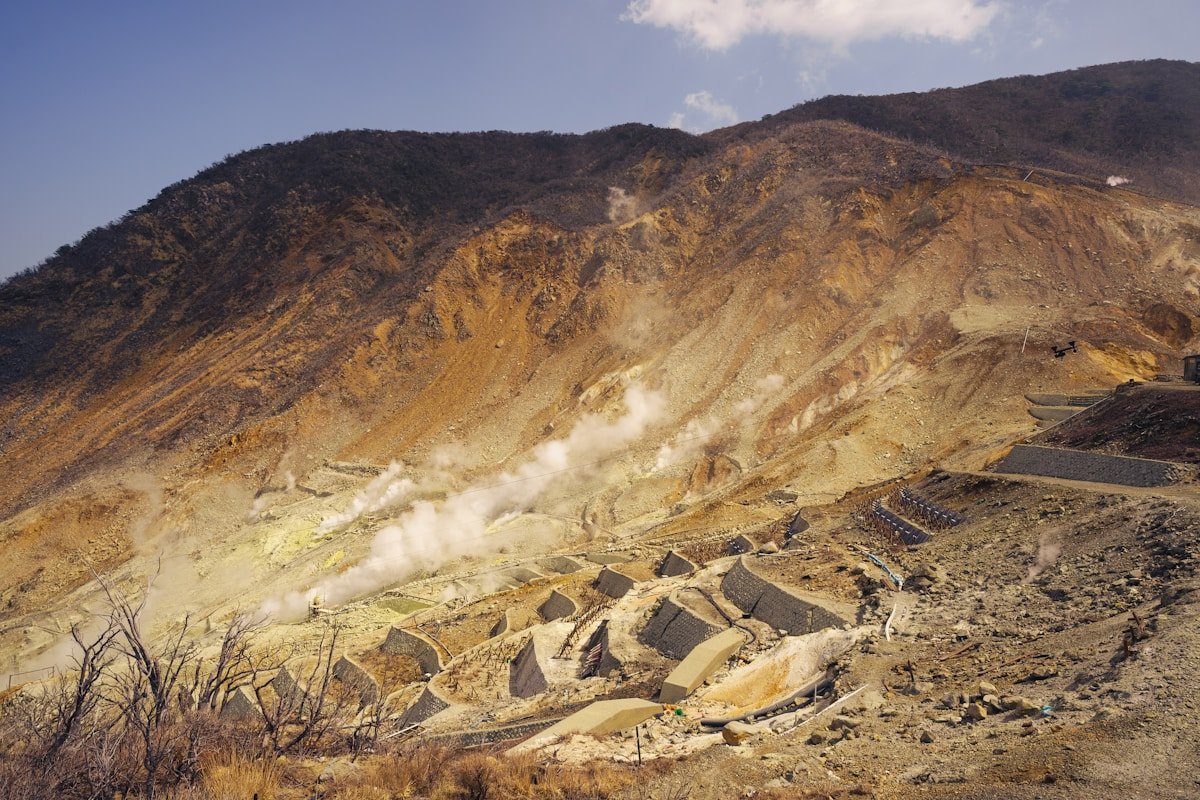
Hakone’s food identity is built around the geology and landscape rather than a single culinary tradition. The volcanic activity at Owakudani produces Japan’s most distinctive snack food. The mountain water is among the country’s best for soba production. The cold, clear Lake Ashi yields a regional freshwater fish found nowhere else nearby. And the ryokan kaiseki tradition - refined seasonal dining across 7–12 courses - makes Hakone one of the stronger destinations in Japan for understanding what seasonal Japanese cuisine actually means in practice.
Kuro-Tamago: Black Eggs
The single most distinctive food item in Hakone is available only at Owakudani, the active volcanic valley accessible by ropeway from Sounzan. Kuro-tamago - black eggs - are regular hen’s eggs hard-boiled in the natural hot spring pools at the base of the sulfur vents.
The chemistry is straightforward: the water at Owakudani contains elevated hydrogen sulfide. As the egg boils, hydrogen sulfide reacts with iron in the calcium carbonate of the shell surface, forming iron sulfide - a black compound. The reaction only affects the outermost shell layer; crack the egg open and the white and yolk are indistinguishable from any other hard-boiled egg.
A bag of five eggs costs approximately ¥600 as of 2026, available from the single vendor in the Owakudani visitor area. The folklore - that each egg extends your lifespan by 7 years - has no scientific backing, but is repeated enthusiastically and accepted cheerfully by most visitors. The deeper reason you cannot take the eggs away is practical: the shells, which are slightly stressed by the hot spring chemistry, crack more easily in lower hydrogen sulfide concentrations. They don’t travel.
Eating black eggs next to active sulfur vents, with steam rising from the valley floor and the ropeway cable overhead, is an experience particular to Hakone. The taste is secondary to the setting.
Kaiseki: The Multi-Course Seasonal Meal
Visitors who stay overnight in a Hakone ryokan (traditional inn) will encounter kaiseki in its most complete form - a dinner of 7–12 courses served in the guest room or in a private dining area, paced across two to three hours. Understanding the structure helps you recognise what you’re eating.
The sequence begins with sakizuke, an amuse-bouche - a small, precise one-bite introduction. This is followed by hassun, the structural centrepiece of kaiseki: a seasonal platter presenting all five classical flavors simultaneously (sweet, sour, salty, bitter, umami), arranged with visual reference to the current season. In autumn, the hassun might include simmered chestnuts, salted salmon, pickled persimmon, and grilled ginkgo nuts on a cedar board.
Yakimono is the grilled dish - in summer this is often ayu (sweetfish) from mountain rivers, salted and skewered over charcoal, or Hakone’s local mountain char. Mushimono (the steamed course) frequently takes the form of chawanmushi - a silky, savory egg custard set in a small ceramic cup, containing seasonal vegetables, mushroom, and sometimes a single piece of tofu or seafood.
Niku (the meat course) is the most expensive component: Kanagawa wagyu, Matsuzaka beef, or - in some top ryokan - Kobe beef, served either as thinly sliced shabu-shabu cooked in hot stock at the table, or seared teppan-style. After the meat course, shokuji arrives: rice, pickles, and miso soup presented together as the meal’s anchor. Finally, mizumono - dessert - uses wagashi (Japanese confectionery), often made from seasonal ingredients such as matcha, yuzu, or chestnut.
Kaiseki dinner in Hakone ryokan starts from approximately ¥12,000 per person within stay packages as of 2026. Gora Kadan charges approximately ¥50,000 per person per night (half board), Fujiya Hotel’s kaiseki dinner from ¥8,000 per person, Mikawaya Ryokan from ¥20,000 per person with dinner and breakfast included.
Yuba: Tofu Skin
Yuba is produced by heating soy milk until a protein-and-fat film forms on the surface. This film is lifted off the surface in a single sheet - fresh yuba - and either served immediately or dried for later use. The process is labor-intensive, which makes fresh yuba considerably more expensive than dried.
Fresh yuba has a rich, creamy texture with a distinct soy milk sweetness. It is typically served chilled with a small dish of soy sauce and freshly grated wasabi. Dried yuba, reconstituted, appears in soups and simmered dishes where it absorbs broth and softens to a tender chew.
Hakone and the Kanagawa region produce yuba used in ryokan kaiseki - it commonly appears as a course in itself or as an element of the hassun platter. In Hakone Yumoto, several shops sell fresh yuba products as takeaway: a fresh yuba roll with dashi jelly costs approximately ¥300–500 as of 2026, and is one of the better street-food buys on the Yumoto pedestrian street. Shops selling yuba crackers (dried, seasoned, sold in flat packages) are found throughout Yumoto and make practical souvenirs.
Handmade Soba
Buckwheat soba requires specific water chemistry to perform well - soft water with balanced minerals draws out the buckwheat’s flavor without competing with it. Hakone’s mountain spring water, filtered through volcanic geology, produces this profile naturally. It’s one reason the Gora area in particular has a concentration of soba restaurants that make their noodles by hand.
Two main varieties appear on menus: juwari soba (10:0 - 100% buckwheat flour, no wheat binder) which is more fragile, earthier, and snaps cleanly; and hazuwari soba (8:2 - 80% buckwheat, 20% wheat flour) which is more elastic, easier to make, and more common. The best soba in Hakone is hazuwari, made daily and served cold (zaru style) or in hot dashi broth.
To eat soba properly: lift a small bundle of noodles with chopsticks, dip only the lower third into the tsuyu dipping broth (a cold liquid of soy sauce, mirin, and dashi), and eat quickly. The noodles soften within seconds in liquid and should not be left submerged. At the end of the meal, ask for soba-yu - the hot starchy cooking water - which is poured into the remaining tsuyu as a finishing soup.
Soba in Gora: from approximately ¥1,100 for zaru soba as of 2026. In Yumoto: from ¥900 for a basic serving at the more casual shops near the station.
Kanagawa Wagyu
Kanagawa Prefecture produces its own regional wagyu classification - less internationally known than Kobe or Matsuzaka beef but raised on similar selective breeding principles. In Hakone’s ryokan kaiseki, Kanagawa wagyu typically appears as the niku (meat) course, cooked tableside as shabu-shabu in kombu stock, or as a seared teppan portion.
Outside of ryokan, Kanagawa wagyu appears in Hakone Yumoto at shabu-shabu restaurants from approximately ¥3,000–¥5,000 for 100g of thinly sliced beef (approximately 2026 pricing), with full set meals from ¥2,500 per person. The key difference from standard supermarket beef is the fat marbling: wagyu develops intramuscular fat that melts at body temperature, producing a different texture and richness when eaten.
Kisoji restaurant near Hakone Yumoto is a practical option for shabu-shabu without the ryokan commitment, from approximately ¥2,500 per person as of 2026.
Mountain Vegetables: Sansai
Sansai - foraged mountain vegetables - are a seasonal product of the Hakone and Tanzawa mountain areas. They appear on restaurant menus and in ryokan kaiseki between March and May, at their freshest in early spring before the shoots become bitter.
Key varieties include fuki no to (butterbur flower buds, intensely bitter, often served as tempura or simmered in miso to moderate the bitterness), taranome (angelica tree shoots, served as tempura with a slightly resinous flavor), warabi (bracken fern, used in salads and simmered dishes after ash-water soaking to remove toxins), and zenmai (royal fern, which requires more preparation but has a distinctive earthy chew).
Warabi-mochi deserves separate mention: it shares a name with regular mochi but is entirely different. Made from bracken starch rather than glutinous rice, it sets as a cool, translucent, gelatinous cube with a soft bounce. It is served cold, dusted with kinako (roasted soybean powder) and drizzled with kuromitsu (brown sugar syrup). Available in Hakone Yumoto shops and at Gora cafés from approximately ¥300–500 as of 2026.
A tempura side of taranome or fuki costs approximately ¥300–600 at restaurants that carry sansai in season. Out of season (June–February), mountain vegetables are unavailable fresh and the menu shifts to dried and preserved forms.
Lake Ashi Wakasagi Smelt
Wakasagi are small freshwater smelt native to northern Japan but introduced to Lake Ashi (Ashinoko), where they have established a self-sustaining population in the cold, clear water. They are caught commercially in the lake and appear on menus at lakeside restaurants - a genuinely regional ingredient tied to this specific body of water.
The standard preparation is karaage: the whole fish, cleaned but unskinned, lightly coated in flour and seasoned with salt, then deep-fried until crisp. The bones are soft enough to eat whole, which is the intended approach - the entire fish disappears in one or two bites. The flavor is mild and slightly sweet, with a clean finish. As a restaurant appetizer, a portion of six to eight wakasagi karaage costs approximately ¥700–1,200 as of 2026 at lakeside restaurants in the Moto-Hakone area.
See Hakone through its food: Food and cultural tours in Hakone often include market visits, tastings, and dishes you’d never find independently.
Onsen Manju and Yumoto Street Sweets
Onsen manju are steamed buns sold throughout Japan’s hot spring towns, and Hakone Yumoto’s pedestrian street has more than a dozen shops selling their own versions. The key difference from ordinary manju: the dough incorporates a small amount of onsen water, which produces a slightly brown exterior and a faint mineral quality in the taste.
Each bun costs approximately ¥100–200. The filling is almost always koshian (smooth red bean paste), occasionally replaced with white bean paste or, in shops targeting tourists, matcha-flavored filling. They are best bought warm from shops that steam them visibly in the window. Cold manju from the previous day’s batch are noticeably inferior.
Other Yumoto sweets worth trying: soft-serve matcha ice cream (¥400–600), available at several shops and notably better quality than the equivalent product at lower-altitude train stations; and Hakone karinto - deep-fried sweet dough sticks with various glazes, sold in small bags from approximately ¥400.
For more on Hakone, see our guides to the Hakone city hub and things to do in Hakone.
Where to stay: Search hotels in Hakone on Booking.com
See also: Hakone travel guide · Best restaurants in Hakone · Things to do in Hakone · Onsen guide Japan · Ryokan guide Japan · Japanese food guide