Hakone Travel Guide: Mount Fuji Views, Onsen, and Art
Hakone travel guide: Mount Fuji views, onsen ryokan, the Open Air Museum, Owakudani volcano, and Lake Ashi - 90 minutes from Tokyo.
Guides for Hakone
Hakone is the most complete escape from Tokyo within 90 minutes. It is a mountain resort area of about 85,000 people spread across valleys, hillsides, and a caldera lake, with a transport network of trains, cable cars, ropeways, and boats that collectively cover most of the major attractions. It sits on the flank of the Fuji Volcanic Belt - the volcanic activity at Owakudani is a reminder that this landscape is geologically active - and the natural hot spring water that feeds its ryokan is drawn from this volcanic ground.
Getting to Hakone
The standard route is the Odakyu Romancecar from Shinjuku Station in Tokyo, which runs directly to Hakone-Yumoto in 1 hour 20 minutes for ¥2,470. The Romancecar is a reserved-seat limited express - book ahead, particularly on weekends. Cheaper options exist (ordinary Odakyu trains take around 2 hours with a transfer at Odawara), but the Romancecar is significantly more comfortable and worth the premium for a weekend trip.
JR Pass holders can take the Tokaido Shinkansen to Odawara (25 minutes from Tokyo, covered by the pass) and then buy a separate ticket on the Hakone Tozan Railway to Hakone-Yumoto (15 minutes, ¥320). This does not save meaningful time over the Romancecar but avoids paying for the Odakyu train.
The Hakone Free Pass
The Hakone Free Pass (¥6,100 from Shinjuku, valid 2 days) is Odakyu’s transport pass covering the round-trip Romancecar from Shinjuku, the Hakone Tozan mountain railway, the Hakone Ropeway, the Lake Ashi cruise, and the local bus network. It also includes discounts at major attractions including the Open Air Museum (¥200 off) and Owakudani (¥100 off).
If you plan to use the Romancecar, ropeway, and lake cruise in addition to local buses, the pass pays for itself clearly. If you are staying in one area and not moving around much, calculate individual ticket costs before purchasing. The pass is available at Shinjuku Station, from the Odakyu website, or on Klook before your trip.
Mount Fuji Visibility
Mount Fuji is visible from Lake Ashi and the higher elevations around Owakudani on clear days - an impressive sight, the white cone rising 3,776 meters above the surrounding peaks. Clear views occur on roughly 60 days per year; the best conditions are in winter, on calm mornings before cloud builds, and immediately after rainfall when the air is clean. By late morning even on fine days, atmospheric haze often reduces the view. Monitoring apps and the Fujisan Navi website provide real-time visibility reports.
If Fuji is hidden by cloud - common in summer - Hakone remains one of the most rewarding destinations near Tokyo regardless. The Open Air Museum, Owakudani, and the ryokan experience are all compelling independent of the mountain view.
Hakone Open Air Museum
The Hakone Open Air Museum (¥1,600) is Japan’s first open-air sculpture museum, opened in 1969. It covers 70,000 square meters of hillside garden with over 120 outdoor sculptures by artists including Henry Moore, Alberto Giacometti, Auguste Rodin, and Joan Miró. The setting - mountain air, forested slopes visible beyond the sculpture terraces - gives the collection a different character from indoor museum experiences.
The Picasso Pavilion (included in admission) contains the largest collection of Picasso works in Japan - approximately 300 pieces including ceramics, paintings, and prints. There is also an outdoor foot bath (included in admission) where you can soak your feet while looking at sculpture. Allow 2 to 3 hours. Located at Chokoku-no-Mori Station on the Hakone Tozan railway.
Hakone Museum of Art
The Hakone Museum of Art (¥900) focuses on Japanese ceramics from prehistoric Jomon ware through to medieval stoneware. The museum is set in terraced gardens of extraordinary quality - the moss garden below the main building is considered one of the finest in Japan, and the garden’s stone-paved paths are particularly beautiful in autumn when the surrounding maples are in color. Budget at least 90 minutes; the garden alone warrants an hour.
Guided Hakone day tours from Tokyo cover the Open Air Museum, Owakudani Valley, and the Lake Ashi cruise as a structured circuit - particularly useful for first-time visitors navigating the Hakone Free Pass and ropeway connections.
Owakudani Volcanic Valley
Owakudani (“Great Boiling Valley”) is an active volcanic zone where sulphurous gases vent through the ground, the rock stained yellow and white, the air sharp with sulphur. It is reached by ropeway from Sounzan Station (¥1,000 for the ropeway segment from Sounzan to Owakudani). The observation area gives views over the volcanic landscape and - on clear days - to Mount Fuji.
The local speciality is Kuro-tamago (black eggs, ¥500 for 5 eggs), hard-boiled in the sulphur-rich spring water, which turns the shells black. Local legend holds that eating one adds 7 years to your life. The eggs taste like ordinary hard-boiled eggs. They sell in enormous quantities.
Lake Ashi Boat Cruise
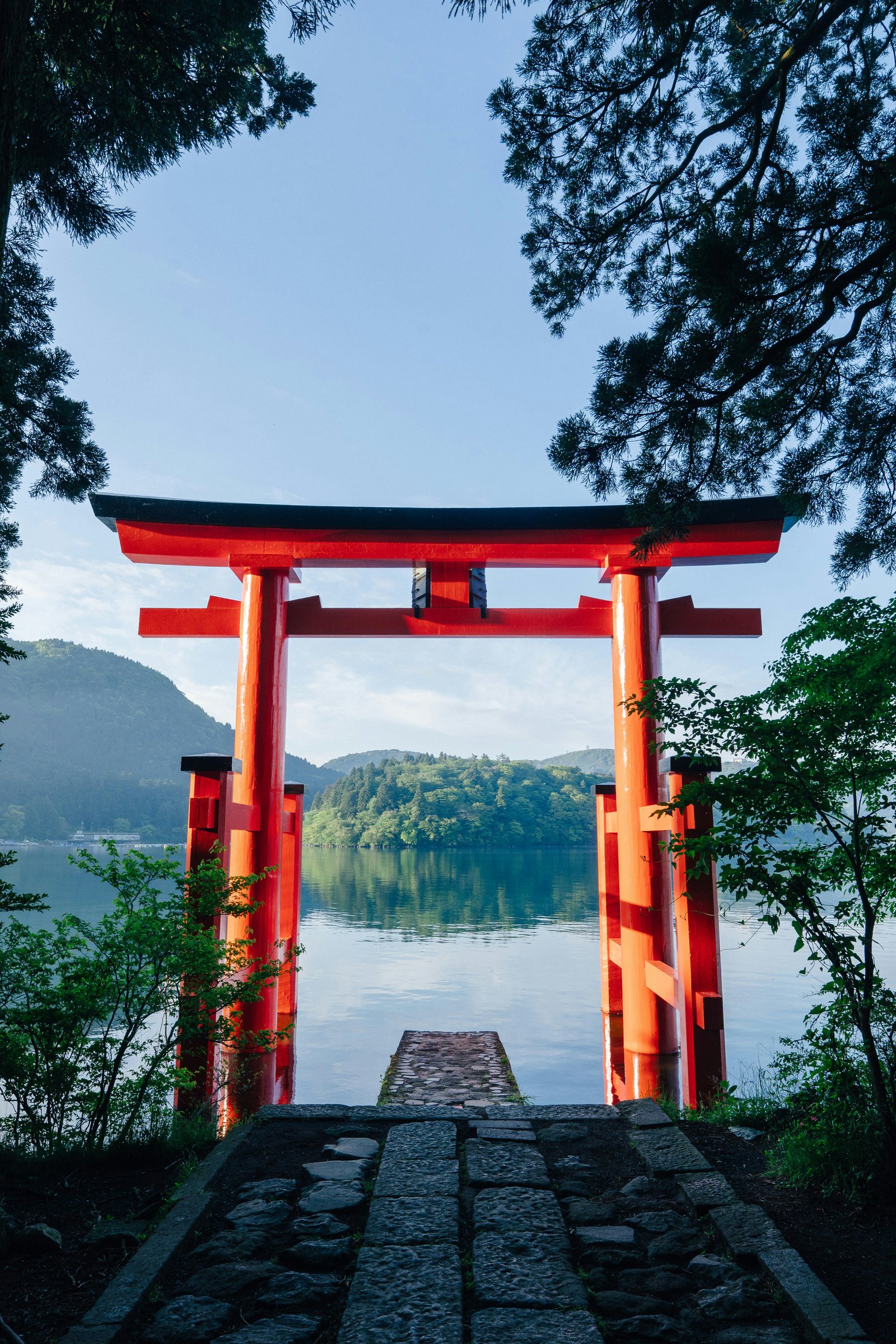
The Lake Ashi cruise (¥1,200 from Togendai to Hakone-machi or Moto-Hakone) runs on the lake using boats styled as 18th-century sailing ships. The views north from the lake surface toward Mount Fuji - framed by cedar trees on the shore - are the iconic Hakone image. The cruise takes about 30 minutes one-way. At Moto-Hakone, the lakeside torii gate of Hakone Shrine, standing in the water at the lake’s edge, is one of the most photographed structures in the area.
Hakone Ropeway
The full Hakone Ropeway (¥1,460 one-way from Sounzan to Togendai) runs 4 kilometers over the Owakudani volcanic zone and down to Lake Ashi, giving aerial views of both the volcanic landscape and the lake. The Owakudani section - where the gondola passes directly over the sulphur vents - is the most dramatic. In good weather, Mount Fuji appears ahead as the gondola descends toward the lake.
Hakone Tozan Cog Railway
The Hakone Tozan Railway (¥590 one-way from Hakone-Yumoto to Gora) is a mountain cog railway that climbs through dense cedar and maple forest on the steepest standard-gauge railway in Japan. The journey passes through a series of switchbacks where the train reverses direction to continue climbing. In June, the hydrangeas planted along the embankments bloom in purple and blue. The train is enjoyable as a transport experience independent of the attraction at the destination.
Onsen Ryokan Areas
The onsen experience is the heart of Hakone and the primary reason many visitors stay overnight. Hot spring water is piped to virtually every hotel and ryokan in the area. The quality and temperature of the water varies by location - the springs at Hakone-Yumoto are the most accessible; the waters at Sengokuhara are known for a slightly different mineral composition.
Hakone-Yumoto: The lowest altitude and most accessible area, directly at the Hakone Tozan railway terminus. The most budget-friendly zone, with ryokan from ¥15,000 per person including meals. Closest to the transport connections.
Gora: A quieter, higher-altitude area at the top of the cog railway, with a concentration of mid-to-upper ryokan. More subdued and forested than Yumoto. Prices from ¥20,000 to ¥50,000 per person.
Miyanoshita: The most historic accommodation zone, midway on the Tozan railway. The Fujiya Hotel (opened 1878) is the landmark property. A traditional ryokan atmosphere, with slightly more character than the purpose-built resort areas. From ¥25,000.
Lake Ashi shores: The most scenically situated accommodation, with direct lake views and some of the most dramatic onsen settings. Also the most expensive, from ¥30,000 to ¥120,000 per person including meals at the premium end.
Sengokuhara: The plateau area north of the ropeway, home to the Pola Museum and several golf courses. Quieter than the main tourist circuit, with good-value ryokan from ¥20,000.
Hakone vs Nikko
Both Hakone and Nikko are popular Tokyo day trips. Our Hakone vs Nikko comparison covers which is more rewarding based on your interests - volcanic landscapes and onsen versus elaborate Edo-era shrine architecture.
Planning your trip to Hakone? Tours and activities in Hakone cover guided experiences, cultural immersion, and the top sights with local expertise. Flights to Japan vary significantly by season - compare early to secure the best fares. Sort out travel insurance for Japan before you book, and pick up an Airalo eSIM for Japan to have mobile data the moment you land.
Search hotels in Hakone on Booking.com
Explore Hakone
Things to do in Hakone · Where to stay in Hakone · Best restaurants in Hakone · Hakone food guide · Day trips from Hakone
Hakone is part of the Kanto region. For an overview of destinations near Tokyo, see our Kanto region guide.
See also: Kanto region guide · Tokyo travel guide · Nikko travel guide · Hakone vs Nikko · Best tours in Hakone · Mount Fuji climb guide · Ryokan guide Japan · Onsen guide Japan · Long stay in Hakone
Upcoming Events in Hakone
Hakone Daimyo Gyoretsu
hakone
Hakone Daimyo Gyoretsu 2026, 3 November. Hundreds march 12km along the Tokaido in Edo-era costume from Odawara to Moto-Hakone. Free to watch.
Hatsumode - New Year Shrine Visits
Hatsumode 2027, 1–3 January. Japan's most important annual tradition - millions visit shrines and temples in the first three days of the new year.
Nearby Cities
Frequently Asked Questions
- Is the Hakone Free Pass worth buying?
- The Hakone Free Pass (¥6,100 from Shinjuku, 2 days) covers the Odakyu Romancecar train from Shinjuku, the Hakone Tozan mountain railway, the ropeway, the Lake Ashi cruise, and the bus network. If you plan to use 3 or more of these, the pass saves money. Check the Odakyu website for current pricing.
- What are the chances of seeing Mount Fuji from Hakone?
- Clear views occur on roughly 60 days per year. The best odds are in winter (December to February), on calm mornings before 10am, and after rainfall clears the air. Summer is the worst season for Fuji views due to humidity and cloud. Even without a Fuji view, Hakone has more than enough to fill two days.
- How do we get to Hakone from Tokyo?
- The Odakyu Romancecar from Shinjuku takes 1 hour 20 minutes directly to Hakone-Yumoto for ¥2,470 (seat reservation required). Alternatively, JR Pass holders can take the Tokaido Line to Odawara and switch to Hakone Tozan Railway, though the total time is similar.
- What is Owakudani and is it safe to visit?
- Owakudani is an active volcanic valley with sulphur vents, reached by ropeway for ¥1,000. It is generally safe to visit but the access trail is sometimes closed during elevated volcanic activity - check the Hakone Ropeway website before visiting. People with severe respiratory conditions should consult the health advisory posted at the ropeway station.
- When is the best time to visit Hakone?
- Winter (December to February) gives the best Fuji views and the onsen atmosphere is most rewarding in cold weather. Spring has cherry blossoms. Autumn has foliage. Summer is the most crowded season. Weekdays are noticeably quieter than weekends year-round.
Book an experience
Top experiences in Hakone
Explore the best tours and activities in Hakone, with instant confirmation and free cancellation on most bookings.