Kamakura Travel Guide: The Great Buddha and Zen Temples
Great Buddha ¥300, Hase-dera ¥400, Hokoku-ji bamboo ¥300, Ten-en hiking trail - Kamakura from Tokyo in 57 minutes for ¥940 JR.
Guides for Kamakura
Kamakura sits on a narrow coastal plain bounded by forested hills on three sides and Sagami Bay to the south. It is one of the most rewarding day trips from Tokyo - a city of 172,000 people that was once the political capital of Japan, home today to 65 temples and 19 shrines packed into an area you can cross on foot in under two hours. The Great Buddha alone is worth the journey, but the real depth of Kamakura reveals itself on the hiking trails threading between temple compounds through stands of bamboo and cedar.
Getting to Kamakura from Tokyo
The simplest route is the JR Yokosuka Line from Tokyo Station, which runs directly to Kamakura Station in 57 minutes for ¥940. The same line also stops at Kita-Kamakura (one stop before Kamakura), which is the better alighting point if you want to walk the temple trail from north to south. From Yokohama, the journey is 25 minutes for ¥360. JR Pass holders travel free on this line. From Shinjuku, the Shonan-Shinjuku Line offers a direct service in around 55 minutes with no transfer required.
Once you are in town, our guide to getting around Kamakura covers trains and the Enoden line in more detail.
The Former Shogunate Capital
Kamakura served as the seat of Japan’s first military government from 1185 to 1333. Minamoto no Yoritomo established the Kamakura Shogunate here after defeating rival clans, choosing a location that was defensible by sea and by the surrounding hills. The city’s peculiar geography - with mountain passes as the only land entry points - made it effectively a natural fortress. Seven of these ancient passes survive today as hiking routes.
After the shogunate fell in 1333, Kamakura lost political power but retained its religious significance. The great Zen temples founded during the Kamakura period - Engaku-ji, Kencho-ji, Jochi-ji, Jomyo-ji, and Jufuku-ji - form the Kamakura Gozan, the five great Zen temples of Kamakura, modeled on the Chinese tradition of the Five Mountains. These temples shaped Japanese culture far beyond religion: the arts of tea ceremony, ink painting, and Noh drama all developed within the Zen monastic culture of Kamakura.
Kotoku-in: The Great Buddha
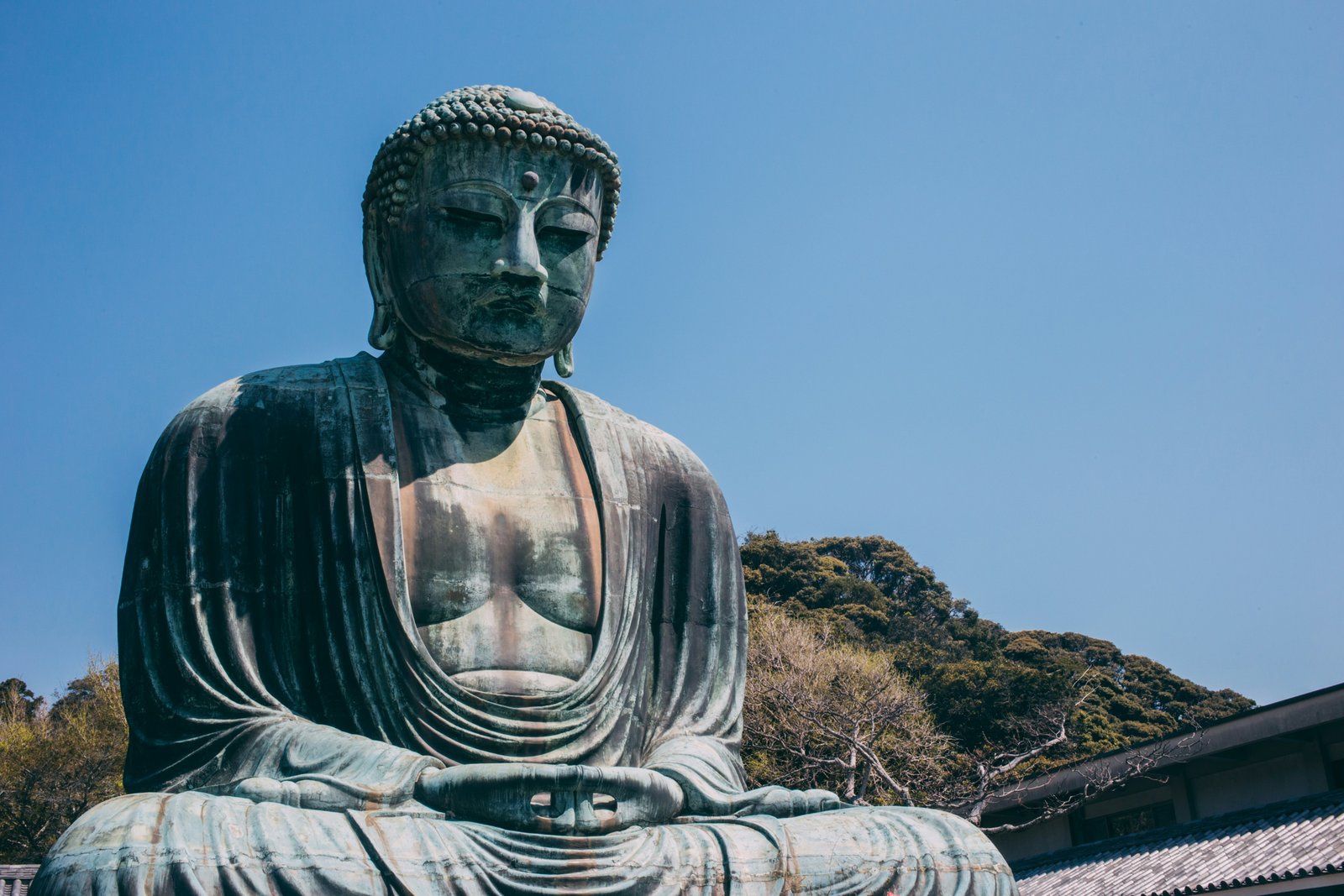
The Great Buddha of Kamakura - Kotoku-in Daibutsu - is the defining image of the city and one of the most recognizable statues in Japan. Cast in bronze in 1252, it stands 13.35 meters tall and weighs approximately 121 tonnes. The figure depicts Amida Buddha in a seated meditative posture, its hands resting in the dhyana mudra position, the eyes half-open in gentle contemplation.
The statue originally stood inside a wooden hall, which was destroyed by a series of storms and tsunami in the late 14th and early 15th centuries. Since then, the Great Buddha has sat outdoors, weathered by 700 years of coastal air. The patina is a deep blue-green, the expression unchanged by centuries of seasons.
Guided Kamakura day tours from Tokyo cover the Great Buddha, Hase-dera, and the main Zen temples as a structured circuit - worthwhile for first-time visitors who want the historical connections between Kamakura’s Buddhist sites explained.
Admission to Kotoku-in is ¥300. The grounds are open from 8:00am to 5:30pm April through September, closing at 5:00pm in winter months. For an additional ¥20, you can enter the hollow interior of the statue through two small windows in its sides - the interior space is dimly lit, with ventilation holes visible in the shoulders.
Hase-dera Temple
Hase-dera stands on a hillside about 10 minutes’ walk from the Great Buddha, with tiered gardens that rise from a lotus pond at the base to a viewing platform looking out over Kamakura and the sea. Admission is ¥400.
The temple’s principal object of veneration is a 9.18-meter gilded wooden statue of Kannon, the bodhisattva of compassion - the largest wooden statue in Japan. According to temple tradition, the statue was carved from a single camphor tree in 721 CE. The main hall also contains a collection of 1,000 small Kannon figures donated by worshippers, each dressed in a bib and hat by the temple priests.
The garden levels are genuinely beautiful. The lower section has a cave complex carved into the hillside, with small Benzaiten shrine alcoves lit by lanterns. The upper terrace has the sea view platform, particularly good in the late afternoon when the light is soft over Sagami Bay.
Tsurugaoka Hachimangu Shrine
Tsurugaoka Hachimangu is the central axis around which old Kamakura was built. Minamoto no Yoritomo relocated and expanded this Shinto shrine in 1191, orienting the entire city around the 1.8-kilometer approach avenue that runs from the sea to the shrine steps. The avenue - Wakamiya Oji - is lined with three pairs of torii gates and flanked by cherry trees that bloom spectacularly in late March.
Entry to the main shrine is free. The complex includes a main hall at the top of a long stone staircase, flanked by two ponds - the Genpei ponds, symbolizing the warring Minamoto and Taira clans. In the center of the source pond stands a small island with a vermilion shrine. The main festivals - the spring Kamakura Matsuri in April and the autumn Reitaisai in September - include horseback archery, traditional dance, and processions in medieval court dress.
Engaku-ji Zen Temple
Engaku-ji sits immediately to the right as you exit Kita-Kamakura Station, making it the natural first stop on a north-to-south temple walk. Founded in 1282 by the regent Hojo Tokimune to commemorate soldiers killed in the Mongol invasions, it is the second-ranked of the Kamakura Gozan. Admission is ¥500.
The complex covers a forested valley behind the station. The main approach passes through the great Sanmon gate and crosses a small bridge over a stream. Beyond the main hall complex, a steep path climbs to the Shariden - a reliquary hall said to contain a tooth of the Buddha - which is one of the oldest surviving structures in Kamakura, dating to the Kamakura period itself, and is a National Treasure.
Kencho-ji Zen Temple
Kencho-ji, founded in 1253, is the first-ranked of the Kamakura Gozan and the oldest Zen training monastery in Japan. Admission is ¥500. The main approach passes through an atmospheric row of tall juniper trees - planted in the early 14th century - to the Sanmon gate, flanked by temple buildings in the Chinese Zen architectural style.
Behind the main hall complex, a path climbs through the forest to Hansobo shrine and then continues to a viewing point over Kamakura. This path connects to the Ten-en Hiking Course, which links Kencho-ji to Zuisen-ji temple on the eastern side of the city - a 4-kilometer trail through the hills that makes an excellent half-day walk.
Hokoku-ji: The Bamboo Temple
Hokoku-ji is less visited than the Gozan temples but is, for many visitors, the most atmospheric place in Kamakura. Founded in 1334, its main feature is a grove of approximately 2,000 moso bamboo (Phyllostachys edulis) growing densely behind the main hall. Admission to the bamboo garden is ¥300.
Inside the grove, a path loops through the bamboo, the stems rising 20 meters overhead, the light filtered green and gold. At the far end of the path is a small teahouse where matcha and a wagashi sweet are served for ¥600. Drinking tea in a bamboo grove in complete quiet is one of those experiences that rewards arriving early - the grove is small enough that 20 people make it feel crowded.
Enoshima: The Day Extension
The small island of Enoshima sits 30 minutes from Kamakura by the Enoden line (¥260), a narrow-gauge railway that runs along the coast through suburban streets and occasional sea views. The island is connected to the mainland by a 600-meter causeway and is dominated by a hillside shrine complex, sea caves, and a lighthouse.
The Iwaya Caves (¥500) are carved by wave action into the island’s rocky base and extend 152 meters into the cliff. The Samuel Cocking Garden at the island’s summit contains the Sea Candle observation lighthouse (¥500), with views south over the Pacific and north to the Tanzawa mountain range - and on very clear days, to Mount Fuji. Freshly grilled whole fish on a stick (shirasu don - whitebait rice bowls ¥1,000–¥1,500) are the island’s signature snacks, sold from vendors along the main shopping street.
Kamakura Hiking Trails
Kamakura’s forested hills contain several well-marked hiking courses that connect the main temple areas. The Daibutsu Hiking Course runs 8 kilometers from Kita-Kamakura to the Great Buddha area, passing through dense cedar and bamboo forest with minimal elevation gain. The walk takes 2 to 3 hours at a moderate pace and passes several minor temples and hillside shrines. Trail marking is good and no specialist equipment is needed. Entry to the course is free.
The Ten-en Hiking Course (4km, approximately 2 hours) connects Kencho-ji to Zuisen-ji on the eastern side of the city, crossing the hills that separate Kamakura from the Zushi coast. Both courses can be combined for a full day of walking with temples at each end.
Day Trip vs Staying Overnight
Most visitors come on a day trip, which is perfectly reasonable. A full day allows you to cover the Great Buddha, Hase-dera, Tsurugaoka Hachimangu, Kencho-ji, and Hokoku-ji with comfortable pacing, plus lunch on Komachi-dori shopping street. The last trains back to Tokyo run until around 23:45.
Staying overnight pays dividends if you want to walk temple grounds at dawn - before the day-trip crowds arrive by mid-morning - or if you want to add Enoshima without rushing. The Enoden line and Kamakura’s beach at Yuigahama are also more enjoyable in the late afternoon light after day-trippers have departed.
Kamakura vs Nara
Both are Japan’s go-to temple day trips, but they suit different itineraries. See our Nara vs Kamakura comparison for a detailed look at which to choose based on your base city and what you want to experience.
Planning your trip to Kamakura? Tours and activities in Kamakura cover guided experiences, cultural immersion, and the top sights with local expertise. Flights to Japan vary significantly by season - compare early to secure the best fares. Sort out travel insurance for Japan before you book, and pick up an Airalo eSIM for Japan to have mobile data the moment you land.
Search hotels in Kamakura on Booking.com
Explore Kamakura
Things to do in Kamakura · Where to stay in Kamakura · Best restaurants in Kamakura · Kamakura food guide · Day trips from Kamakura · Getting around Kamakura
Kamakura is part of the Kanto region. For an overview of destinations near Tokyo, see our Kanto region guide. Planning a Tokyo-based trip that includes Kamakura? Our one week in Tokyo itinerary and 3 days in Tokyo both include day-trip options to the city.
Official sources worth checking before you go: Japan National Tourism Organization.
See also: Kanto region guide · Tokyo travel guide · Nikko travel guide · Nara vs Kamakura · One week in Tokyo itinerary · Japan cherry blossom guide · Long stay in Kamakura
Upcoming Events in Kamakura
Hatsumode - New Year Shrine Visits
Hatsumode 2027, 1–3 January. Japan's most important annual tradition - millions visit shrines and temples in the first three days of the new year.
Nearby Cities
Frequently Asked Questions
- How long does it take to get from Tokyo to Kamakura?
- The JR Yokosuka Line runs directly from Tokyo Station to Kamakura Station in about 57 minutes for ¥940. From Shinjuku, change at Ofuna or take the Shonan-Shinjuku Line directly in about 55 minutes for the same fare.
- Is Kamakura worth visiting as a day trip from Tokyo?
- Yes, most visitors come on a day trip and see the main highlights in 6–8 hours. Staying overnight is worthwhile if you want to visit temples at dawn before crowds arrive, or extend to Enoshima.
- What is the entry fee for the Great Buddha at Kotoku-in?
- Admission to Kotoku-in and the Great Buddha is ¥300 for adults. You can pay an additional ¥20 to enter the hollow interior of the bronze statue itself.
- When is the best time to visit Kamakura?
- Late March to early April for cherry blossoms, June for hydrangeas at Meigetsuin, and November for autumn foliage. Weekday mornings are significantly less crowded than weekend afternoons year-round.
- Can I use a JR Pass to get to Kamakura?
- Yes. The JR Yokosuka Line from Tokyo is covered by the JR Pass. The Enoden line within Kamakura is not covered by the JR Pass but costs ¥260–¥310 per journey.
Book an experience
Top experiences in Kamakura
Explore the best tours and activities in Kamakura, with instant confirmation and free cancellation on most bookings.