Nagasaki’s geography makes it an excellent base for exploring western Kyushu. The city sits at the tip of a peninsula flanked by islands, inlets, and the Shimabara Peninsula across the Ariake Sea - and within 2 hours, you can reach one of Japan’s most surreal industrial ruins, an active volcano region, a Dutch-themed theme park, and the castle town of Saga.
For more on the city itself, see the Nagasaki travel guide.
1. Gunkanjima (Hashima Island) - UNESCO Abandoned Coal Island
Travel time from Nagasaki: 50 minutes by boat from Nagasaki Port Terminal 2 Tour cost: Approximately ¥4,000–¥5,500 per person (as of 2026) Best for: Industrial history, photography, unusual experiences Recommended time: Half day (3 hours total)
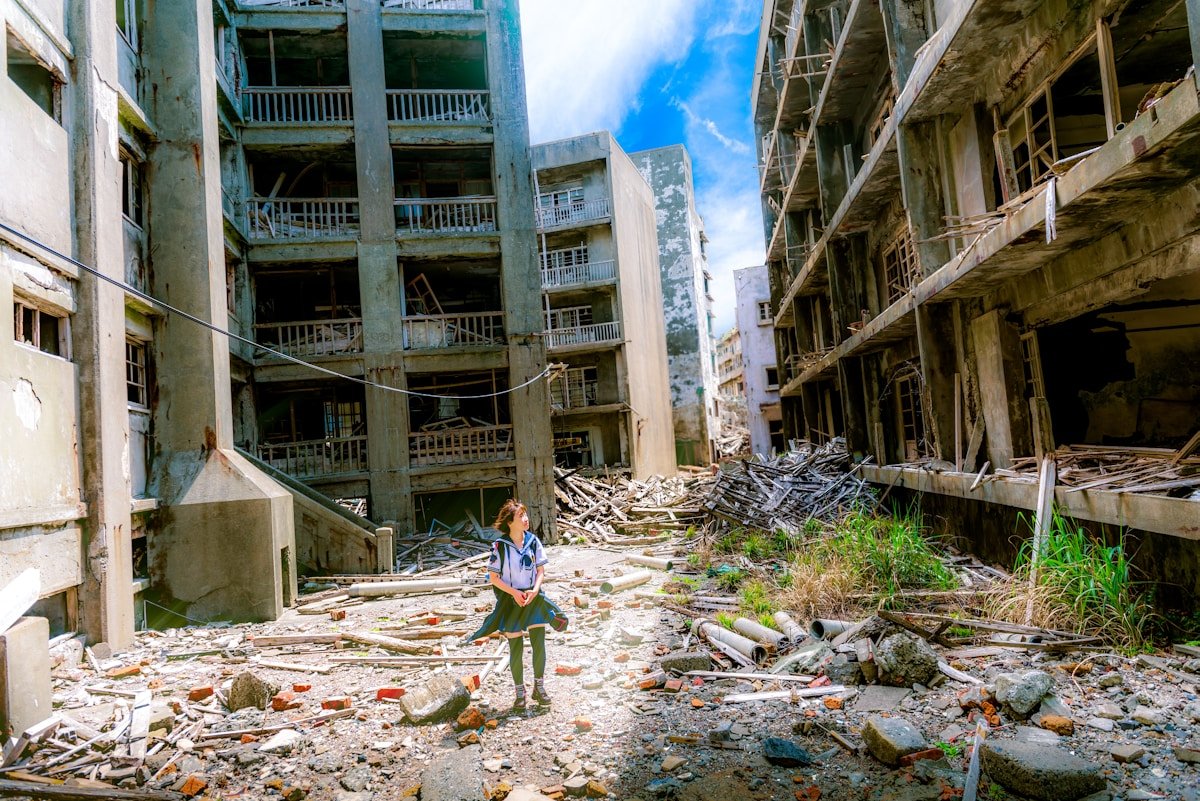
Hashima Island - called Gunkanjima (Battleship Island) because its silhouette resembles a warship - is one of the most extraordinary sites in Japan. A 6.3-hectare island 15km offshore from Nagasaki, it was developed from 1887 as a coal mine by Mitsubishi, eventually housing over 5,000 workers and their families in extremely high-density concrete apartment blocks, schools, and a hospital, all within an island that can be crossed on foot in 5 minutes.
The mine closed in January 1974 as Japan shifted away from coal. The island was evacuated within months, and the entire settlement was left intact. Five decades of wind and salt have accelerated the collapse of the reinforced concrete buildings, creating a dramatic ruin that has attracted photographers, historians, and UNESCO scrutiny (it was inscribed as part of a broader Meiji-era industrial heritage listing in 2015).
The tour: Boats depart from Nagasaki Port Terminal 2. The journey takes approximately 50 minutes each way. On the island, visitors follow a guided path through the accessible section of the ruins (about a third of the total area - the most collapsed sections are fenced off for safety). Landing typically takes 30–40 minutes.
Booking: Several licensed operators run tours; Yamasa Kaiun and Seaman Club are the main options. Book online well in advance (April–September especially). Landing is not guaranteed - if sea conditions prevent docking, the boat circles the island and the landing portion of the fee is refunded. Check conditions the morning of your departure.
Photography note: The viewpoints from the safe zone provide excellent angles on the collapsed apartment blocks and the rusting infrastructure. Early morning tours have the best light.
2. Shimabara Peninsula - Volcano, Castle, and Hot Springs
Travel time from Nagasaki: 1.5 hours via JR to Isahaya + Shimabara Railway, or 1 hour by ferry Best for: Nature, history, onsen Recommended time: Full day
The Shimabara Peninsula is dominated by Unzen-Fugen-dake, an active stratovolcano whose 1991 eruption killed 43 people including a team of volcanologists. The pyroclastic flow paths are still visible on the eastern slopes, and the Disaster Memorial Hall in Shimabara documents the eruption with disturbing effectiveness (admission approximately ¥1,050, as of 2026).
Shimabara Castle: A 1624 fortress reconstructed in 1964 on its original site, with a museum inside covering the 1637 Shimabara Rebellion - a Christian peasant uprising that contributed to Japan’s isolation policy. Admission approximately ¥540. The castle grounds have cherry blossoms in spring.
Unzen Onsen: The hot spring town of Unzen, 30 minutes by bus from Shimabara, sits at 700m elevation in the volcanic mountains and centres on jigoku (hells) - steaming sulphur vents in the ground. Entry to the public jigoku paths is free; they are a 5-minute walk from the bus stop. Onsen bathing at guesthouses from approximately ¥500–¥700 for a public bath entry.
Getting there: The Shimabara Ferry departs from Nagasaki’s Shimabara Port terminal, crossing the Ariake Sea in about 1 hour to Shimabara (¥1,000–¥1,300). The same ferry continues to Kumamoto Port - making a Nagasaki–Shimabara–Kumamoto loop possible as a multi-day extension.
3. Huis Ten Bosch - Dutch-Themed Resort
Travel time from Nagasaki: 90 minutes by JR Seaside Liner to Huis Ten Bosch Station (¥1,680 one way) Admission: Approximately ¥2,300–¥3,000 depending on season and zone (as of 2026) Best for: Flowers, illuminations, novelty Recommended time: Half to full day
Built in the early 1990s in Sasebo, Huis Ten Bosch is a 152-hectare Dutch-themed resort with reproductions of classic Dutch architecture, functioning canals, tulip and rose gardens, and a collection of experiences ranging from traditional Dutch craft workshops to VR attractions and seasonal illuminations.
Key seasonal highlights:
- Spring (February–April): Tulip festival with approximately 1 million bulbs
- Summer–Autumn (July–November): Rose garden, sunflower fields
- Winter (November–March): Kingdom of Light illumination - one of Japan’s most celebrated seasonal lighting events, covering the full park
The scale is genuinely impressive - it is the largest theme park in terms of area in Japan - and the contrast between Dutch architectural replicas and the surrounding Japanese countryside is distinctive rather than unsettling. It reads better as a resort day out than as a cultural destination.
Note on getting there: The JR Huis Ten Bosch direct service from Nagasaki Station runs several times daily and arrives at a dedicated station at the park entrance.
4. Saga City and Yoshinogari Historical Park
Travel time from Nagasaki: 50 minutes by JR Nagasaki Main Line to Saga Station (¥1,230 one way) Best for: Japanese early history, archaeology, alternative to tourist crowds Recommended time: Half day
Saga Prefecture is quieter than its neighbours but has two significant attractions accessible as an extension of a Nagasaki stay.
Yoshinogari Historical Park: Japan’s largest Yayoi period (300 BCE–300 CE) archaeological site, reconstructed to show how a large settlement and moat complex looked before Japan had writing, rice cultivation, and bronze tools. Admission approximately ¥460. The reconstructed burial mounds, communal buildings, and watchtowers give an unusual sense of Japan before the historical record begins.
Saga Balloon Museum: Saga Prefecture hosts one of the world’s largest hot air balloon races (Saga International Balloon Fiesta, late October–early November). The associated balloon museum near the central park has interactive simulators and is free of charge - best visited if the Fiesta itself is not running.
Make the most of your time around Nagasaki: Guided day trips from Nagasaki handle the logistics - transport, guide, and timing - so you can focus on the experience. For airport arrivals and departures, Kiwitaxi offers fixed-price airport transfers with no meter surprises.
Day Trip Summary
| Destination | From Nagasaki | Transport | Approx one-way cost (2026) |
|---|---|---|---|
| Gunkanjima | Nagasaki Port | Boat tour | ¥4,000–¥5,500 total |
| Shimabara | Isahaya → Shimabara Railway | JR + private rail | ¥1,500–¥1,800 |
| Shimabara | Nagasaki Shimabara Port | Ferry | ¥1,000–¥1,300 |
| Huis Ten Bosch | Nagasaki Station | JR direct | ¥1,680 |
| Saga | Nagasaki Station | JR | ¥1,230 |
Where to stay: Search hotels in Nagasaki on Booking.com
See also: Nagasaki travel guide · Things to do in Nagasaki · Where to stay in Nagasaki · Hiroshima vs Nagasaki · Kyushu region guide