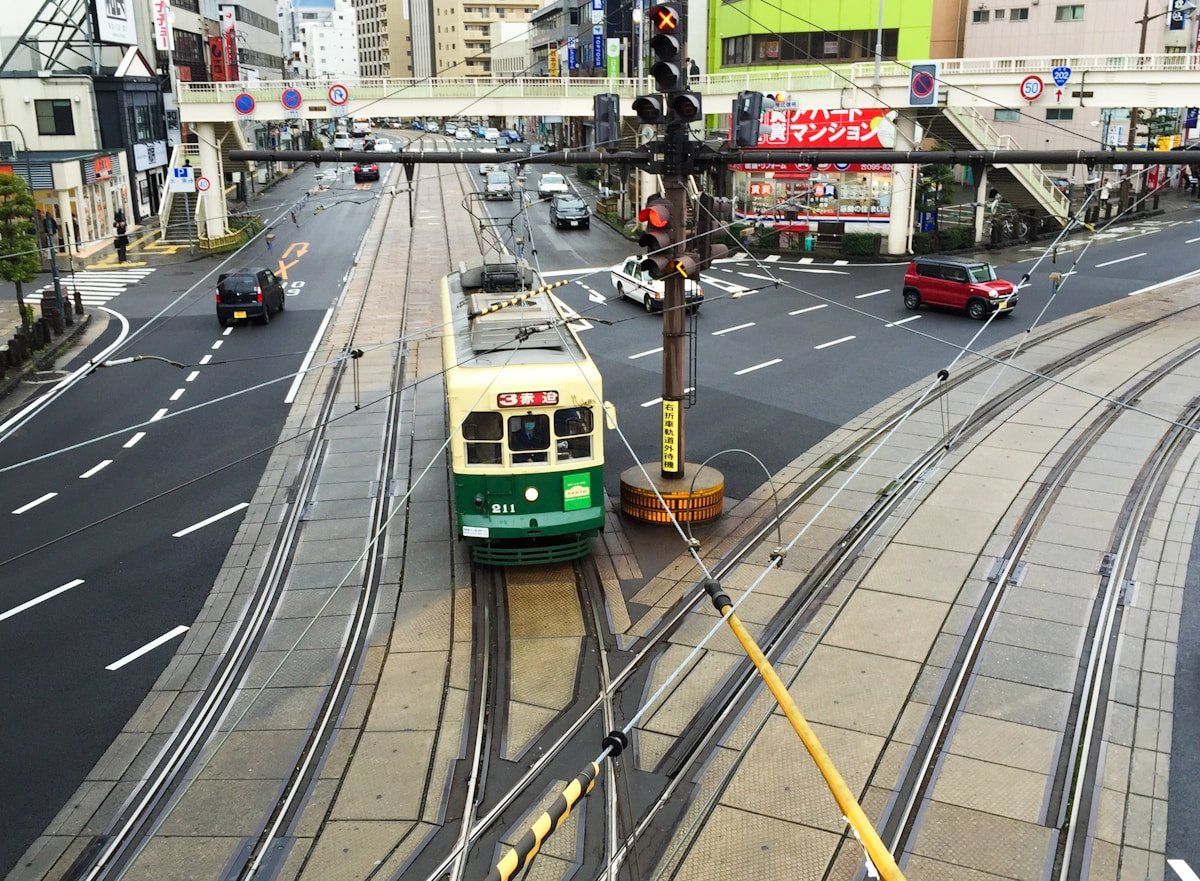
Nagasaki is a city shaped by its geography - built into a series of hillside valleys running down to one of Japan’s finest natural harbours. The layout means some neighbourhoods sit on steep slopes, but the main tourist corridor along the valley floor is served by one of Japan’s most charming tram networks. For a city of its size, Nagasaki is remarkably easy to navigate: the tram handles the flat central route, the Ropeway covers the main hill viewpoint, and most of the key sights are concentrated enough to walk between them.
Nagasaki Electric Railway (Trams)
The Nagasaki Electric Railway (長崎電気軌道) operates four tram lines across central Nagasaki, covering the vast majority of tourist destinations. These are distinctive cream-and-green trams - some are decades old and all are well-maintained, running through streets that feel unchanged from a previous era.
Lines and key stops:
| Line | Key stops for visitors |
|---|---|
| Line 1 (Akasako direction) | Nagasaki Station-mae, Tsukimachi (Chinatown), Shimin Byoin-mae (Glover Garden) |
| Line 2 (Shōtai direction) | Nagasaki Station-mae, Matsuyama-machi (Peace Park area) |
| Line 3 (Hotarujaya direction) | Nagasaki Station-mae, Tsukimachi (transfer), Shianbashi (main nightlife strip) |
| Line 4 (Hotarujaya direction, via Wajiro) | Nagasaki Station-mae, Suwa Jinja-mae (Suwa Shrine) |
Boarding and payment: Board at the rear door; pay when alighting at the front door. Accept IC cards (tap in at rear, tap out at front) or exact coins. The flat fare of ¥140 per ride (as of 2026) regardless of distance is one of the lowest in Japan.
Transfers: To change between lines, alight at a designated transfer stop (Tsukimachi is the main one) within five minutes - show your transfer voucher (printed when you tap off) or ask the driver for a transfer slip if paying cash. This allows a free connection on the next tram.
Tram Day Pass
A 1-day tram pass costs ¥700 (as of 2026) - equivalent to five single journeys. If you plan to travel between Nagasaki Station, Peace Park, Chinatown, and Glover Garden in one day (four trips is a realistic minimum), the pass pays for itself. Available from tourist information offices at Nagasaki Station and from some tram drivers.
Reaching Key Attractions by Tram
| Attraction | Stop | Line |
|---|---|---|
| Atomic Bomb Museum / Peace Park | Matsuyama-machi, then 7-min walk | Line 1 or 2 |
| Nagasaki Peace Memorial Hall | Hamaguchi-machi | Line 1 or 2 |
| Dejima (Dutch trading post) | Dejima-mae | Line 1 |
| Chinatown (Shinchi area) | Tsukimachi | Line 1, 3, or 4 |
| Glover Garden | Shimin Byoin-mae, then 10-min walk uphill | Line 5 |
| Shianbashi (restaurants/bars) | Shianbashi | Line 3 |
Note: Glover Garden involves a steep uphill walk from the tram stop - approximately 10–15 minutes. A free outdoor escalator runs from the main gate to the upper garden area during opening hours.
JR Trains and the Nishikyushu Shinkansen
Nagasaki Station was relocated and rebuilt in 2024 and is now an impressive modern terminus directly integrated with the new Nishikyushu Shinkansen.
Nishikyushu Shinkansen (from Nagasaki):
| Destination | Train | Time | Approximate Fare |
|---|---|---|---|
| Takeo Onsen | Kamome (Shinkansen) | 23 min | ¥2,130 |
| Hakata (Fukuoka) | Kamome + Relay Kamome (change at Takeo Onsen) | ~1h 20min | ¥5,250 |
| Sasebo (via JR Seaside Liner) | JR local | 1h 50min | ¥1,790 |
| Huis Ten Bosch | JR Omura Line (change required) | ~1h 30min | ¥1,790 |
Note: The Nishikyushu Shinkansen section currently operates only between Nagasaki and Takeo Onsen - passengers must change to a connecting limited express at Takeo Onsen for Hakata. JR Pass holders can use this route.
Nagasaki Ropeway
The Nagasaki Ropeway (稲佐山ロープウェー) connects the Fuchi-jinja-shita base station (accessible by bus from central Nagasaki) to the observation deck on Inasayama (稲佐山) - one of the city’s famous night-view locations, and officially listed as one of Japan’s “Three Great Night Views.”
- Round trip: approximately ¥1,250 (as of 2026)
- One way: approximately ¥730
- Runs from approximately 09:00 to 22:00
From central Nagasaki, take the city bus from Nagasaki Station or Tsukimachi to the Ropeway base. IC cards are accepted on the bus but not on the Ropeway (pay by cash or purchase tickets at the base station).
IC Cards
Any national IC card works across Nagasaki’s tram network and city buses - Suica, Pasmo, ICOCA, Sugoca, Hayakaken all function identically. Top up at Nagasaki Station (JR machines) or at convenience stores near the station. IC cards are not accepted on the Ropeway.
Navigating Nagasaki’s hillside streets is much easier with Google Maps and a live data connection. Japan SIM options ensure you have data coverage throughout Nagasaki and on day trips to rural Kyushu.
Airport Connection
Nagasaki Airport (NGS) is located on reclaimed land in Omura Bay, approximately 40km from central Nagasaki.
- Nagasaki Airport Limousine Bus: Airport to Nagasaki Station, approximately 40–50 minutes depending on traffic. Fare approximately ¥900 (as of 2026). Buses run roughly every 15–30 minutes. Also serves Urakami (for the Urakami Cathedral and Atomic Bomb Museum) at approximately ¥900.
- Taxi: Approximately ¥8,000–¥12,000. Not recommended unless travelling in a group with heavy luggage.
For arrivals, Kiwitaxi offers fixed-price transfers from Nagasaki Airport to city hotels - a convenient option for late arrivals when the bus schedule is sparse.
Taxis
Taxis rank at Nagasaki Station and can be flagged throughout the central city.
Approximate fares (as of 2026):
- Flag fall: approximately ¥680–¥730 for the first 1.2km
- Nagasaki Station to Glover Garden: ¥1,000–¥1,400
- Nagasaki Station to Peace Park: ¥1,000–¥1,300
- Nagasaki Station to Inasayama Ropeway base: ¥1,500–¥2,000
Late-night surcharge (22:00–05:00): +20%. The GO app operates in Nagasaki for pre-booked rides.
Cycling
Nagasaki’s terrain is hilly, and cycling is not practical for most tourist routes - the main sights sit at varying elevations connected by steep streets. The valley-floor areas near Dejima and Chinatown are manageable by bicycle, but the tram is more practical.
For those wanting to explore the flatter Omura Bay coastal roads or the Shimabara Peninsula (accessible by ferry), bicycles can be rented near Nagasaki Station from approximately ¥1,500 per day.
Day Trip Connections
| Destination | Route | Time | Approximate Fare |
|---|---|---|---|
| Sasebo / Huis Ten Bosch | JR Seaside Liner from Nagasaki | 1h 30–1h 50min | ¥1,790 |
| Shimabara (castle + ferry) | Bus from Nagasaki + Shimabara Express Ferry | ~1h 30min | ¥1,300 |
| Hakata (Fukuoka) | Shinkansen + Relay Kamome | ~1h 20min | ¥5,250 |
| Unzen Onsen | Bus from Nagasaki Station | ~1h 30min | ¥1,600 |
| Gunkanjima (Hashima Island) | Cruise boat from Nagasaki Port | 2–3h total | ¥4,000–¥5,000 |
Gunkanjima (Battleship Island) - the atmospheric abandoned coal-mining island - is visited by cruise boat departing from Nagasaki Port, bookable through authorised tour operators. The site requires a licensed guide.
Plan Your Trip
- Flights - Find the best fares to Japan
- Hotels - Search hotels in Nagasaki on Booking.com
- Travel Insurance - Get covered before you go
- eSIM - Stay connected from landing
- Car Rental - Compare prices across providers
See also: Nagasaki travel guide · Things to do in Nagasaki · Where to stay in Nagasaki · Getting around Japan · Day trips from Nagasaki