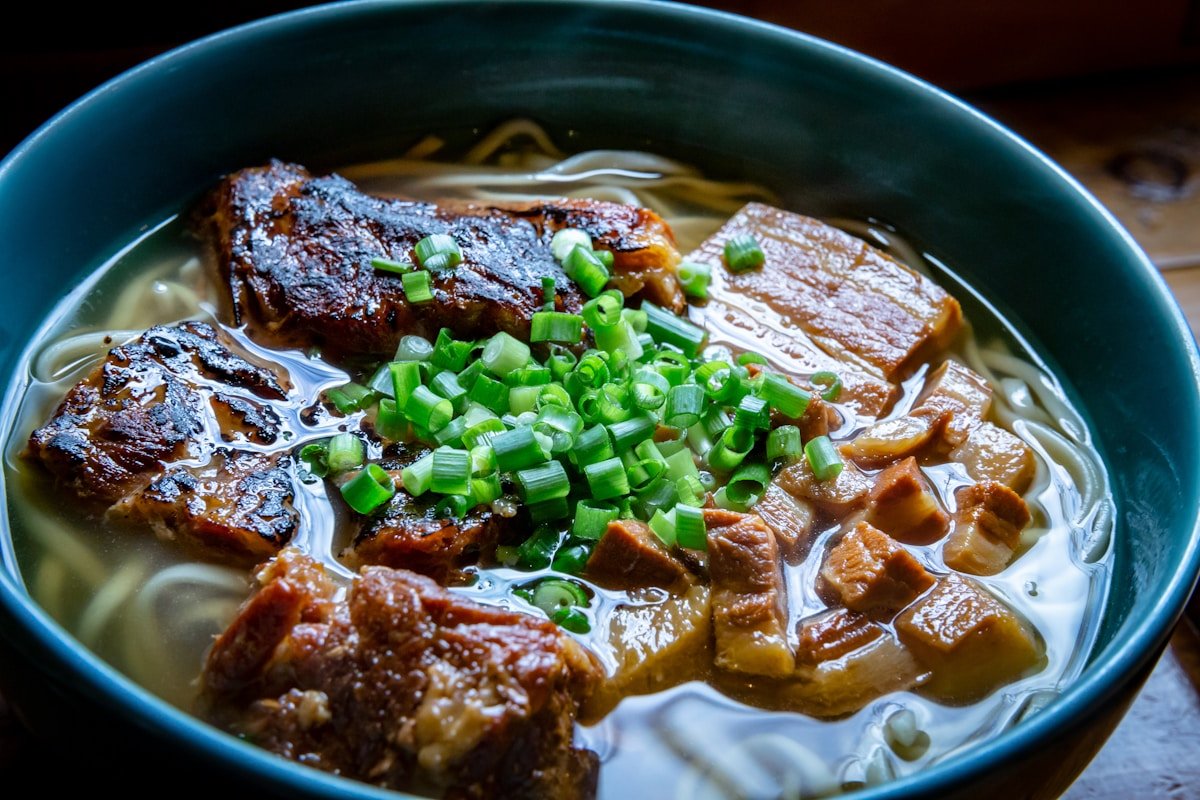
Nagasaki’s food culture is unlike anywhere else in Japan. For over 200 years during Japan’s period of national isolation (sakoku, 1641–1853), Nagasaki was the country’s only open port - Dutch and Chinese traders were permitted to reside and trade here while the rest of Japan was closed to foreign contact. This created a food culture that absorbed Portuguese, Chinese, and Dutch influences early and integrated them so thoroughly that they are now considered native Nagasaki traditions.
The result is a city where the local noodle soup was invented by a Chinese immigrant, the famous sponge cake came from Portuguese missionaries, and the formal banquet tradition is a hybrid of three cuisines. Nagasaki food is genuinely unusual in a country that already has extraordinary regional variety.
For more on exploring the city, see the Nagasaki travel guide.
Champon
The city’s signature dish and the most practical eating experience in Nagasaki. Champon is a thick, rich noodle soup: soft-textured noodles (similar to ramen noodles but more yielding) in a cloudy pork and chicken bone broth, loaded with stir-fried pork belly strips, prawns, squid, fish cake, cabbage, bean sprouts, and carrots.
The key to the best versions is the lard finish - a small spoon of lard added at the end that rounds out the broth without making it greasy. The soup arrives in a deep bowl, very hot, and stays warm throughout eating.
Ringer Hut (リンガーハット): A national champon chain founded in Nagasaki. The most accessible version and genuinely good - better than the chain category suggests. Large champon from approximately ¥730. Multiple locations in and around Nagasaki Station and throughout the city. The chain imports its vegetables from domestic farms and the champon is a reliable baseline for understanding the dish.
Shikairou (四海楼): The restaurant that claims to have invented champon in 1899, still operating near Glover Garden. The fourth-floor dining room has harbour views. Regular champon from approximately ¥1,200; the menu also covers a range of Nagasaki Chinese dishes. This is more of a pilgrimage restaurant than a casual lunch spot.
Chinatown (Shinchi area) champon restaurants: Nagasaki’s Chinatown is small (about 20 restaurants and shops) but the champon here is consistently excellent. Several restaurants serve both champon and sara udon from approximately ¥900–¥1,300.
Sara Udon
Champon’s related but distinct cousin - served dry on a plate (sara means plate) rather than in broth. The same stir-fried pork, seafood, and vegetable mixture is bound with a glossy starch-thickened sauce and served over noodles.
The most common version uses thin, deep-fried crispy noodles that soften as the sauce is absorbed - the texture contrast between the crispy noodles at the edges and the absorbed ones in the centre is distinctive. A second style uses thicker, softer noodles similar to the champon version.
Order sara udon with thin noodles (hosomen) for the canonical experience. Price approximately ¥900–¥1,200 at restaurants that serve both dishes.
Castella Cake (Kasutera)
Castella is a honey-sweetened sponge cake brought to Nagasaki by Portuguese missionaries in the 16th century and refined by local confectioners over four centuries. The Nagasaki version is denser and more honey-forward than castella sold in other parts of Japan, with a characteristic brown sugar base crust.
Fukusaya (福砂屋): Established in 1624, this is the oldest and most historically significant castella producer. Their shop in the Hamanomachi shopping arcade and a second location near Glover Garden both sell standard castella in boxes from approximately ¥1,200 (small) to ¥2,500 (standard). The texture - damp, dense, slightly sticky at the base - is the benchmark.
Bunmeido (文明堂): A second major brand founded in 1900, slightly lighter in texture than Fukusaya. Their main shop is near Nagasaki Station. Individual slices available for approximately ¥250.
Shoken (松翁軒): A third venerable producer (founded 1681) known for a slightly more honeyed, aromatic version. A smaller shop experience with less tourist traffic.
Shippoku Cuisine
Nagasaki’s formal banquet tradition - a unique fusion that developed when Dutch and Chinese traders were permitted to dine with Japanese merchants during the Edo-period isolation era. The format involves a low round table (shippoku-dai) set with simultaneous dishes rather than the sequential presentation of Japanese kaiseki.
A full shippoku meal includes:
- Soup (typically shark fin or sea bream)
- Roast suckling pig (buta no maruyaki) - the centrepiece, Portuguese-influenced
- Sashimi
- Nimono (simmered dishes)
- Tempura
- Castella-derived egg desserts (gyuhi and shippoku sweets)
Where to eat shippoku: Several restaurants in the Shimabara and Hollander Hill areas of Nagasaki specialise in shippoku. Advance reservation is required; the experience is most practical with 4 or more people sharing the communal table. Full course from approximately ¥8,000–¥15,000 per person as of 2026.
Portuguese and European Sweets
Nagasaki’s trading history produced a range of egg-and-sugar sweets derived from Portuguese and Dutch recipes:
Ovos moles-style egg sweets: Available at confectionery shops near Glover Garden - small yellow egg-yolk and sugar confections in various shapes. Approximately ¥200–¥400 per piece.
Kakuni-manju (角煮まんじゅう): Braised pork belly (kakuni) in a steamed Chinese bun - a hybrid of Nagasaki’s Chinese tradition and Japanese bun-making. Available from stalls and takeaway shops throughout the city for approximately ¥400–¥600. A highly practical snack while walking the historic districts.
See Nagasaki through its food: Food and cultural tours in Nagasaki often include market visits, tastings, and dishes you’d never find independently.
Budget Reference (as of 2026)
| Item | Venue | Cost |
|---|---|---|
| Champon | Ringer Hut | ¥730–¥850 |
| Champon | Shikairou or Chinatown | ¥1,200–¥1,300 |
| Sara udon | Chinatown restaurant | ¥900–¥1,200 |
| Castella (standard box) | Fukusaya | ¥1,200–¥2,500 |
| Castella slice | Bunmeido | ¥250 |
| Kakuni manju | Street stall | ¥400–¥600 |
| Shippoku banquet (per person) | Specialist restaurant | ¥8,000–¥15,000 |
Where to stay: Search hotels in Nagasaki on Booking.com
See also: Nagasaki travel guide · Best restaurants in Nagasaki · Things to do in Nagasaki · Kyushu region guide