Nagasaki compresses an extraordinary amount of history - prehistoric, medieval, colonial, industrial, and nuclear - into a compact, steeply hilled city that is genuinely one of Japan’s most distinctive places to explore on foot. A careful 2 to 3-day itinerary can cover the atomic bomb sites, the Dutch trading post, the Western hillside mansions, Chinatown, the mountain night view, and a harbour island tour without feeling rushed. Here are the 16 best things to do.
1. Atomic Bomb Museum
The Nagasaki Atomic Bomb Museum (¥200) is one of the most effectively curated historical museums in Japan. The exhibits begin with a recreation of the moment of detonation (11:02am, August 9, 1945), then move through a sequence of carefully chosen objects and documents - a wristwatch stopped at 11:02, charred Urakami Cathedral statues, children’s clothing found at the hypocenter, survivor testimonies, and a medical analysis of radiation effects.
The museum’s restraint is part of its power: it does not sensationalise or overwhelm, but presents the specific, particular reality of what happened to individual people and objects in this city. Allow at least 90 minutes. The museum connects to the broader Peace Park and the International Memorial Hall for the Atomic Bomb Victims (free, underground architectural space also worth visiting).
Opening hours: 8:30am–5:30pm (until 6:30pm in August). Closed December 29–31.
2. Peace Park Monuments
The Nagasaki Peace Park (free) is a broad terraced public space running north from the museum to the large Peace Statue. The park contains a notable collection of peace sculptures donated by countries from around the world - the Czech Republic, China, the Soviet Union (donated pre-1991), and others - each in the representative style of the donating nation. The donations create an inadvertent survey of international monumental sculpture across different political traditions.
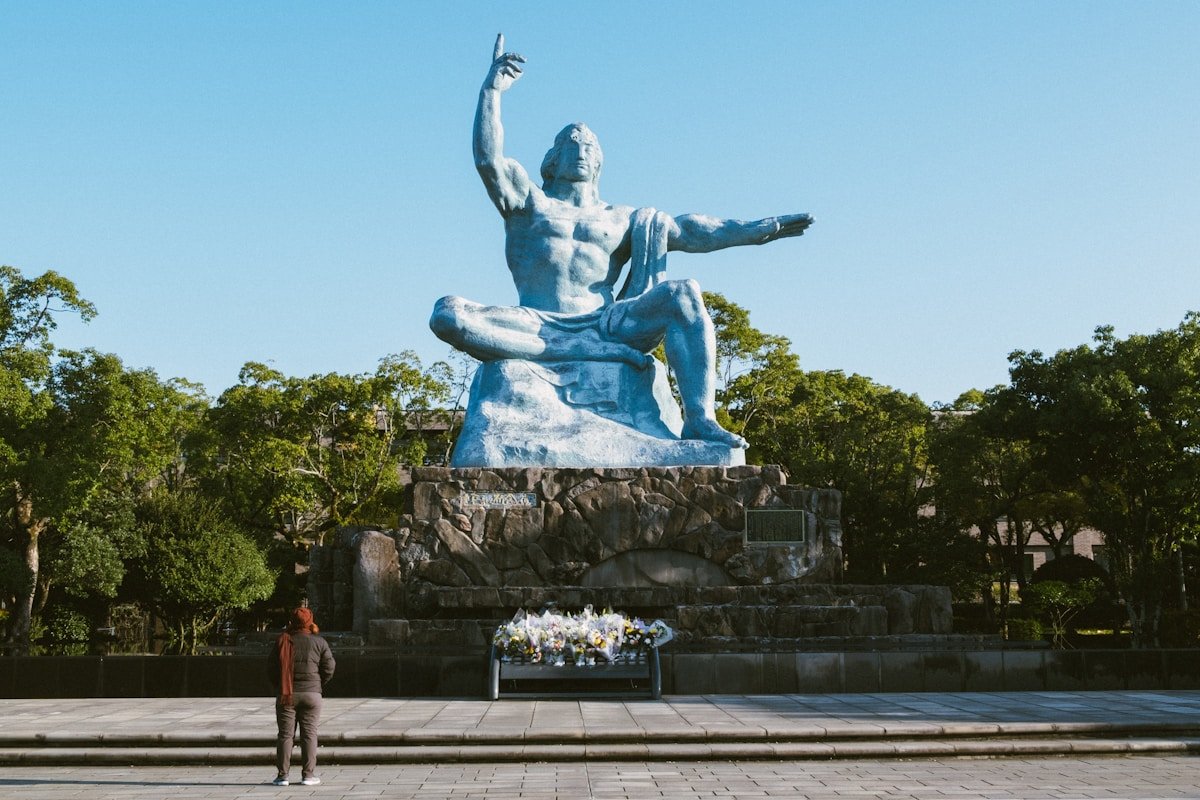
The Peace Statue (9.7 metres, bronze, 1955) has one arm pointing skyward to warn against nuclear weapons and one pointing horizontally to represent peace - an image designed to be understood intuitively without language. The fountains in the park flow continuously to the memory of victims who cried for water as they died.
3. Urakami Cathedral
The rebuilt Cathedral of the Immaculate Conception (1959) stands near the hypocenter in Urakami, a residential district on the hill above central Nagasaki. Entry to the interior is free (appropriate dress required; no shorts). The building’s twin towers are the most recognisable silhouette in Urakami. Original stones from the bombed 1925 cathedral are incorporated into the exterior fabric as a deliberate memorial device.
The Urakami community’s story - 250 years of underground Christian practice during persecution, the 3,000 to 4,000 Catholics killed when the bomb fell on their district - is told in the museum at the nearby Urakami Catholic Centre. A walking circuit combining the cathedral, the hypocenter park, and the museum takes approximately 2 hours.
4. Glover Garden Victorian Mansions
The Glover Garden (¥620) on a terraced hillside above the harbour contains several Western merchants’ residences from the 1860s to 1910s - the oldest surviving Western-style residential buildings in Japan. The garden is connected by outdoor escalators rising through successive terraces with harbour views expanding at each level.
Thomas Glover’s mansion (1863) is the largest and most architecturally accomplished of the preserved houses: a veranda-fronted structure with elegant proportions and documented connections to the early history of Mitsubishi, Japan’s railways, and Kirin Beer. The upper terrace provides one of the best panoramic views of Nagasaki harbour.
Opening hours: 8:00am–6:00pm (later hours July–October and late October illumination).
5. Dejima Dutch Trading Post
The reconstructed Dejima trading post (¥520) is the most substantial historical reconstruction in Nagasaki and covers Japan’s only Western trade contact point during two centuries of isolation. The fan-shaped island - originally surrounded by water, now surrounded by land - has been recreated with merchant warehouses, residential quarters, a captain’s house, and a small Dutch garden.
The exhibits are well-researched and genuinely interesting: the mechanics of the trading system, the smuggling networks, the Japanese interpreters who developed into Japan’s first Western-language scholars, and the remarkable exchange of scientific knowledge (anatomy, botany, astronomy, cartography) that passed through this single small island. Allow 60 to 90 minutes.
6. Hashima Island Boat Tour
The Hashima (Gunkanjima/Battleship Island) tour (¥4,500–¥5,500, approximately 3 hours total, 15 minutes on island) is the most dramatic day activity available in Nagasaki. The boat journey from Nagasaki Port (25 minutes each way) passes through the harbour past active shipyards, then approaches the island from the sea with its ruined apartment blocks and concrete seawall rising from the water.
Landing is guided and restricted to a safe circuit path along the island’s western edge, covering the sea wall, a plaza area with collapsed apartment block facades visible, and views of the main residential block’s advanced decay. Photography is excellent. Tours are cancelled if sea conditions prevent safe docking - there is a meaningful cancellation rate in winter. Book with Gunkanjima Concierge or Yamasa Kaiun (¥4,500 and ¥5,500 respectively). Major operators depart from terminal 5 at Nagasaki Port.
7. Nagasaki Chinatown and Champon Noodles
Shinchi Chinatown, marked by four ornate Chinese-style gates, is Japan’s oldest Chinatown and the origin point of champon noodles. The dish - thick white noodles in pork-and-chicken broth with stir-fried seafood and vegetables - was created by Chinese restaurant owner Chen Ping-shun at the Shikairou restaurant in 1899 as a filling, inexpensive meal for Chinese students. The original Shikairou restaurant still operates (champon ¥1,400, open 11:30am–3pm and 5pm–9pm).
Sara udon (¥1,000) - the same stir-fry ingredients served over crispy deep-fried noodles rather than in broth - is the drier variant. Kasutera (Portuguese-derived sponge cake, ¥1,000–¥3,000 per box) is sold at shops throughout the Chinatown vicinity and is Nagasaki’s primary food souvenir.
8. Sofukuji Chinese Temple
Sofukuji (¥200) is the most architecturally impressive Chinese-style temple in Japan. The main gate (Sanmon, 1693) and secondary gate (Daiippomon, 1695) are both National Treasures, with the vivid vermilion-orange paint typical of Fuken-style Chinese Buddhist architecture creating a stark visual difference from the more austere Japanese temple tradition. The Dragon’s Bell (1647) in the bell tower is the third-oldest bell in Japan.
The temple was founded by the Chinese immigrant community in 1629 and served as a religious and cultural centre for Nagasaki’s large Chinese population throughout the sakoku period. Allow 30 minutes for a thorough visit.
9. Mt Inasa Night View
The Mt Inasa ropeway (¥1,250 return, summit at 333 metres) provides what the local tourism board promotes as one of the world’s three greatest night views, alongside Monaco and Hong Kong. The claim is promotional rather than formally designated, but the view - Nagasaki harbour and the city spread across multiple hillsides, the bay reflecting lights from the port - is undeniably beautiful.
The ropeway operates until 10:00pm. Arriving 30 minutes before local sunset gives the transition from daylight to full night illumination, which is the most rewarding approach. The summit observation deck can be crowded in summer; the side viewing areas away from the central terrace give better photography angles.
10. Spectacles Bridge
The Meganebashi (Spectacles Bridge), built in 1634 by Zen monk Mokusunyojo, is Japan’s oldest surviving stone arch bridge. The double-arch design creates a mirror reflection in the river water that resembles a pair of eyeglasses - the source of the name. The bridge is free to view and cross; the best photography is from the riverbank level, facing east in morning light when the reflection is clearest.
The surrounding Nakashima River district has four other historic stone bridges within 200 metres, making a 20-minute bridge-hopping walk worthwhile.
11. Old Foreign Settlement District
The Minami-Yamate and Higashi-Yamate residential districts above Motomachi preserve Victorian-era Western residences built by the British, American, Dutch, and other foreign merchant communities during the Meiji period. The streets are steep and narrow - more a walking experience than a museum visit. The Yamate Western-style residential area (free) includes the No. 15 Western Residence museum (¥100) and several buildings with original furnishings.
The district connects naturally with the Glover Garden (at the lower end) and the Oura Cathedral (at the top of the district) in a hillside walking circuit.
12. Nagasaki Lantern Festival
The Nagasaki Lantern Festival (Lantan Matsuri) coincides with Chinese New Year - 15 days in late January to February (exact dates vary with the lunar calendar). Approximately 15,000 red lanterns are suspended throughout Chinatown and the surrounding streets, supplemented by large-scale dragon and tiger lantern installations, traditional Chinese performing arts, and acrobatic demonstrations. Entry to all street events is free. The evenings of the main weekend periods are the most atmospheric; daytime is considerably quieter.
13. Champon Noodle Cooking Class
Several Nagasaki cooking schools and guesthouses offer champon cooking classes - typically 2 to 2.5 hours, ¥4,000 per person, including ingredients and a sit-down meal of the finished dish. Classes cover broth preparation (mixing chicken and pork stock), the stir-fry technique for the seafood and vegetable topping, and noodle timing. A good option for a rainy afternoon. Book through Nagasaki city tourism website or guesthouse concierge.
14. Confucius Shrine
The Confucius Shrine (Koshi-byo, ¥660) in the Oura district was built in 1893 by the Chinese community to honour the philosopher Confucius. The yellow-glazed roof tiles and traditional Chinese architectural style distinguish it from the city’s other religious buildings. The attached National Museum of Chinese History (included in entry) exhibits artefacts on loan from the Beijing Palace Museum - a significant collection for a small provincial museum.
15. Oura Cathedral
The Oura Cathedral (Oura Tenshu-do), built between 1864 and 1875 by French missionary Bernard Petitjean, is the only National Treasure designated among the Gothic churches of Japan. The building is the oldest surviving Western Gothic-style church in Japan, dedicated to the 26 martyrs of Japan executed in Nagasaki in 1597 - the first Christian martyrs in Japan. The exterior is free to view at any time; interior admission for prayer or formal visiting periods varies.
Book ahead for popular experiences: Tours and activities in Nagasaki include guided options, skip-the-line tickets, and immersive cultural experiences.
16. Shimabara Castle Day Trip
Shimabara, 1.5 hours from Nagasaki by bus and ferry or 2 hours by JR, has a well-preserved castle (¥650, 1625, five-storey keep) surrounded by a moat where large koi and carp swim in the clear spring water visible from the bridge. The samurai residence district (buke yashiki) - three original samurai houses open to the public (free) with spring water channels running past the garden gates - is one of the best-preserved samurai neighbourhood examples in Kyushu. A half-day from Nagasaki is sufficient; the castle and samurai district cover the main sights.
Where to stay: Search hotels in Nagasaki on Booking.com
See also: Nagasaki travel guide · Where to stay in Nagasaki · Best restaurants in Nagasaki · Day trips from Nagasaki · Hiroshima vs Nagasaki · Kyushu region guide