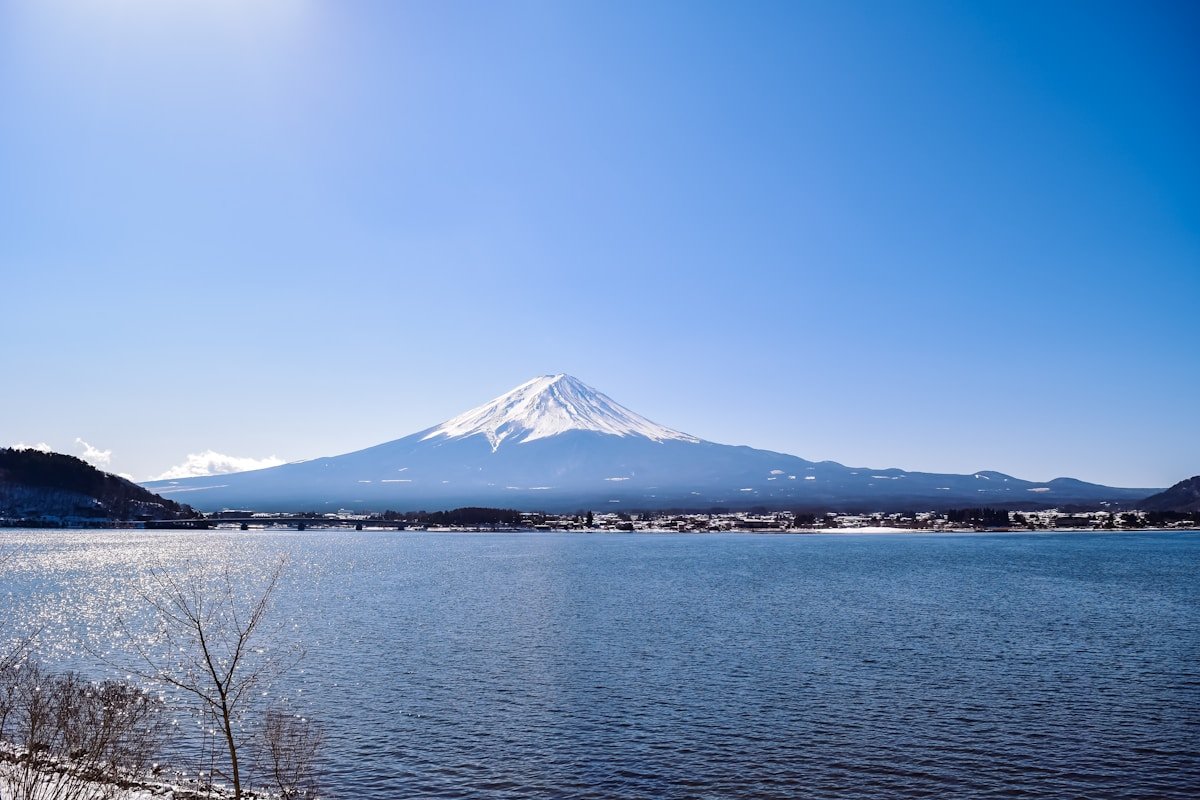
Kawaguchiko’s appeal is elemental: a 20 km lake at 833 metres elevation with Mount Fuji rising directly to the south. On clear mornings - most reliably in winter - the mountain’s perfect cone reflects in the still water. That image drives a lot of the tourist traffic, but there’s enough here for a full two days: hiking trails, onsen ryokan, hot spring villages, pagodas, and day trips to four more lakes within easy reach.
1. Lakefront Dawn Walk - North Shore
Cost: Free | Best time: Sunrise, any clear morning | Duration: 30–90 minutes
The north shore of Lake Kawaguchiko is the single best place to be at dawn in the Fuji Five Lakes area. The lake faces directly south and the mountain is due north of the lake’s centre, giving an unobstructed mirror reflection when the water is flat - typically before 8am on calm mornings.
The Ubuyagasaki peninsula is the closest point to the mountain and the most popular dawn photography spot. Walk west from Kawaguchiko Station along the lakefront road (about 15 minutes) to reach it. No entry fee, no opening time.
The Kawaguchiko Music Forest grounds (Kawaguchiko Ongakuno Mori, ¥1,500 entry as of 2026) provide a manicured foreground with rose gardens for a more composed shot, but the free lakefront path gives essentially the same mountain angle.
Winter mornings (November–February) are the most reliable for both a clear mountain and flat water. November and December bring peak clarity. April offers cherry blossoms but spring haze makes the mountain less sharp.
2. Chureito Pagoda
Cost: Free | Journey: Fujikyu Railway from Kawaguchiko to Shimo-Yoshida Station, ¥250 one way; 20-minute uphill walk + 398 steps | Best time: April (cherry blossoms) or any clear morning
Chureito is the most reproduced Japan photograph: a five-storey red pagoda set against Mt Fuji, with cherry trees in bloom below the pagoda in April. It’s part of the Arakurayama Sengen Shrine complex, reached via a long stone staircase from Shimo-Yoshida Station.
The climb is 20 minutes at a steady pace. The pagoda is at the first landing; the main shrine is 50 steps further above. Entry to the shrine precincts is free at all hours.
Outside cherry blossom season, the pagoda is far less crowded - winter mornings with snow on the stairs and a sharp Fuji summit are arguably more impressive than April. The mountain is statistically clearer in winter, and a mid-week February morning at Chureito is a completely different experience from the April weekend crowds.
Timing note: The cherry trees along the staircase typically bloom in early to mid-April, about one week after the Tokyo bloom. Exact dates vary by year - check NHK sakura forecasts in late March for the current year’s prediction.
3. Kachi-Kachi Ropeway (Tenjo Ropeway)
Cost: ¥900 return | Hours: 9am–5:30pm (to 6pm summer) | Duration: 3 minutes each way
The Kachi-Kachi Ropeway - named after a traditional folk story set on Mount Tenjo - runs from the north shore up to 1,075 metres in just under 3 minutes. From the summit observation deck, you’re looking down at Lake Kawaguchiko and across to Mount Fuji in a way that ground-level shots can’t replicate.
The summit café serves soft serve ice cream and drinks. The Tanuki (raccoon dog) Shrine at the summit is from the folk story involving a rabbit and a raccoon dog - the small shrine and statue make for an unusual foreground detail in photographs.
Clear-sky days only - if the mountain is in cloud at lake level, it won’t be visible from the ropeway summit either.
4. Oshino Hakkai
Cost: ¥500 main village area | Journey: Bus from Kawaguchiko Station, 20 minutes, approximately ¥480 each way | Duration: 45–60 minutes
Oshino Hakkai is a cluster of eight spring-fed ponds 10 km east of Kawaguchiko town, fed by Mount Fuji snowmelt that has filtered through the mountain’s volcanic rock over 80 years before emerging here at a constant 14°C. The water is crystal-clear turquoise and the ponds contain mirror carp.
The main Wakuike pond (designated a National Natural Treasure) is the centrepiece - the bottom is perfectly visible through the clear water. The surrounding thatched-roof village has souvenir stalls, wasabi products, and Mt Fuji-shaped mochi.
Without a car, reach Oshino Hakkai by the Fujikyu-Yamanashi Bus (Line 31) from Kawaguchiko Station. Buses run approximately every 30–60 minutes.
5. Kawaguchiko Lake Cruise
Cost: Approximately ¥1,000 for a 20-minute cruise | Hours: 9am–5pm (reduced in winter) | Location: Near Kawaguchiko Music Forest pier
The retro-style swan boats and covered sightseeing vessels operated from the north shore provide a different angle on Mt Fuji from water level. Winds frequently pick up by afternoon - morning cruises get flatter water and a clearer mountain.
The swan boats (pedal-powered, 2-person) cost approximately ¥700 for 20 minutes and can be rented independently.
6. Kawaguchiko Herb Festival (Lavender Season)
Cost: Free (festival grounds) | Dates: Late June–early July | Location: Oishi Park, north shore
The north shore Oishi Park hosts a lavender field that blooms in late June and early July, with Mt Fuji as the backdrop. This is one of the most accessible lavender-and-Fuji photography combinations in Japan, and the festival coincides with hydrangea season on the hillside trails above the park.
Outside festival season, Oishi Park is free and offers one of the best open lakefront views of the mountain year-round.
7. Mount Fuji Fifth Station (Yoshida Trail)
Cost: Bus from Kawaguchiko Station to 5th Station, approximately ¥1,800 each way (as of 2026) | Climbing season: Early July to mid-September
The Yoshida Trail is the most popular of Mt Fuji’s four climbing routes, and the 5th Station at 2,305 metres is accessible by bus from Kawaguchiko in about 50 minutes. Outside the climbing season (July–September), the trails above the 5th Station are closed and snow-covered, but the bus still runs and the station area itself - with its visitor centre, shrine, and mountain views - is worth the trip.
The 2026 climbing season opens 1 July with mandatory pre-registration required. See the official Fuji-san Net registration portal for current requirements.
8. Saiko Bat Cave (Fugaku Wind Cave and Narusawa Ice Cave)
Cost: ¥350 per cave, combination ticket approximately ¥500 | Journey: Retro Bus from Kawaguchiko, approximately 30 minutes
The Aokigahara lava forest on the north flank of Mt Fuji contains two lava tube caves accessible from the highway: Fugaku Wind Cave (64 metres long, constant 3°C interior) and Narusawa Ice Cave (153 metres, ice formations year-round). Both formed from lava flows and remain cold enough for ice to persist even in summer.
A combination ticket covers both caves. The surrounding Aokigahara forest is also accessible via signed trails - the lava-field tree roots and dense undergrowth create an unusually atmospheric forest walk.
9. Cycling the Lake Circuit
Cost: Rental from approximately ¥1,000–¥1,500 for 3 hours | Distance: 20 km full circuit
Multiple rental shops near Kawaguchiko Station offer standard road bikes and e-bikes. The full lake circuit is flat and takes 90 minutes to 2 hours at a comfortable pace. The best cycling stretch is the north shore from the station west to the Music Forest, where Mt Fuji is directly ahead and the lake is on the right.
The south shore road is narrower and more road-facing, with fewer lake views, but quieter traffic.
Book ahead for popular experiences: Tours and activities in Kawaguchiko include guided options, skip-the-line tickets, and immersive cultural experiences.
10. Day Trip to Yamanakako
Journey: Fujikyu bus from Kawaguchiko, approximately 40 minutes, ¥820 each way | Cost: Free to visit the lakefront
Yamanakako - the largest of the Five Lakes - is less developed than Kawaguchiko and quieter. The south shore gives good views of the Mt Fuji summit and its western ridgeline, a different angle from Kawaguchiko’s north-shore reflection view.
Swan boat and kayak rentals are available at the Yamanakako Leisure Centre. The Panorama Platform viewpoint (accessible by road, free) gives an elevated view across the lake to the summit.
For where to stay near the lake, see our Kawaguchiko accommodation guide. For where to eat, see best restaurants in Kawaguchiko.
Where to stay: Search hotels in Kawaguchiko on Booking.com
See also: Kawaguchiko travel guide · Day trips from Kawaguchiko · Food guide for Kawaguchiko · Hakone vs Nikko · Kanto region guide