Kawaguchiko is compact enough to cover its own lakefront attractions in a day, which makes it a natural base for day trips into the surrounding region. Chureito Pagoda and Oshino Hakkai are within 30 minutes by public transport. The other Fuji Five Lakes take 30–60 minutes by bus. Mount Fuji’s climbing trail is reachable in 50 minutes by bus, and Hakone - Japan’s most famous onsen resort - is 90 minutes away. Here is how to approach each.
Chureito Pagoda
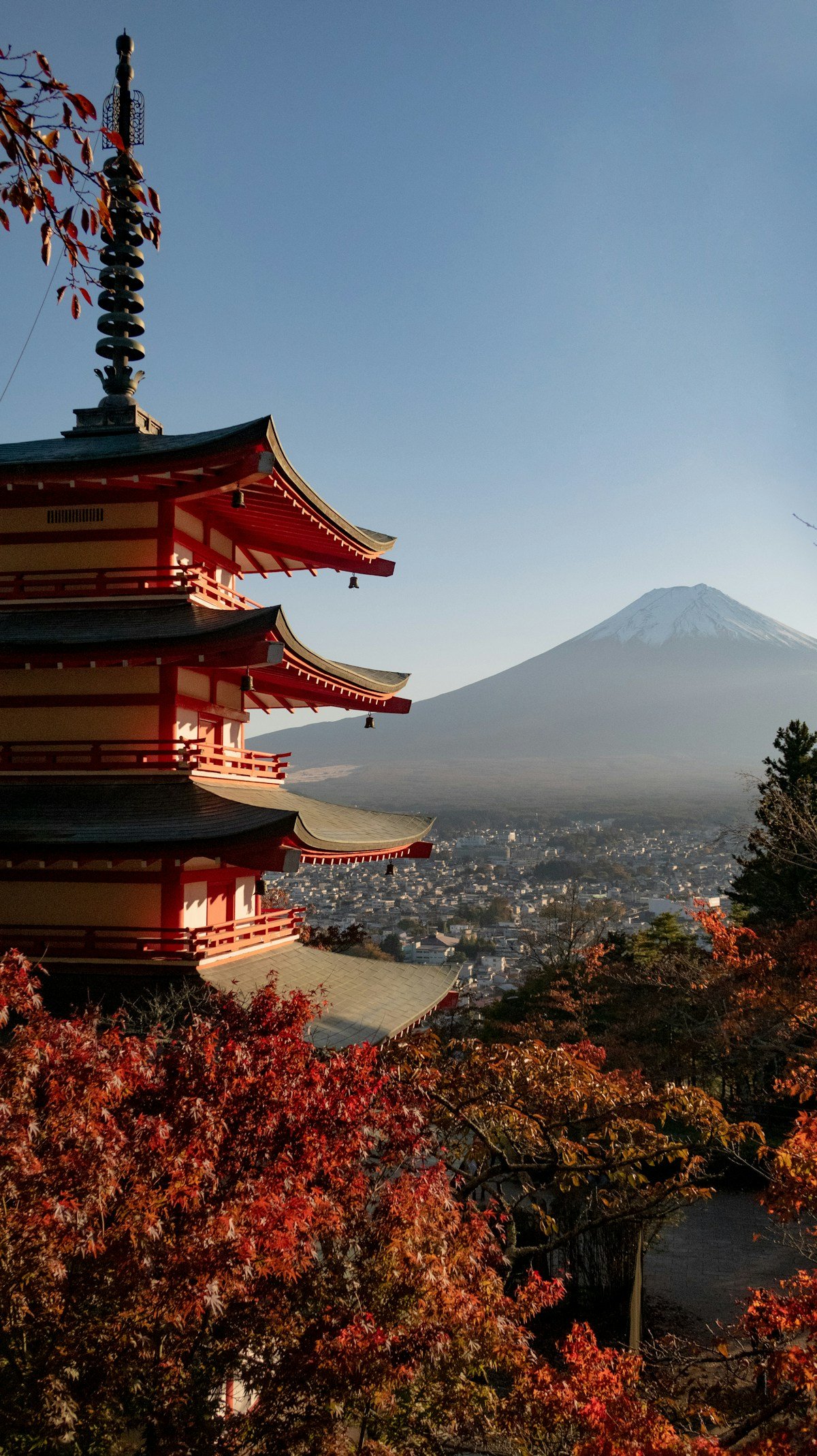
Chureito is the most reproduced image in the Fuji area - a five-storey vermilion pagoda with Mount Fuji rising directly behind it. It is formally part of the Arakurayama Sengen Shrine complex on a hillside above Fujiyoshida city.
Getting there: Fujikyu Railway from Kawaguchiko Station east to Shimo-Yoshida Station (approximately 10 minutes, ¥250 as of 2026). From the station, walk 20 minutes to the shrine gate and climb 398 stone steps to the pagoda level. Total journey from Kawaguchiko: about 40 minutes.
What to see: The pagoda was built in 1963 as a peace memorial and sits against a hillside that provides a direct line of sight to Fuji’s summit. The quality of the view depends entirely on Mount Fuji’s visibility - on clear days the mountain fills the frame behind the pagoda; on cloudy days the summit disappears. Early mornings in winter (November–March) offer the highest probability of a clear mountain.
The cherry blossom season (late March to mid-April) is the peak photography period - the pagoda, cherry trees, and mountain align for the image that dominates Japanese tourism photographs. Visitor numbers are extreme during cherry season; arrive by 7am or expect a crowded climb.
Shrine entry is free. The climb is on your own schedule - the steps are steep but the path is clear and takes 15–20 minutes at a moderate pace.
Allow: 2 hours from Kawaguchiko, including travel, the climb, and time at the pagoda level.
Oshino Hakkai
Oshino Hakkai is a cluster of eight spring-fed ponds about 10 kilometres east of Kawaguchiko, fed by snowmelt that filters through Mount Fuji’s volcanic rock over approximately 80 years before emerging at 14°C. The water is exceptionally clear - the ponds are shallow enough to see the bottom in detail, and they are home to large mirror carp.
Getting there: Fuji Five Lakes bus from Kawaguchiko Station to Oshino Hakkai, approximately 20 minutes, ¥480 one way as of 2026. Buses run roughly every 30–60 minutes.
Entry: ¥500 for the main Hakkai area (the central village with all eight ponds). The surrounding roads are accessible without paying.
What to see: The ponds are arranged within a historic village, surrounded by thatched-roof structures and souvenir stalls. The largest pond, Waku-ike, produces 2 tonnes of water per second and is the clearest. Mounted Fuji views from Oshino are different from the lakefront views - you see the mountain from lower elevation with less interference from the lake reflections that define Kawaguchiko shots.
Best time: Early morning on weekdays. Coach groups from Tokyo arrive from 10am and the ponds become crowded quickly. Before 9am the village has a calm, pre-tourist atmosphere.
Allow: 2 hours, including travel. Oshino works well combined with a Chureito Pagoda morning - take the Kawaguchiko bus east, stop at Oshino, then continue to Fujiyoshida for the pagoda before returning.
Mount Fuji Fifth Station
The Fuji Subaru Line - a toll road on the north slope of Mount Fuji - leads to the Yoshida Fifth Station at 2,305 metres, the standard starting point for the Yoshida Trail summit climb. The fifth station has an observation area, restaurants, souvenir shops, and the start of the paved upper trails.
Getting there: Fuji Subaru Line buses from Kawaguchiko Station, approximately 50 minutes, ¥1,800 each way as of 2026. Buses run approximately every 30 minutes during the open season (mid-April to mid-November). The road itself is closed to private vehicles when buses run (mid-July to mid-September) - bus is the only access during the climbing season.
What to do: Even if you are not climbing, the fifth station is worth visiting for the atmosphere and the views below the cloud layer. The air at 2,305 metres is noticeably cool and thin even in summer. The visitor area at the fifth station includes a shrine (Komitake Shrine), a cafe, and access to the initial paved walking trail above the station (free, open to all).
Summit climbing: The Yoshida Trail to the summit (3,776 metres) involves 2,305 metres of climbing and takes 5–7 hours up, 3–4 hours down. The official climbing season is early July to mid-September only - outside this window, the trails above the fifth station are closed and snow-covered. Climbing gear, appropriate footwear, and layering are essential; the temperature at the summit is approximately 6°C in August. Mountain huts on the upper trails (¥7,000–¥9,000 per person including dinner and breakfast as of 2026) provide the only overnight option.
The Other Fuji Five Lakes
Yamanakako - the largest of the five lakes, approximately 30 minutes east of Kawaguchiko by bus. Less developed for tourism but popular for cycling (flat lakefront path, bike rental from ¥500/hour) and for different Fuji angles from the south shore.
Saiko - 20 minutes west of Kawaguchiko by bus. Quieter and less visited. The Saiko Bat Cave (Komori-ana, ¥280 entry, open 9am–5pm) is a lava tunnel accessible by short trail - a natural volcanic formation carved by ancient lava flows. The western shore has some of the least-photographed Fuji views in the region.
Shojiko - the smallest lake, 40 minutes west. Known for a serene forested atmosphere and the Shoji-guchi lava forest trail. Very limited accommodation; popular with campers.
Motosuko - the deepest lake (138 metres), 50 minutes west. The image on the old ¥1,000 banknote was taken from the north shore of Motosuko on a winter morning. Hardest to reach by public transport but rewarding for the wide, unobstructed mountain panorama across the lake surface.
The Fuji Five Lakes Retro Bus (two-day pass ¥1,570 as of 2026) covers Kawaguchiko, Saiko, and Shojiko but does not serve Motosuko or Yamanakako reliably. A rental car is the most flexible option for covering all five in a single day (from approximately ¥6,000/day from Kawaguchiko Station).
Make the most of your time around Kawaguchiko: Guided day trips from Kawaguchiko handle the logistics - transport, guide, and timing - so you can focus on the experience. For airport arrivals and departures, Kiwitaxi offers fixed-price airport transfers with no meter surprises.
Hakone
Hakone is Japan’s most famous onsen resort district, built around the Hakone caldera in Kanagawa Prefecture. It has an entirely different character from Kawaguchiko - volcanic landscape, ropeway over sulphur vents, open-air sculpture park, lakeside onsen ryokan, and views of Fuji from the southern side across Lake Ashi.
Getting there from Kawaguchiko: The most direct route is the Fujikyu highway bus to Hakone-Yumoto, approximately 85 minutes, ¥2,050 one way as of 2026 (check current Fujikyu schedules, as service frequency varies by season). An alternative route goes from Kawaguchiko via Mishima by train, adding time but more reliable service.
What to see: The Hakone Ropeway (¥1,500 for the Sounzan to Togendai section as of 2026) crosses the active volcanic zone of Owakudani, where you can see steam vents and buy kuro-tamago (black eggs hard-boiled in the sulphur hot springs, ¥500 for five). Hakone Open Air Museum (¥1,800) has outdoor sculpture across a large hillside with Fuji views on clear days. Lake Ashi boat cruises (¥1,200) provide different Fuji perspectives from the south.
Hakone is better suited as an overnight destination than a day trip, but a full day is feasible if you leave Kawaguchiko early.
See the Kawaguchiko travel guide for lake activities, ryokan options, and transport around the Fuji Five Lakes, and food to try in Kawaguchiko for hoto noodles and local Fuji area specialties.
Where to stay: Search hotels in Kawaguchiko on Booking.com
See also: Things to do in Kawaguchiko · Where to stay in Kawaguchiko · Best restaurants in Kawaguchiko · Mount Fuji climb guide · Hakone travel guide · Kanto region guide