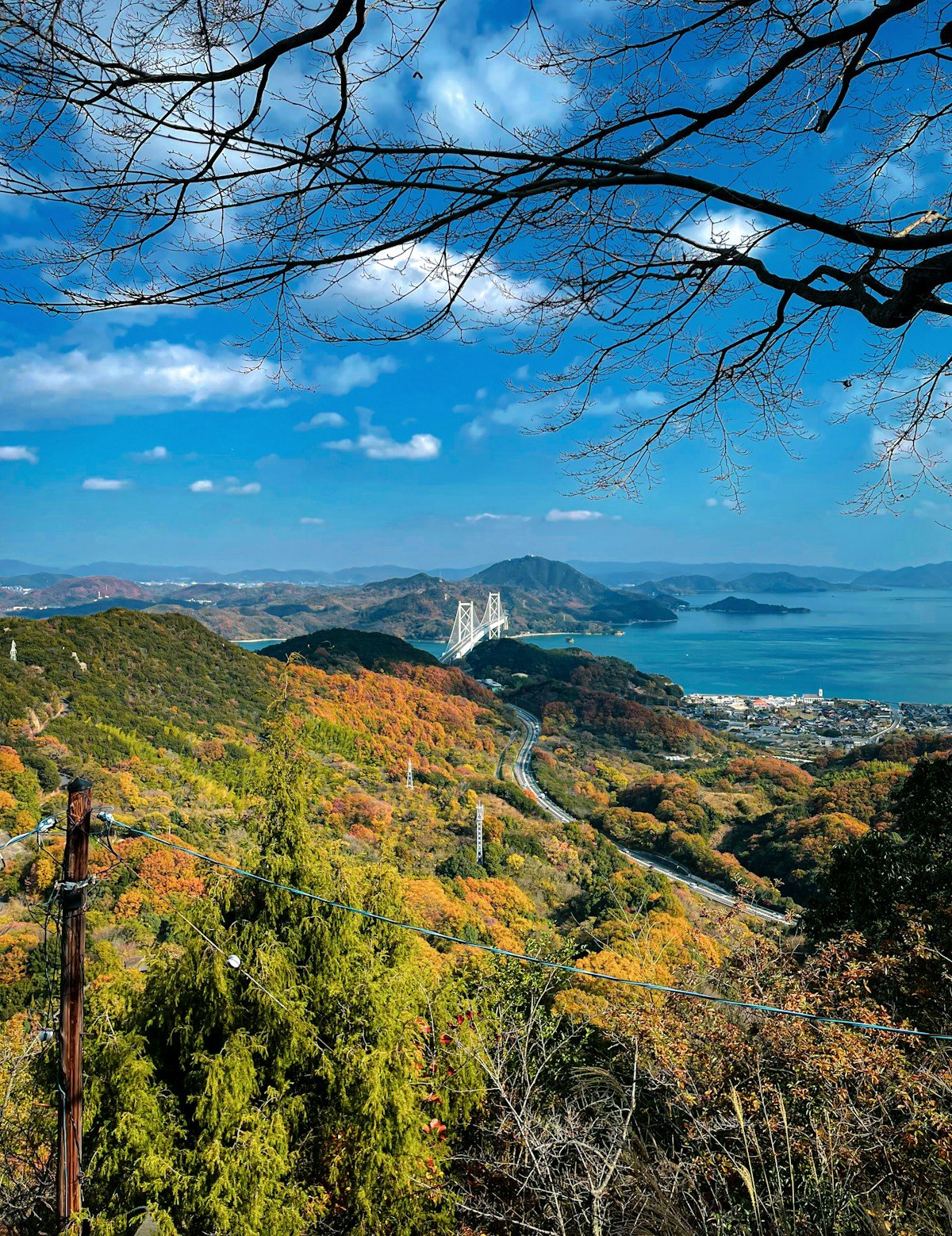
Matsuyama’s position on the north coast of Shikoku makes it a natural base for day trips in several directions. The Shimanami Kaido cycle route connects Shikoku to Honshu via a series of island-hopping bridges. The castle towns of Ozu and Uchiko sit inland to the southwest. And Ishizuchi-san, the highest peak in western Japan, rises an hour to the east. All are reachable from Matsuyama city centre in under two hours.
Shimanami Kaido (Cycling Route)
The Shimanami Kaido is a 70-kilometre cycling and walking route connecting Imabari (Ehime) on Shikoku with Onomichi (Hiroshima) on Honshu, crossing six suspension bridges across the islands of the Seto Inland Sea. It is consistently ranked among Japan’s most scenic cycling routes.
From Matsuyama for a day trip: Take the JR Yosan Line from Matsuyama to Imabari (30 minutes, ¥880). At Imabari Station, bicycle rental is available from approximately ¥1,000–¥2,000 per day (standard bikes) or ¥2,000–¥4,000 (electric assist). The first bridge from Imabari, the Kurushima Kaikyo Bridge, is a sequence of three suspension bridges crossing an island group with strong tidal currents - one of the most dramatic segments of the route.
A half-day from Imabari covers the first 25–35 kilometres to Omishima Island and back - enough to experience three bridges, sea views, and the citrus-terraced hillsides of the islands. Omishima has a waterfront lunch option (local fish or seafood donburi from approximately ¥1,200–¥1,800) before returning.
Cycling guides and toll information are available at the Imabari rental stations. Bridge tolls for cyclists are minimal (¥50–¥200 per bridge). The route is clearly signed and suitable for casual cyclists on a fine day.
Ozu - Castle Town on the Hiji River
Ozu is a castle town 40 kilometres south of Matsuyama, built along a bend in the Hiji River. It is one of the better-preserved small castle towns in western Japan: a compact historic district of merchant townhouses, several traditional machiya (townhouse) buildings, and a reconstructed hilltop castle.
Getting there: JR Yosan Line from Matsuyama to Iyo-Ozu (40 minutes, approximately ¥880).
Ozu Castle: Rebuilt in 2004 using traditional construction techniques (hand-cut timber, no nails in the main structure), the castle is a precise reconstruction of the original 17th-century keep destroyed in 1888. The reconstruction quality is exceptional - the building looks and feels like a genuine historic structure rather than a concrete replica. Admission approximately ¥550. Open 9am–5pm.
Garyu Sanso: A riverside villa built in 1907 by Torajiro Kouchi, a local merchant who spent 10 years and a considerable fortune constructing a private retreat on the Hiji River bank. The building uses traditional carpentry techniques of exceptional refinement - no square corners, subtle curves in every beam and pillar, a garden designed to frame views of the river and the castle hill. Admission approximately ¥550. One of the most skillfully constructed private buildings of the Meiji era in western Japan.
Cormorant fishing (ukai): In summer evenings (June to September), trained cormorants on leashes dive for sweetfish (ayu) on the Hiji River while visitors watch from flat-bottomed boats. The tradition is managed by Ozu City and requires advance booking. Evening cruises approximately ¥3,000–¥4,500 per person.
Uchiko - Preserved Merchant Town
Uchiko, 25 kilometres southeast of Matsuyama, is a small town that grew wealthy in the 19th century from wax production - a now-obscure industry that produced Japan’s candles, hair pomade, and wood polish. The wax merchants built substantial machiya townhouses along a 600-metre street called Yokaichi, and these have been preserved in their original condition.
Getting there: JR Uchiko Line from Matsuyama (35 minutes, approximately ¥660).
The Yokaichi historic street is free to walk. Several buildings are open to visitors: the Kamihaga Residence (¥500) shows the interior of a wealthy wax-merchant household, including the wax production workshop in the back. The Uchiko-za kabuki theatre (¥400) is a restored 1916 wooden theatre with the original hemp curtain and mechanical stage mechanisms still functional.
Uchiko is smaller and less visited than Ozu. It suits visitors interested in Meiji-era craft industry history and the texture of a genuinely working historic town rather than a museum.
Ishizuchi-san - Highest Peak in Western Japan
Ishizuchi-san (1,982 metres) is the highest mountain in western Japan and a significant Shinto pilgrimage site. The summit is marked by a small shrine; the final section involves climbing steep chains bolted to the rock face (the traditional pilgrimage ascent). A parallel trail on wooden steps bypasses the chains.
Getting there: JR Yosan Line from Matsuyama to Iyo-Saijo (35 minutes, ¥820), then Tozan Railway (private railway, 40 minutes, ¥730) to Tsuchigoya, then ropeway (¥1,000 return) to the trailhead at 1,300 metres. Total travel time from Matsuyama approximately 2 hours each way.
From the ropeway station, the summit trail takes 2–3 hours each way through mountain forest, rock outcrops, and - in the final section - chains and steep ladders. The summit gives 360-degree views of Ehime, the Seto Inland Sea, and on clear days, central Shikoku’s mountain ranges. Allow a full day and check weather carefully - Ishizuchi is subject to rapid changes.
Best conditions: May–June (clear weather before summer humidity), October–November (autumn foliage on the lower slopes). The mountain is covered in snow December–April; crampons and ice axes required above the ropeway in winter.
Make the most of your time around Matsuyama: Guided day trips from Matsuyama handle the logistics - transport, guide, and timing - so you can focus on the experience. For airport arrivals and departures, Kiwitaxi offers fixed-price airport transfers with no meter surprises.
Hiroshima Day Trip
By ferry, Matsuyama connects directly to Hiroshima - a 1-hour 10-minute journey by high-speed jet ferry (¥6,600 from Matsuyama Kanko Port) or 2 hours 40 minutes by regular ferry (¥3,500). This makes a Hiroshima day trip feasible, covering the Peace Memorial Museum, the Peace Park, and the A-Bomb Dome - a UNESCO World Heritage Site.
From Hiroshima, Miyajima (the floating torii gate and Itsukushima Shrine) is 50 minutes by public transport. Combining Hiroshima and Miyajima in one long day from Matsuyama is ambitious but achievable with an early ferry departure.
For things to do in Matsuyama itself, see our Matsuyama travel guide. For food and restaurants, see our Matsuyama food guide.
Where to stay: Search hotels in Matsuyama on Booking.com
See also: Things to do in Matsuyama · Where to stay in Matsuyama · Best restaurants in Matsuyama · Shikoku region guide · Hiroshima travel guide