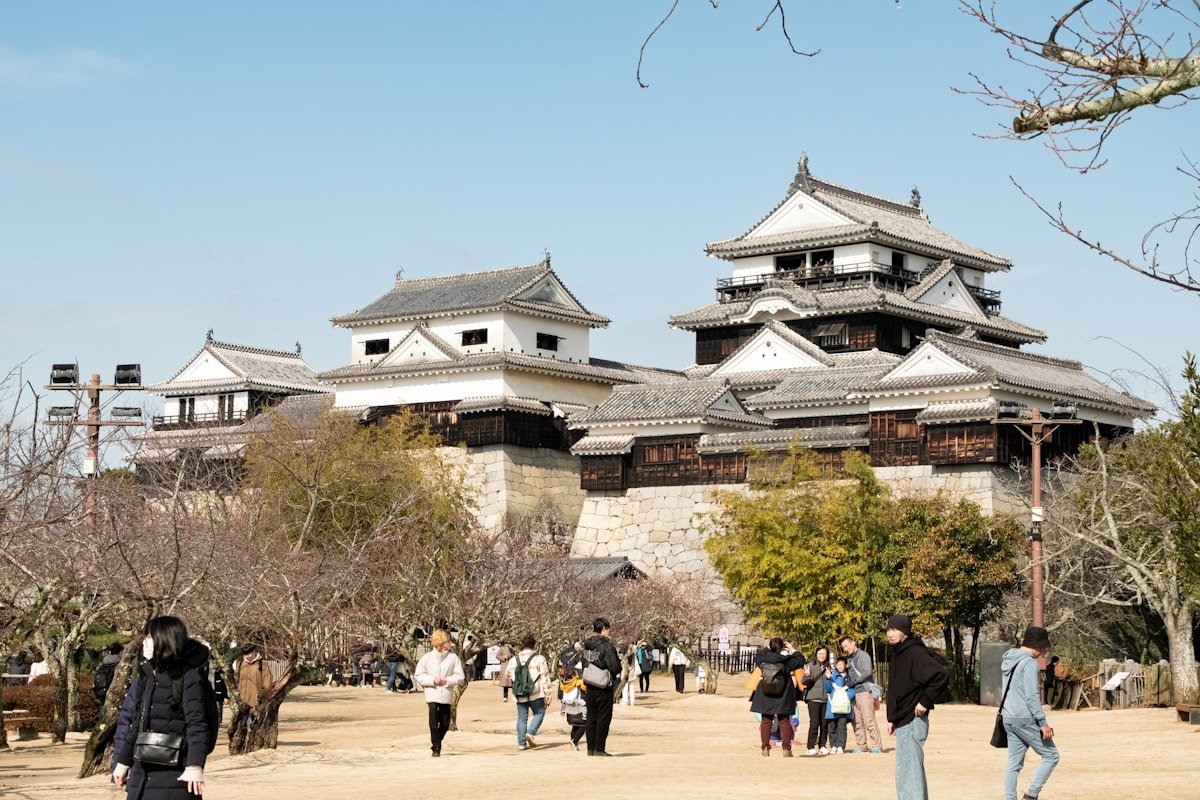
Matsuyama is a city that rewards unhurried exploration. The onsen district, the castle hill, the pilgrimage temple, the tram network, and the surrounding sea coast all have their own distinct characters. Below are 15 things to do in Matsuyama, from the city’s most famous attractions to the day trips that make it one of the best bases in Shikoku.
1. Dogo Onsen Honkan Historic Bath
The Dogo Onsen Honkan (¥450–¥1,250) has been in continuous operation for a documented 1,400 years - the oldest public bathhouse in Japan and one of the oldest continuously operating bath facilities in the world. The current 1894 Meiji-era building is an Important Cultural Property: a three-story wooden structure with a decorative tower, cedar-paneled interior, and a cast-iron bath that has been used by countless millions of people over the decades.
The spring water is mildly alkaline with a slight silky quality on the skin. Temperature in the main bath is typically 42–43°C. The basic admission (¥450) gives access to the ground-floor Kami-no-Yu communal bath - the same water as the premium options. The premium tier (¥1,250) includes the Botchan-no-Ma private tatami rest room and a serving of mitsu-dango.
Currently under phased renovation; check current access at dogo.jp before visiting.
2. Tsubaki-no-Yu Annex Onsen
Tsubaki-no-Yu (¥400) is the municipal annex bathhouse drawing from the same Dogo spring and located 5 minutes’ walk from the Honkan. It has been fully operational throughout the Honkan renovation. The facilities are straightforward - a single large communal bath for each gender, shower stations, and basic changing rooms - but the spring water quality is identical to the historic main building. For early morning visits (Tsubaki-no-Yu opens at 6:30am), this is the most reliable Dogo onsen option.
3. Matsuyama Castle
Matsuyama Castle (cable car ¥270 + castle ¥520) is one of 12 original surviving feudal castle keeps in Japan - a fact that gives it a different quality from the reconstructed castles that constitute most of Japan’s “castle cities.” The 1854 main keep has the proportions and structural logic of an authentic defensive fortification, not a reconstruction optimized for museum layout.
The hilltop setting (132 meters) gives unobstructed views in four directions: the Seto Inland Sea to the north, the city below, and the Shikoku mountains inland. The cable car ascent and a 10-minute walk across the hilltop plateau bring you to the main keep. The interior exhibitions cover samurai armor and Matsuyama domain history. Allow 2 hours including the ascent.
4. Ninomaru History Garden
Below Matsuyama Castle, the Ninomaru History Garden (¥100) occupies the ruins of the castle’s second defensive enclosure. The garden reconstructs the layout of the original secondary compound, with foundation stones and garden stones from the Edo-period castle incorporated into a landscaped space. A small teahouse serves matcha. Combined with the castle ascent, this is a natural 30-minute addition.
5. Ishite-ji Temple (Shikoku 88 Pilgrimage Site 51)
Ishite-ji (free) is the most important temple in Matsuyama city and one of the three most visited temples on the Shikoku 88-temple pilgrimage. The approach passes through a medieval gate complex - the Niomon gate dates to 1318 - before entering a courtyard with several 13th and 14th-century buildings. The cave passage is the most distinctive feature: carved into the hillside, lined with stone Buddhas representing the 88 pilgrimage sites, and emerging into a small valley behind the main compound. The cave is free to walk and takes about 10 minutes.
White-clad henro pilgrims are present throughout the day, many completing individual temples of the 88 rather than the full circuit. The atmosphere is distinctly different from the tourist-oriented shrines of Nikko or Kyoto.
6. Saka no Ue no Kumo Museum
The Saka no Ue no Kumo Museum (¥400) is built into the hillside between the castle and Dogo Onsen, designed by architect Kengo Kuma as a series of narrow triangular structures integrated into the slope. The museum is focused on the novel and NHK drama of the same name, a historical story set in Matsuyama during the Meiji period. The building’s architecture - natural materials, light-filled corridors, views framed by the structural geometry - is itself the main reason to visit, independent of the exhibit content.
7. Masaoka Shiki Commemoration Museum
The Masaoka Shiki Commemoration Museum (¥50) near Dogo Onsen is one of Japan’s most affordable cultural institutions. Shiki (1867–1902) was the Matsuyama-born poet who systematized and modernized haiku and tanka poetry during the Meiji era, dying of tuberculosis at 34. The museum holds original manuscripts, correspondence, and a recreation of his writing room. The ¥50 admission is less than a convenience store snack and the content is genuinely absorbing for anyone interested in Japanese literature.
8. Botchan Train Retro Tram
The Botchan train (¥200 per ride) is a replica steam-locomotive-style tram connecting Dogo Onsen with central Matsuyama on the regular tram network. Riding it once - from Dogo Onsen to the city center, watching the miniature “locomotive” thread through modern traffic - is worth doing. The name comes from Natsume Soseki’s novel Botchan, set in Matsuyama, in which the title character arrives by a similarly diminutive train. The tram runs on a fixed schedule with more frequent departures on weekends; check at the Dogo Onsen terminal.
9. Cycling the Shimanami Kaido from Imabari
The Shimanami Kaido cycling route (Onomichi to Imabari, 70km, JA Pass-enabled train to Imabari at ¥1,500 from Matsuyama) is Japan’s most famous island-hopping cycling route, connecting 6 islands in the Seto Inland Sea via purpose-built cycling lanes on the suspension bridges. Bicycle rental from the Imabari terminal costs approximately ¥500 per day for a basic bicycle, with ¥3,000 in bridge tolls for the full route. The full route takes 2 days; cycling to the first island (Oshima, 15km) and returning makes a manageable half-day. The bridge approach ramps offer the most dramatic cycling experience - elevated views across the sea to both coasts.
10. Ishizuchi-san Day Hike
Ishizuchi-san (1,982m) is the highest mountain in western Japan (west of Nagoya), sacred in Shinto tradition, and a challenging but accessible day hike from Matsuyama. Take the express bus from Matsuyama to Nishi-no-Kawa (1h20m), then the Ishizuchi Ropeway to the 8th station (¥1,980 return). From the ropeway top, the summit trail climbs steeply over 2 hours, with sections using iron chains bolted to vertical rock faces. The summit view across Shikoku’s mountain spine is extensive. Only suited to confident hikers with appropriate footwear; the season runs May to October.
11. Ozu Castle Town Day Trip
Ozu (40 minutes by JR Yosan Line, ¥670) is a small Ehime city with a castle and a remarkably preserved Edo-period townscape. The castle (reconstructed 2004 using traditional timber methods without concrete - unusual) charges ¥550 and gives views over the Hiji River. Garyu Sanso villa (¥700) is a 1907 private villa built in traditional sukiya-style architecture with formal garden - considered one of the finest examples of Meiji-era domestic architecture in Shikoku. The combination of castle and villa makes a full half-day outing.
12. Day Trip to Imabari
Imabari (1 hour by JR limited express, ¥1,500) is the eastern Shikoku terminus of the Shimanami Kaido. The city itself has Imabari Castle (¥520, notable for a moat filled with seawater rather than freshwater - allowing boats to approach directly) and a textile museum (Ehime is Japan’s leading towel-producing region). Primarily useful as the starting point for Shimanami Kaido cycling, but the castle is worth the stop.
13. Uwajima Bullfighting
Uwajima (2 hours by JR limited express, ¥3,300 from Matsuyama) hosts traditional togyu bullfighting on a seasonal schedule (typically 6 events per year). Unlike Spanish bullfighting, the Uwajima version pits two bulls against each other, with no humans in the ring and no injury or death intended - the bout ends when one bull retreats. Admission is ¥2,000. Check the Uwajima Tourism website for the current year’s schedule before planning a visit.
14. Coastal Walk from Matsuyama to Horie
The coastal road and path between central Matsuyama and the Horie district to the northwest gives views across the Seto Inland Sea to the islands. The walk is approximately 5 kilometers one-way (about 1h15m) and passes through a mix of residential streets and open waterfront. Free. The late afternoon light across the water is particularly clear in autumn and winter. Horie has a small local shopping street and tram stop for the return journey.
15. Fresh Seafood at Okaido Market
The Okaido covered shopping arcade and the surrounding side streets contain a concentration of seafood restaurants and fish market stalls serving produce from the Seto Inland Sea - sea bream (tai), octopus, small squid, and shellfish. A set lunch at a reputable fish restaurant costs ¥1,000 to ¥2,000. Matsuyama is particularly known for tai meshi - sea bream cooked with rice in a clay pot - and tartar sauce on fried seafood (a local comfort food variation). The Okaido is the city’s main commercial street and is always active from 10am onward.
Book ahead for popular experiences: Tours and activities in Matsuyama include guided options, skip-the-line tickets, and immersive cultural experiences.
Dogo Onsen Options Compared
| Option | Location | Admission | Includes | Best Time to Visit |
|---|---|---|---|---|
| Honkan basic (Kami-no-Yu) | Honkan main building | ¥450 | Ground-floor bath only | Check renovation status |
| Honkan standard (Tama-no-Yu) | Honkan second floor | ¥840 | Bath + yukata + rest room | Check renovation status |
| Honkan premium | Honkan third floor | ¥1,250 | Bath + private room + snack | Check renovation status |
| Tsubaki-no-Yu | Annex building (5 min walk) | ¥400 | Communal bath | 6:30am–11pm, always open |
| Day-use ryokan bath | Various Dogo inns | ¥500–¥1,500 | Private or communal onsen | Afternoon, reservation advised |
Where to stay: Search hotels in Matsuyama on Booking.com
See also: Matsuyama travel guide · Where to stay in Matsuyama · Best restaurants in Matsuyama · Day trips from Matsuyama · Onsen guide Japan · Shikoku region guide