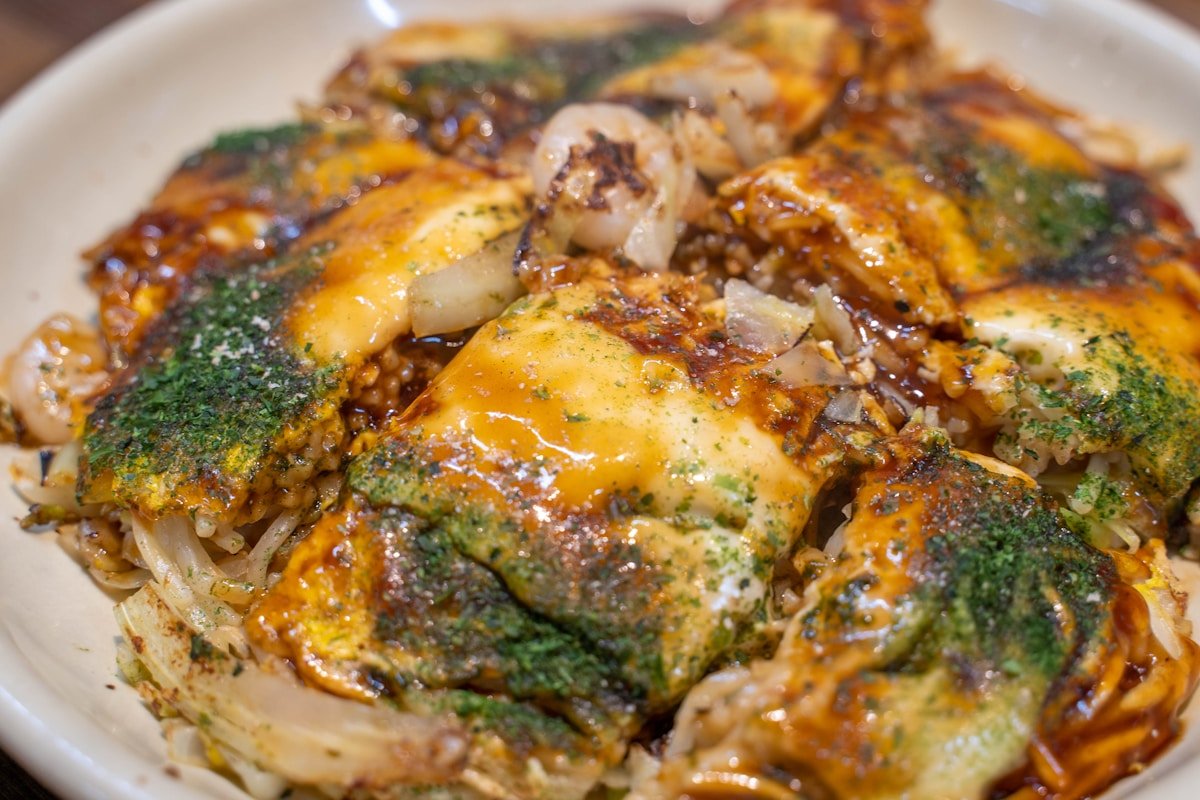
Hiroshima’s food scene is defined by two things: the layered okonomiyaki that the city invented and refuses to share credit for with Osaka, and the oyster beds that stretch across Hiroshima Bay to produce roughly 70 percent of Japan’s entire oyster output. Beyond those two anchors, the city has a set of regional specialties - anago conger eel from Miyajima, lemon-derived dishes from the Seto Inland Sea islands, and momiji manju maple leaf cakes - that reward visitors who stay to eat beyond the obvious.
For an overview of Hiroshima’s sights and logistics, see our Hiroshima travel guide.
Hiroshima Okonomiyaki
The word okonomiyaki means “cook what you like” - a flexible savoury pancake built around a flour and dashi batter base with cabbage and whatever protein or vegetable you choose. The dish exists across Japan, but Hiroshima and Osaka have developed radically different interpretations that locals in both cities regard with something close to regional pride.
The key difference: Osaka-style (kansai-style) mixes all ingredients into the batter before cooking, producing an integrated, soft pancake. Hiroshima-style is layered - a thin crepe is cooked first, then cabbage, bean sprouts, thinly sliced pork belly, and optionally squid or prawn are piled on top and cooked through, and a separately cooked portion of yakisoba (stir-fried noodles) or udon is added as a distinct layer, with egg cracked over the base and the entire structure flipped and pressed flat. The result is taller, more structurally complex, and has a different textural range - you taste the crisp noodle layer distinctly against the soft cabbage.
The flavour profile is similar (okonomiyaki sauce, Japanese mayonnaise, aonori, katsuobushi on top), but the eating experience is quite different. Hiroshima residents are consistent on this point: the two styles are not interchangeable.
Where to Eat It
Okonomimura - A building near the Hatchobori tram stop (a 10-minute tram ride from Hiroshima Station) containing approximately 25 okonomiyaki restaurants spread across three floors. Each restaurant is small (6–16 seats), each has its own house recipe, and prices run from approximately ¥900–¥1,400 depending on fillings. The building has operated since 1945. Most restaurants have counters where you watch the cooking on the teppan griddle in front of you. No single restaurant is definitively “the best” - the differences are subtle, and exploring two or three visits across the building is a reasonable approach if you are staying more than one night.
Micchan - Multiple locations across Hiroshima, with the Nagarekawa branch the most central. Micchan is credited by most Hiroshima food historians as the originator of the layered noodle-inclusive style in the 1950s, under founder Michiko Nobuhara. From ¥900. The noodle version (soba-iri) is the one to order here.
Street stalls and local restaurants - Outside the Okonomimura building and tourist-facing restaurants, Hiroshima has neighbourhood okonomiyaki restaurants throughout the city that serve the same dish to local office workers and students at lunch for ¥800–¥1,100. They typically have no English menus and occasionally no English signage, but a laminated photo menu in the window or pointing at a neighbouring customer’s plate works reliably.
Hiroshima Oysters
Hiroshima Bay’s calm, protected waters and strong nutrient flows from inland rivers create ideal conditions for oyster cultivation. The prefecture produces approximately 70 percent of Japan’s oyster output, and the scale is visible from the ferry to Miyajima - long lines of floating racks mark the oyster beds across the bay.
Hiroshima oysters tend to be larger than the oysters of Brittany or Pacific Northwest varieties, with a plump, creamy texture and a relatively mild brine level. The best season is October through March, when cold water concentrates the flavour; summer oysters are edible but smaller and less rich.
Preparation options:
- Raw (nama): Available at select restaurants and the covered Hondori market area. From ¥300–¥500 per piece. Given the scale of Hiroshima’s oyster industry and turnover, raw oysters here are among the safer raw oyster experiences in Japan.
- Grilled with butter (yaki): The most popular tourist-facing preparation. From ¥350–¥500 per oyster. Available at stalls near Miyajima ferry pier and at the Itsukushima Shrine approach market.
- Deep-fried (kaki furai): Breaded and fried, typically served in sets of 4–6 with rice, miso soup, and shredded cabbage. ¥1,000–¥1,500 at sit-down restaurants. This is the most widely available preparation citywide.
- Oyster sets (course): Several restaurants in central Hiroshima and near Miyajima offer multi-preparation oyster courses from approximately ¥2,500–¥4,000 per person.
Where to eat them: The Miyajimaguchi ferry terminal area has stalls and small restaurants selling grilled oysters. In central Hiroshima, the Ote-machi and Fukuro-machi areas have restaurants specialising in kaki. The Hondori covered arcade market has fresh oyster vendors.
Anago: Conger Eel from Miyajima
Anago (conger eel) is Miyajima’s local specialty - not to be confused with the freshwater unagi eel found across Japan. Anago is a saltwater species with a more delicate, less fatty flavour than unagi. It is typically braised in a sweetened soy sauce and served over rice.
Anago meshi - The classic Miyajima anago preparation: braised conger eel over rice in a wooden lacquered box, with pickles and soup. Available at restaurants along the approach to Itsukushima Shrine. The most famous is Ueno Restaurant (est. 1901), where anago meshi lunch boxes cost approximately ¥1,800–¥2,500. The shops near the ferry terminal also sell anago bento (boxed lunch) for the return ferry journey at ¥1,700–¥2,000.
Anago is best consumed at Miyajima itself rather than carried back to Hiroshima - the flavour degrades within a few hours even in a sealed box. Plan to eat on the island.
Momiji Manju
Momiji manju - maple leaf-shaped steamed cakes filled with sweet red bean paste - are the signature souvenir food of Miyajima, where the surrounding maple forests turn red in November. The cake batter is caramelised and slightly sweet, the filling typically anko (smooth red bean paste), though variations include custard, matcha, chocolate, and cheese.
The standard version costs ¥100–¥150 per piece, with boxed assortments of 6–12 pieces available from ¥700–¥1,500 at souvenir shops along the Miyajima approach. The best momiji manju are freshly made - several shops on the island cook them in front of customers in cast-iron moulds, and the warm, just-made version is significantly better than the packaged version sold in Hiroshima city centre. Budget ¥400–¥600 for a bag of fresh ones on the island.
Lemon Dishes
Hiroshima Prefecture - specifically the Seto Inland Sea islands of Oshima and Ondo - produces approximately 40 percent of Japan’s domestic lemon harvest. The proximity of lemon production to the city has generated a range of lemon-based dishes and products that are specific to Hiroshima in a way that does not exist elsewhere in Japan.
Lemon ramen - A Hiroshima-specific variation where fresh lemon juice is used as a tare (seasoning base) in a light chicken or seafood broth. Several ramen shops in central Hiroshima serve this style, most notably Seto Inland Sea Lemon Ramen near the Fukuro-machi area. From ¥900. The flavour is lighter and more citrus-forward than standard shoyu ramen.
Lemon-flavoured products - Lemon tarts (¥250–¥400 each), lemon cream puffs, and lemon-flavoured Hiroshima oyster sauce are available at most souvenir shops in the city and at the Hiroshima Station shopping complex. The Onomichi lemon salt - a seasoning made from Seto Inland Sea lemons - is a practical souvenir that most non-Japanese visitors overlook and most people who discover it regret not buying more of.
Lemon chuhai - A lemon-based shochu and soda drink is common across Japan, but the Hiroshima versions made with fresh local lemon (as opposed to concentrate) are notably better. Available at most izakaya in the city from ¥400–¥600.
Hiroshima Tsukemen
Tsukemen - ramen noodles served separately from a concentrated dipping broth, eaten by dipping the noodles into the broth rather than serving everything in one bowl - is a Tokyo-derived style that has developed its own Hiroshima variation in recent years. The Hiroshima version tends toward richer, slightly sweeter dipping broths and thicker noodles than the Tokyo original.
Tsukemen Tetsu - A specialist tsukemen chain with a Hiroshima branch, serving thick noodles with a concentrated pork and fish broth. From approximately ¥900–¥1,100. Worth seeking out if you have eaten okonomiyaki and oysters and want something different.
Budget Eating in Hiroshima
Hiroshima is one of the more affordable cities in Japan’s western circuit. Set lunch menus (teishoku or ranchi setto) at restaurants throughout the city cost ¥800–¥1,100 and typically include a main dish, rice, miso soup, and pickles.
The Hondori covered shopping arcade - Hiroshima’s main retail street, running from near the Peace Memorial Museum toward the city centre - has a good range of affordable restaurants and food stalls on its side streets, including a mix of teishoku restaurants, conveyor belt sushi, and standing ramen shops.
Convenience store food (7-Eleven, FamilyMart, Lawson) is as reliable in Hiroshima as elsewhere in Japan, with onigiri from ¥130–¥180 and complete meals for ¥500–¥700.
See Hiroshima through its food: Food and cultural tours in Hiroshima often include market visits, tastings, and dishes you’d never find independently.
Food Overview
| Dish / Venue | Price Range | Notes |
|---|---|---|
| Momiji manju (fresh, Miyajima) | ¥100–¥150 each | Buy warm from cast-iron mould shops |
| Oyster, grilled (Miyajima stalls) | ¥300–¥500 each | Best Oct–Mar |
| Okonomiyaki (Okonomimura) | ¥900–¥1,400 | 25 restaurants across 3 floors |
| Okonomiyaki (Micchan) | From ¥900 | Credited originator of layered style |
| Lemon ramen | From ¥900 | Hiroshima-specific; citrus broth base |
| Tsukemen | From ¥900–¥1,100 | Dipping ramen; Tsukemen Tetsu |
| Teishoku lunch | ¥800–¥1,100 | Citywide; look for laminated picture menus |
| Kaki furai (fried oyster set) | ¥1,000–¥1,500 | Sit-down restaurants citywide |
| Anago meshi (Miyajima, Ueno) | ¥1,800–¥2,500 | Eat on the island; flavour degrades fast |
| Oyster course | ¥2,500–¥4,000 | Multi-preparation; central Hiroshima restaurants |
Where to stay: Search hotels in Hiroshima on Booking.com
See also: Hiroshima travel guide · Best restaurants in Hiroshima · Miyajima food guide · Chugoku region guide