Hiroshima rewards at least two full days of exploration. The Peace Memorial complex deserves 3 to 4 hours on its own; add the castle, Shukkei-en garden, and the okonomiyaki district and you have a full first day. Miyajima fills a second day. Below are 16 things to do in Hiroshima, from the essential to the overlooked.
1. Peace Memorial Museum
The Peace Memorial Museum (¥200) is the most important museum in Japan in terms of historical and moral weight. The exhibition documents the bombing of Hiroshima on August 6, 1945, and its consequences with a precision that goes beyond political abstraction. Individual victims are identified - their photographs, their belongings, the circumstances of their death. A wristwatch stopped at 8:15am. A child’s burned lunchbox still containing carbonized rice. A stone step with the shadow of a human being burned into it by the thermal flash.
The second section of the museum covers Japan’s nuclear policy advocacy and the ongoing international campaign for nuclear disarmament. Allow 2 to 3 hours. The museum closes at 6pm. Admission is ¥200 for adults.
2. The Atomic Bomb Dome
The Genbaku Dome (free) is the gutted shell of the Hiroshima Prefectural Industrial Promotion Hall, the only structure near the bombing hypocenter that partially survived. The building’s dome framework - exposed iron ribs now rusted and preserved - stands directly on the bank of the Motoyasu River, 160 meters from the hypocenter. UNESCO designated it a World Heritage Site in 1996.
The dome is viewable from the river path at all hours. At night, the ruin is lit from below, the skeletal framework visible against the dark sky. Both the daytime and nighttime versions carry weight; the scale of what happened becomes real here in a way it does not through text or photographs.
3. Peace Memorial Park Dawn Walk
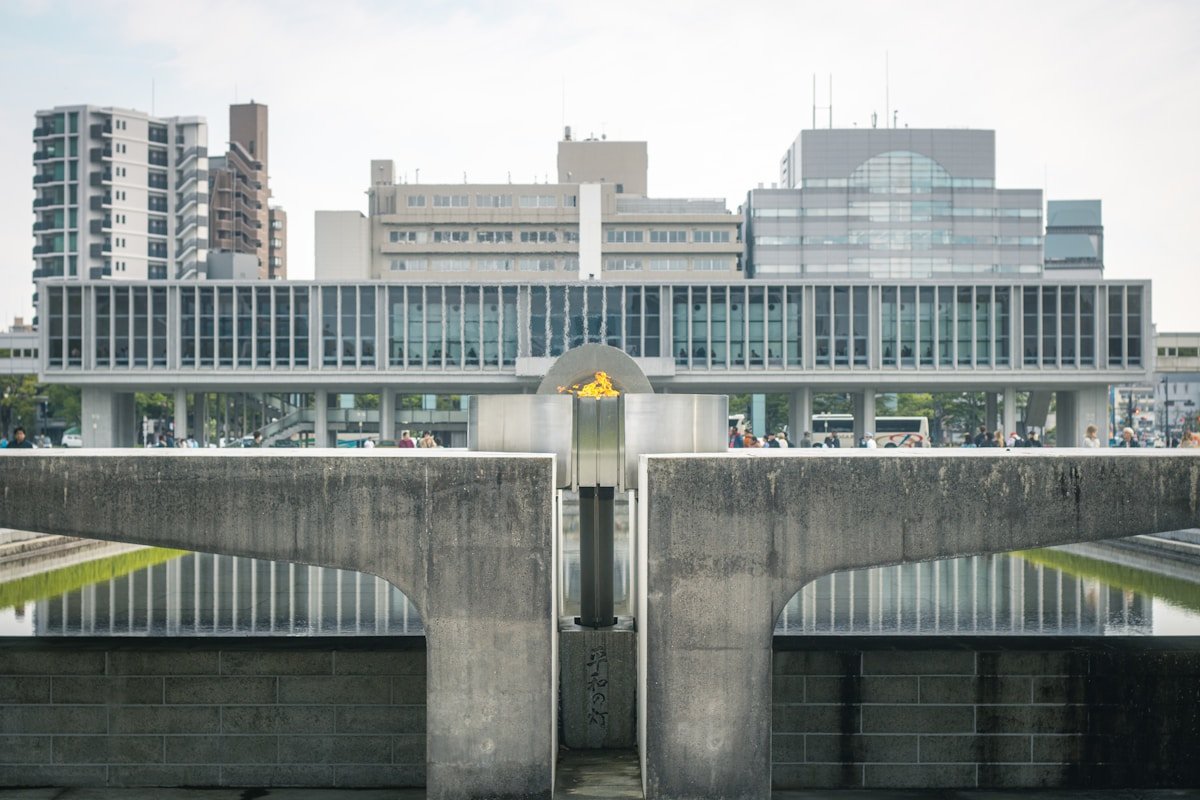
Walking the Peace Memorial Park before 8am (free) gives the park space and silence. The Cenotaph for the A-Bomb Victims, the Peace Flame (burning since 1964 and intended to burn until all nuclear weapons are abolished), and the Motoyasu River reflecting the dome - these elements have an entirely different quality in the early morning without crowds. The alignment of the cenotaph, the flame, and the dome is deliberate: they form a straight line, which the designer intended as a symbol of direct acknowledgment.
4. Children’s Peace Monument
The Children’s Peace Monument (free) commemorates the child victims of the bombing, particularly Sadako Sasaki, who developed leukemia at age 12 from radiation exposure and died in 1955. Her story of folding 1,000 paper cranes prompted schoolchildren across Japan to begin sending paper cranes to Hiroshima. The monument receives tens of millions of cranes annually, which are displayed in glass cases around its base. The statue at the top depicts a girl holding a paper crane with arms outstretched.
5. Hiroshima National Peace Memorial Hall
The National Peace Memorial Hall for the Atomic Bomb Victims (free) is a largely underground building beside the Peace Memorial Museum, designed by Kisho Kurokawa. Its interior contains a circular hall with panoramic photographs of the destroyed city, a registry of the names of all known atomic bomb victims (estimated at 300,000+), and quiet spaces for individual reflection. It is less visited than the museum but more intimate, and the registry of names is one of the most affecting elements in the entire Peace Memorial complex.
6. Hiroshima Castle
Hiroshima Castle (¥370) was built in 1589 and destroyed in the 1945 bombing. The current five-story keep is a 1958 reinforced concrete reconstruction that serves as a museum of feudal Hiroshima history. The samurai armor exhibits on the upper floors are among the best-presented in the Chugoku region, and the view from the top story over the flat city to the mountains beyond provides geographical context for understanding Hiroshima’s pre-war urban layout. The surrounding castle moat and earthworks are original 16th-century construction.
7. Shukkei-en Garden
Shukkei-en (¥260) is a 17th-century stroll garden centered on a pond with islands, bridges, and miniature scenic landscapes. The garden was devastated in 1945 and restored over the following decades. It is one of the more peaceful places in central Hiroshima, the sound of the city muted by the dense plantings. The garden is at its best in late March (cherry blossoms over the pond) and November (maple foliage). Koi in the central pond are available for feeding near the main gate.
8. Hiroshima Prefectural Art Museum
The Hiroshima Prefectural Art Museum (¥510, temporary exhibitions extra) is adjacent to Shukkei-en and houses a collection of late 19th and 20th century Japanese and Western art, with particular strength in Shin-hanga (new woodblock prints) and Surrealist works. The museum building overlooks the garden and is a comfortable 90-minute visit combined with the garden admission.
9. Okonomi-mura Okonomiyaki Village
Okonomi-mura is a three-story building near Parco department store in central Hiroshima containing 25 individual okonomiyaki stalls, each run by a single cook with their own minor variations on the Hiroshima-style recipe. The building is explicitly conceived as a food hall, with counter seating at each stall directly in front of the cooking griddle. Prices range from ¥800 for a basic version to ¥1,200 for additions (extra pork, oyster, cheese). Go at opening (11am) or after 2pm to avoid the main lunch queue.
10. Nagarekawa Nightlife District
The Nagarekawa area, a 15-minute walk from the Peace Memorial Park, is Hiroshima’s main evening entertainment district - a grid of narrow streets lined with izakayas, yakitori restaurants, karaoke bars, and standing sake bars. Budget ¥2,000 to ¥3,500 per person for a full evening of izakaya food and drink. The area is livelier on Friday and Saturday nights; on weeknights the atmosphere is relaxed and local.
11. Mitaki Temple Forested Hillside Walk
Mitaki-dera (¥200) is a temple complex in the western hills of Hiroshima, 20 minutes from Hiroshima Station by JR local train to Mitaki Station. The temple grounds climb through forested hillside with three pagodas and a series of small hall buildings. The autumn foliage here - maples over stone staircases and wooden halls - is among the best in the city. The climb to the upper precincts is steep but accessible; allow 90 minutes.
12. Hiroshima City Museum of Contemporary Art
The Museum of Contemporary Art (¥360, temporary exhibitions extra) is located in Hijiyama Park, a hillside park above the eastern city. The building, designed by Kurokawa Kisho, integrates with the hilltop terrain. The permanent collection focuses on Japanese and international contemporary art from the 1960s onward. The park location provides panoramic views over the city from the approach path.
13. JR Ferry to Miyajima
The JR ferry from Miyajimaguchi to Miyajima island (¥210 one-way, free with JR Pass) is a 10-minute crossing over the Seto Inland Sea to one of Japan’s most photogenic destinations. The floating torii gate of Itsukushima Shrine is visible on approach. Miyajima deserves a full day. See our dedicated Miyajima guide for complete coverage.
14. Ujina Harbour Sunset
The Ujina port area, accessible by city tram from Hiroshima Station, is an industrial harbour district that offers largely unobstructed western-facing views over the Seto Inland Sea. Sunset from the port area - the light falling across the water and the silhouettes of distant islands - is an uncrowded, unpolished alternative to the busier tourist viewpoints. Free.
15. Hiroshima Mazda Museum
The Hiroshima Mazda Museum (free) covers the history of Mazda Motor Corporation, which is headquartered in Hiroshima, through its collection of historic vehicles and a factory production line tour. The tour runs Monday to Friday (excluding holidays) and requires advance reservation via the Mazda website. The factory tour - watching vehicles assembled on the production line - is the main draw. Allow 90 minutes.
16. Sake Breweries in Saijo
Saijo (30 minutes from Hiroshima by JR San-yo Line, ¥700 return) is one of Japan’s three most famous sake-producing towns, with eight major breweries concentrated within walking distance of each other. Most breweries have tasting rooms open to visitors without reservation during business hours (approximately 9am to 5pm). A ¥200 to ¥500 tasting fee typically covers 3 to 5 samples. The Sake Museum (free) provides context on the brewing process. Best visited on a weekday when the breweries are operating.
Book ahead for popular experiences: Tours and activities in Hiroshima include guided options, skip-the-line tickets, and immersive cultural experiences.
1-Day vs 2-Day Itinerary
| Day | Morning | Afternoon | Evening |
|---|---|---|---|
| Day 1 only | Peace Memorial Museum + Dome (3h) | Hiroshima Castle + Shukkei-en (2h) | Okonomi-mura okonomiyaki |
| Day 1 of 2 | Peace Memorial Park + Museum + Dome (3h) | National Peace Hall, Children’s Monument (1h), castle (1.5h) | Nagarekawa izakayas |
| Day 2 of 2 | Full day Miyajima (ferry + shrine + Mt Misen hike) | - | Return by 6pm, Okonomi-mura dinner |
Where to stay: Search hotels in Hiroshima on Booking.com
See also: Hiroshima travel guide · Miyajima city guide · Where to stay in Hiroshima · Best restaurants in Hiroshima · Day trips from Hiroshima · Hiroshima vs Nagasaki · Chugoku region guide · Kansai and Kyushu itinerary