Chugoku occupies the western tip of Honshu between the Kansai region and Kyushu. Most visitors pass through on the Shinkansen between Kyoto and Fukuoka, stopping at Hiroshima and Miyajima. The region rewards a slower approach: Onomichi is one of Japan’s most atmospheric small port cities, the Shimanami Kaido cycling route across the Seto Inland Sea bridges is a world-class ride, and the Tottori Sand Dunes on the Japan Sea coast are a genuine surprise in a country most people associate with mountains and city density.
Hiroshima is the transport hub and logical base, a two-and-a-half hour Shinkansen ride from Osaka or an hour from Shin-Yamaguchi near Kyushu.
Hiroshima
Hiroshima requires serious time - not because the city is large, but because the Peace Memorial Park and Museum are the kind of places that take longer than you expect, and rushing them is a mistake.
The Atomic Bomb Dome (Genbaku Dome) sits within the park and is what remains of the former Hiroshima Prefectural Industrial Promotion Hall, directly below the bomb’s hypocenter. The building was not demolished after the war and now stands as the only structure near the hypocenter that was not completely destroyed. It is a UNESCO World Heritage Site. Entry is free; the exterior is accessible at all hours.
The Peace Memorial Museum (¥200/$1.30) holds photographs, artefacts, and testimony from survivors of August 6, 1945. The museum is straightforward in its documentation, neither sensationalised nor minimised. Allow 2–3 hours minimum. The newer East Building focuses on the broader historical context; the West Building contains survivor testimony and physical artefacts.
The park itself is large and navigable on foot - the Cenotaph for Atomic Bomb Victims, the Flame of Peace (kept burning since 1964, to be extinguished when all nuclear weapons are eliminated), and the Children’s Peace Monument are all within the park.
Beyond the Peace Park: Hiroshima Castle (¥180/$1.20 for the moat area, ¥370/$2.50 for the reconstructed keep museum) was completely destroyed by the bomb and rebuilt in 1958; the museum inside covers Hiroshima’s pre-war feudal history. Hiroshima okonomiyaki - a layered version distinct from the Osaka style, built on a crepe base with noodles inside - is best eaten in the Okonomimura building (six floors of okonomiyaki restaurants, prices ¥1,000–1,500/$6.60–10 per person).
From Osaka: 1h29min Shinkansen (¥10,590/$70; JR Pass valid). From Tokyo: 4h Shinkansen (¥19,380/$129; JR Pass valid).
Miyajima
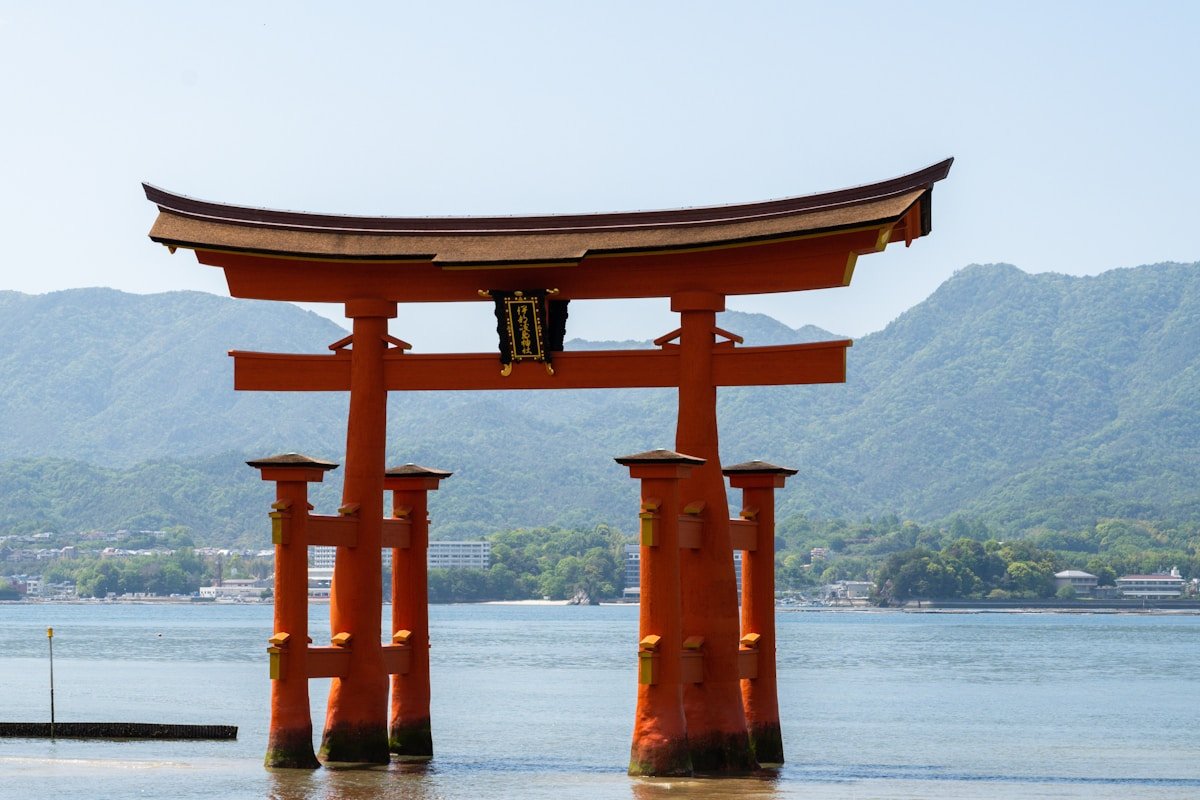
Miyajima (officially Itsukushima) is a sacred island 30 minutes from Hiroshima by train and ferry. The “floating” torii gate of Itsukushima Shrine stands in the water at high tide, the vermilion structure appearing to float against the mountainous backdrop. At low tide, visitors can walk to the base of the gate across the exposed sandflat.
The shrine itself (¥300/$2) is constructed over the water on pilings and dates in its current form to the 12th century. It was designed so the island itself - considered sacred - would not be defiled by construction on land. The mountain above the shrine (Mount Misen, 535 metres) is accessible by ropeway (¥1,840/$12.20 one way) or a 90-minute hike. The summit views of the Seto Inland Sea islands are exceptional.
Deer wander freely on Miyajima as they do in Nara. They are less aggressive than Nara deer and are not fed commercially. The island’s main street food is momiji manju - maple leaf–shaped cakes filled with red bean paste (¥100/$0.70 each) or newer fillings like cream cheese or chocolate.
Access: JR Sanyo Line from Hiroshima station to Miyajimaguchi (28 minutes, ¥410/$2.70; JR Pass valid), then JR ferry to Miyajima island (10 minutes, ¥200/$1.30; JR Pass covers the ferry).
Onomichi
Onomichi is a small port city on the Seto Inland Sea that seems to have avoided the postwar reconstruction that standardised most Japanese city centres. The hill above the harbour has 25 temples connected by a walking trail (the “Temple Walk” or Senko-ji Temple Walk) that takes 2–3 hours and passes through neighbourhoods of traditional wooden houses, some being gradually restored by artists and small businesses.
The city has developed a reputation as a centre for bicycle culture - it sits at the eastern end of the Shimanami Kaido, a 70km cycling route across six islands and seven bridges connecting Onomichi to Imabari in Shikoku. The bridges and the island roads are designated cycling paths. GIANT bicycle rental operates from outside Onomichi station; the full route takes 1–2 days. A day trip covering the first two islands (Mukaishima and Innoshima) and returning by ferry is manageable.
Cat Alley (Neko no Hosomichi) is a narrow lane in the temple walk area where cats have congregated for decades, maintained by a local volunteer group - less touristy than it sounds, and worth 20 minutes.
From Hiroshima: 45 minutes by JR Sanyo Line to Onomichi (¥1,520/$10; JR Pass valid).
Tottori Sand Dunes
The Tottori Sand Dunes are on Chugoku’s Sea of Japan coast, north of the mountain range that divides the region. They are Japan’s only significant desert landscape: dunes up to 47 metres high extending 2.4km along the coast, formed by sand carried by the Sendai River and shaped by sea winds over 100,000 years. Camel rides are available (¥1,500/$10 for a 15-minute circuit) and sand-boarding is operated from a hire point near the dunes.
Entry to the dunes is free. The adjacent Sand Museum (¥800/$5.30) is a serious gallery with annually rebuilt large-scale sculptures carved from sand - each year covers a different country or theme, and the scale and detail are impressive.
Tottori is off the Shinkansen network. From Osaka: 2h30min by JR Super Hakuto Limited Express to Tottori (¥6,150/$41; JR Pass valid). From Hiroshima: 2h45min by JR train via Okayama.
Getting Around Chugoku
Hiroshima is the main base. The San’yo Shinkansen runs along the south coast through Hiroshima to Shin-Yamaguchi. Local JR lines reach Onomichi and, with connections, the Tottori coast. Miyajima access includes a JR ferry covered by the JR Pass.
Key journey times from Hiroshima:
- Miyajima: 38 minutes (JR train + JR ferry; JR Pass valid)
- Onomichi: 45 minutes (JR Sanyo Line; JR Pass valid)
- Osaka: 1h29min Shinkansen (JR Pass valid)
- Tottori: 2h45min via Okayama (JR Pass valid) Search hotels in Hiroshima on Booking.com
Best Season
Spring (late March to early April): Hiroshima’s Peace Park cherry blossoms are among western Japan’s better displays. Miyajima’s cherry blossoms combined with the torii gate are heavily photographed.
Autumn (October–November): Foliage on Miyajima’s Mount Misen and the Onomichi hillside. November is the most comfortable temperature for the Shimanami Kaido cycling route.
Summer: Warm and manageable - less humid than Kansai. Tottori dunes are best visited early morning or evening in summer to avoid the heat.
Winter: The Chugoku mountain range catches significant snow on the San’in (Sea of Japan) coast side, while the San’yo (Pacific) coast stays relatively mild. Hiroshima and Miyajima have few winter crowds and comfortable daytime temperatures around 8–12°C.
Plan your Chugoku visit: Tours and activities across Chugoku cover the region’s top experiences. Flights to Japan - compare early, especially for travel to regional airports outside Tokyo. Travel insurance for Japan and an Airalo eSIM are worth sorting before you fly.
City Guides for Chugoku
Detailed city guides: Hiroshima · Miyajima
Related guides: Hiroshima vs Nagasaki · Things to do in Hiroshima · Kansai and Kyushu itinerary · Japan Golden Route · Two weeks in Japan
See also: Hiroshima travel guide · Miyajima travel guide · Where to stay in Hiroshima · Day trips from Hiroshima · Kansai region guide · Kyushu region guide · Hiroshima long-stay guide