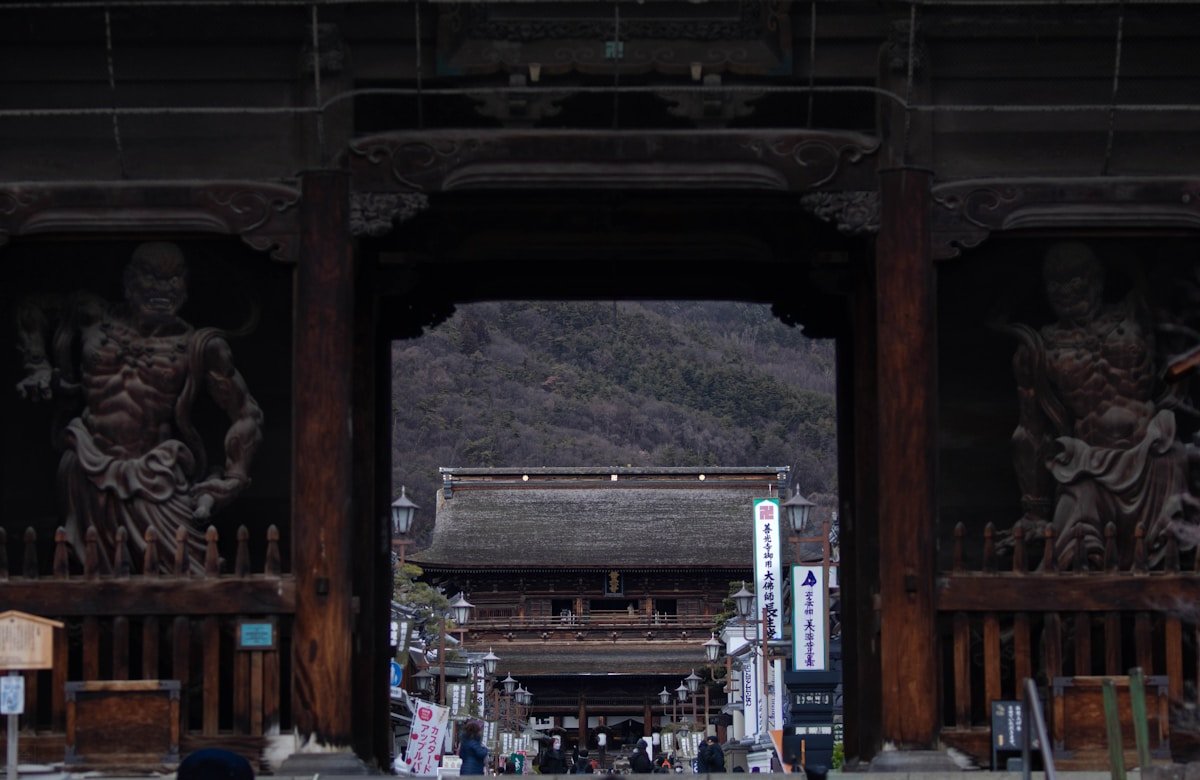
Nagano Prefecture packs an exceptional range of experiences into a compact area. The city itself offers one of Japan’s most important pilgrimage temples. The surrounding mountains hold wild macaques bathing in hot springs, Japan’s most significant original castle keep, some of Asia’s best powder skiing, and one of the country’s oldest hot spring towns. This list covers 16 things that reward the time invested.
1. Zenko-ji Dawn Pilgrimage and Morning Ceremony
The morning ceremony at Zenko-ji (free) runs daily - at 5:30am in summer, 6am in winter. Monks process from the temple residence to the main hall in a candlelit procession. Pilgrims line both sides of the approach path (Nakamise-dori), and the monks pause to touch the heads of those who kneel along the route - a blessing that people travel days to receive.
Arriving before 5am secures the best position. The stone-flagged approach path in pre-dawn light, the smell of incense, and the sound of the gong in the still cold air create an atmosphere entirely different from a daytime visit. This is one of the most affecting experiences available at any temple in Japan and costs nothing.
After the ceremony, the inner sanctuary opens for the o-kaidan passage (¥500) - a completely lightless underground tunnel in which pilgrims search the wall for a sacred metal key while moving in total darkness. The passage takes around 5 minutes and is disorienting in a way that illuminates something about the physical dimension of religious practice.
2. Jigokudani Snow Monkey Park
The journey to Jigokudani (¥800 park entry) takes around 2 hours from Nagano by train and bus, but the experience more than justifies the travel time. Take the Nagano Dentetsu line from Nagano to Yudanaka (1 hour 15 minutes, ¥1,350), then a connecting bus to Kanbayashi Onsen stop (15 minutes, ¥600), followed by a 20-minute walk through cedar forest to the park.
Around 200 wild Japanese macaques live in the park. The troop has bathed in a purpose-built outdoor hot spring for decades, with knowledge passing from mother to offspring. In January and February, when deep snow covers the surrounding forest, the image of red-faced macaques floating in steaming water against a white background is among the most extraordinary wildlife scenes in Asia.
Arrive by 9am. Tour groups from Tokyo and Osaka typically reach the park by 10am and the pool viewing area becomes significantly more crowded. Staying until 3pm lets you see the monkeys in afternoon light when groups have left. Budget ¥5,000 for the full day including transport and a lunch stop at Yudanaka.
3. Yudanaka and Shibu Onsen Hot Spring Town
Yudanaka and the adjacent Shibu Onsen form a small hot spring town in the Shiga Kogen foothills. Shibu Onsen has nine outdoor communal baths (soto-yu) that are, in theory, open to all guests staying at local ryokan - staying in any of the town’s ryokan gives access to a stone key that unlocks all nine. Day-trippers can use the public Shima-yu bath (¥500) without an accommodation booking.
The town itself is worth walking for 30 minutes regardless. Stone-paved lanes, tiled ryokan facades, and the persistent smell of sulphur create a landscape that hasn’t changed substantially since the Edo period. Combining a snow monkey morning visit with an afternoon at Shibu Onsen makes a natural full day if you’re already at Yudanaka.
4. Matsumoto Castle Day Trip
Matsumoto Castle (¥720, 45 minutes from Nagano by JR limited express, ¥1,140) is one of the 12 original surviving castle keeps in Japan - structures never destroyed and reconstructed. Built between 1592 and 1614, it has a distinctive black exterior that has earned it the nickname “Crow Castle.” The six interior floors are reached by steep original wooden staircases, with armour displays and historical exhibits on each level. Views from the top floor across the moat to the Northern Alps are exceptional on clear days.
Arrive when the castle opens (8:30am) to avoid the queue that builds by 10am, particularly on weekends. Reduced hours apply November to March (last entry 4pm).
5. Matsumoto Old Town and Nawate-Dori
After the castle, spend an hour walking Matsumoto’s historic streets. Nakamichi-dori has several well-preserved Edo-period storehouses (kura) converted into craft galleries and restaurants. Nawate-dori, running parallel to the Metoba River, is known as the “frog street” - the river’s frog population inspired small frog sculptures and souvenirs throughout. Antique dealers and small restaurants cluster along both streets.
Lunch in Matsumoto is an opportunity to eat Matsumoto-style soba (buckwheat noodles, ¥900–¥1,400 for a full set). The city has a strong soba culture and several well-regarded shops within walking distance of the castle.
6. Obuse Chestnut Town and Hokusai Museum
Obuse (40 minutes from Nagano by JR, ¥640) is a small town that holds Japan’s largest collection of Katsushika Hokusai’s works outside Tokyo at the Hokusai Museum (¥1,000). The collection emphasises Hokusai’s later works, including two large-scale ceiling paintings commissioned for local festival wagons when the artist was in his eighties. These paintings are rarely reproduced and are the primary draw.
Obuse is also Japan’s premier chestnut town. Obusedo confectionery makes the most celebrated mont blanc (¥900), and chestnut sweets of various forms are sold throughout the compact town centre. Allow 2 to 3 hours total.
7. Hakuba Ski and Snowboard Resort
Hakuba Valley (60 minutes from Nagano by JR, ¥1,170) comprises 12 interconnected resorts across a single broad valley, with a combined total of over 200 runs at elevations between 700 and 2,000 metres. Happo-One, the main resort, hosted the 1998 Olympic downhill courses - the ski runs are genuinely challenging and the off-piste options are extraordinary.
Day lift passes cost ¥5,000 to ¥7,500 depending on resort. Hakuba receives some of the heaviest snowfall in Japan due to its position relative to Sea of Japan weather systems. Powder days are frequent from late December through February.
Summer at Hakuba offers gondola access to alpine meadows (¥2,800 return, July to August), mountain biking on dedicated trails, and hiking on well-marked paths with mountain hut accommodation for multi-day routes.
8. Shiga Kogen - Japan’s Largest Ski Area
Shiga Kogen (approximately 1 hour 30 minutes by bus from Nagano) is the largest interconnected ski area in Japan, with 19 resorts, over 80 lifts, and terrain ranging from broad beginner slopes to demanding tree runs. The plateau sits at 1,500 to 2,000 metres and receives reliable snow from December through late March.
The area hosted the 1998 Olympic biathlon and cross-country events - those courses are still used for competitive events. A single-day pass covering all 19 areas costs approximately ¥6,000. The scale means that even during Japanese holiday periods, you can find less-crowded runs by choosing non-obvious resorts within the linked network.
9. Togakushi Shrine and Cedar Avenue
Togakushi (40 minutes by bus from Nagano, approximately ¥780 each way) is a Shinto shrine complex in the foothills above the city. The upper shrine approach involves a 2-kilometre walk through an avenue of ancient cryptomeria cedar trees - some more than 400 years old, forming a canopy over the stone-flagged path.
The shrine complex (free entry) is dedicated to deities of martial arts and ninjutsu - Togakushi is considered one of the birthplaces of ninja technique, and a small Ninja Museum (¥800) nearby explains this history with considerable enthusiasm.
Soba noodles in Togakushi are considered among Japan’s finest - the buckwheat grown at altitude in cool conditions produces a particularly flavourful flour. Set lunches at restaurants along the approach road cost ¥1,000 to ¥1,500.
10. Togakushi Soba Making Workshop
Several soba restaurants in Togakushi offer hands-on soba-making workshops (¥2,000–¥3,000, typically 90 minutes). You mix and knead the buckwheat dough, cut the noodles, and eat the result as your lunch. The technique involved in producing the thin, even noodles that Togakushi is famous for is more demanding than it looks. These workshops typically run in mornings and require advance booking.
11. Bessho Onsen Day Soak
Bessho Onsen (40 minutes by Ueda Dentetsu from Ueda Station, around ¥760 return including Nagano to Ueda on the Shinkansen ¥1,640) is considered Japan’s oldest onsen town, with written records of bathing here dating to the 8th century. The water is a murky grey-brown clay bath - one of the rarer bath water types in Japan.
The town has three public baths. Dai-yu is the most popular public bath (¥300); the smaller Ishiyu is older and slightly more atmospheric. Day-use bathing at the town’s larger ryokan costs from ¥600. Bessho is compact and tranquil - pair it with a Ueda Castle visit (free grounds) for a comfortable half-day.
12. Matsushiro Underground War Headquarters
Matsushiro (30 minutes by bus from Nagano, bus ¥350) holds one of Japan’s most sobering WWII sites - a vast tunnel complex dug under the Maizuru mountain by forced Korean and Japanese labour between 1944 and 1945. Entry costs ¥500.
The tunnels were intended as Japan’s wartime headquarters had the mainland been invaded - a vast underground city that was never completed or used. Approximately 10 kilometres of tunnels are accessible to visitors. The scale of the project and the conditions in which it was built - inadequate tools, no safety equipment, under wartime pressure - are documented in exhibits along the tunnel walls.
13. Matsumoto Yayoi Kusama Art Museum
The Matsumoto City Museum of Art (¥410) dedicates significant space to Yayoi Kusama, who was born in Matsumoto in 1929. The permanent collection includes large-scale polka dot paintings, a mirror infinity room, and rotating works from her career. Kusama began creating obsessive repetitive patterns as a child, documenting her hallucinations through art - the context given here is more thorough than at most institutions displaying her work.
14. Iiyama Rural Snowshoeing
Iiyama (1 hour 30 minutes by Shinkansen and local train) is a small city in the northern Nagano mountains that receives among the heaviest snowfall in Japan. Winter snowshoe tours (¥3,000–¥5,000 for a guided 3-hour excursion) take small groups through cedar forests and rice paddies buried under 2 to 3 metres of snow. The landscape in deep winter - wooden farmhouses half-submerged in snow, silence broken only by wind - is a rural Japan almost entirely unvisited by foreign tourists.
Book ahead for popular experiences: Tours and activities in Nagano include guided options, skip-the-line tickets, and immersive cultural experiences.
Skiing Near Nagano: Resort Comparison
| Resort | Distance from Nagano | Day Pass | Difficulty Spread | Best For |
|---|---|---|---|---|
| Hakuba Happo-One | 60 min by JR | ¥7,000 | Intermediate–Expert | Olympic terrain, off-piste |
| Hakuba Goryu | 65 min by JR + shuttle | ¥6,000 | Beginner–Intermediate | Families, beginners |
| Shiga Kogen | 90 min by bus | ¥6,000 (all areas) | All levels | Scale, variety |
| Nozawa Onsen | 70 min by bus | ¥5,500 | Intermediate | Onsen village atmosphere |
| Madarao | 80 min by bus | ¥5,000 | Beginner–Intermediate | Light powder, small crowds |
Where to stay: Search hotels in Nagano on Booking.com
See also: Nagano travel guide · Where to stay in Nagano · Day trips from Nagano · Snow monkeys at Jigokudani · Chubu region guide