Hakodate Travel Guide: Night Views, Markets & Goryokaku
Complete guide to Hakodate - Michelin 3-star night view, morning seafood market, Goryokaku star fort, and Motomachi Western heritage district.
Guides for Hakodate
Hakodate is a city of approximately 265,000 people at the southern tip of Hokkaido, separated from the northernmost point of Honshu by the Tsugaru Strait. It was the first Japanese city to open its port to Western trade following the Convention of Kanagawa in 1854, and the layers of cultural influence accumulated during that period - Western-style consulates, churches, merchant houses, and a distinct hybrid food culture - give Hakodate a character notably different from most Japanese cities.
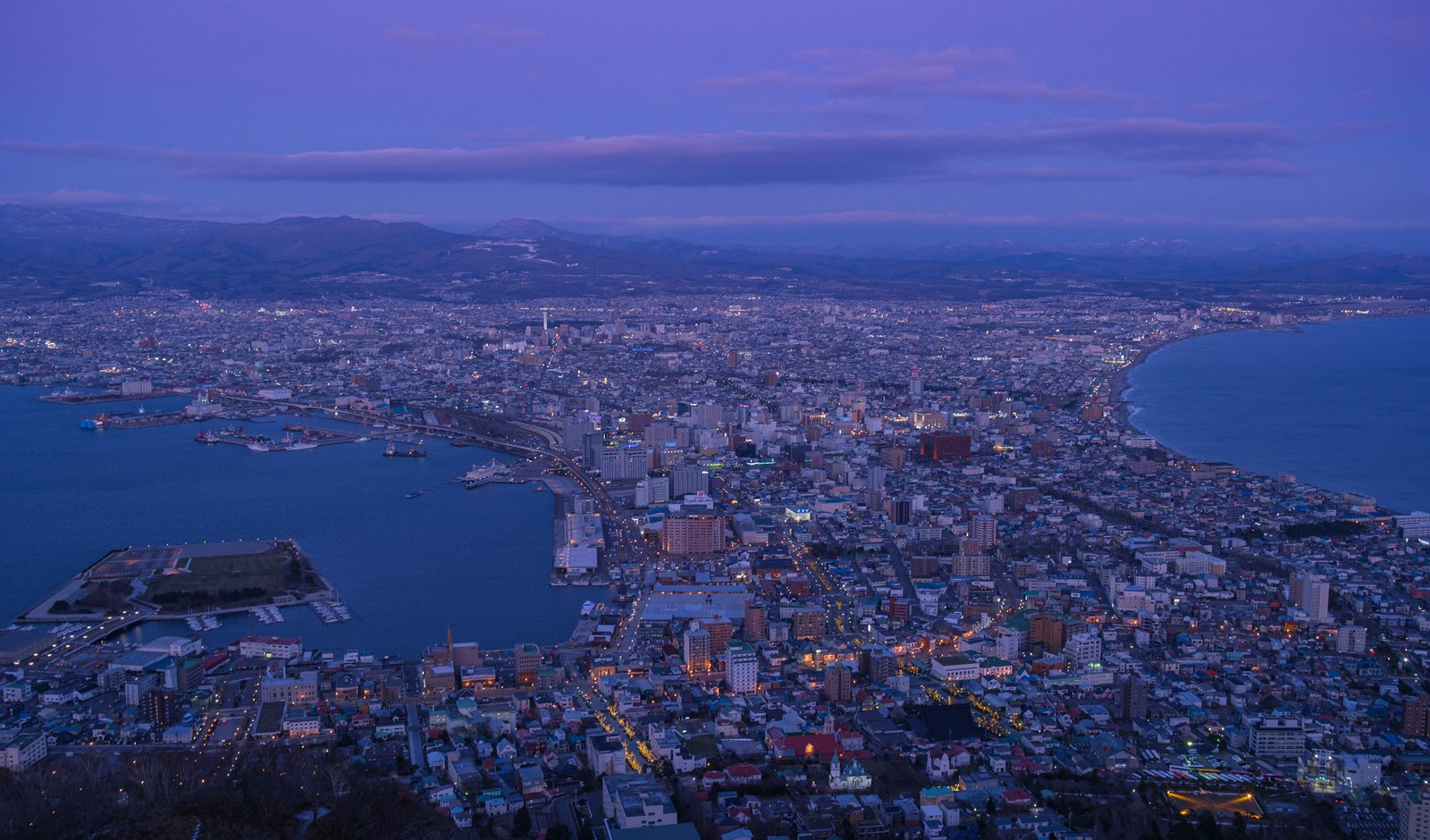
It is consistently ranked as one of Japan’s most atmospheric destinations. The night view from Mt Hakodate across the narrow isthmus on which the city sits - lights reflected on the ocean on both sides - is rated Michelin three stars (worth a special journey) in the Michelin Green Guide Japan, placing it alongside Kyoto temples and Mt Fuji as one of the country’s most visually exceptional experiences.
Mt Hakodate Night View
The most famous view in Hokkaido is from the summit of Mt Hakodate (334 metres), where the city below lies on a narrow strip of land between two bays, illuminated on both flanks by harbour and residential lights. The isthmus, widening from the mountain’s base toward the north, creates a distinctive triangular form visible from above.
The ropeway (¥1,500 return) runs from the Motomachi hillside to the summit, with departures every 3 minutes during peak hours. The mountain is accessible by ropeway from 10:00am to 10:00pm (9:00am–10:00pm in summer). The recommended approach is to take the ropeway approximately 30 to 40 minutes before local sunset - in winter this is around 4:00pm; in summer around 7:00pm. Watching the transition from daylight to full night illumination from the observation deck is one of the more memorable experiences in northern Japan.
The summit can be very cold even when the city is mild - temperatures drop significantly at elevation, and winter nights at the top can reach -10°C with wind chill. Bring an additional layer regardless of season.
Driving or taking a taxi to the summit is an alternative to the ropeway (road open April–November, approximately ¥2,000 by taxi from Motomachi).
Hakodate Morning Market
The Hakodate Morning Market (Asaichi) is one of Japan’s most celebrated seafood markets open to the public, operating from 5:00am to noon across a 2-block covered area adjacent to Hakodate Station. The market’s 300+ stalls sell Hakodate’s prime seafood: fresh squid (ika - Hakodate is famous for squid, particularly from July to November when live squid can be caught and eaten immediately), sea urchin (uni), salmon roe (ikura), snow crab (zuwaigani), abalone, and the morning’s fish catch.
Counter restaurants within the market serve kaisen-don (seafood rice bowls) from opening: ikura-don costs ¥1,500–¥2,000; uni-don runs ¥2,500–¥4,000; a combined ikura-uni-crab bowl can reach ¥5,000 for premium quality. The busiest period is 7:00am to 9:00am; a 6:00am arrival finds stalls setting up and prices firm. Live squid fishing (squid-tsuri, ¥1,000 to catch from a small tank, ¥500 to have sashimi-prepared) is available at certain stalls from July to November.
Goryokaku Star Fort
Goryokaku (Five-Ridge Enclosure) is Japan’s first Western-style fortification, constructed between 1857 and 1866 by the Tokugawa shogunate as a military stronghold and administrative centre for Hokkaido. The fort’s pentagonal star shape - based on European bastioned fort design of the 17th century - was intended to give defensive fire coverage in all directions without blind angles.
The star shape is invisible from ground level - from within the park you see moats and earthen ramparts like any other Japanese fortification. The Goryokaku Tower (¥840), constructed adjacent to the fort, provides the only elevated view revealing the full star geometry: the five-pointed earthwork, moat-filled star outline, and the cherry tree-lined ramparts below visible as a coherent geometric form.
In late April and early May, approximately 1,600 cherry trees planted along the ramparts bloom simultaneously, creating a pink border around the fort’s star perimeter - one of the most distinctive and photographed sakura displays in Hokkaido. The tower includes a ground-floor exhibition on the Battle of Hakodate (1868–69), when pro-shogunate forces made their last stand at Goryokaku against the new Meiji Imperial Army.
The fort grounds are a public park (free). The tower opens 9:00am to 6:00pm (until 7:00pm April–October).
Guided Hakodate day tours cover the morning market, Goryokaku, and the Motomachi Western residences as a structured circuit - useful for visitors arriving on the overnight train from Tokyo with a single full day before moving on.
Motomachi Historic District
Motomachi, the hillside district rising above the tram street south of the centre, preserves the most concentrated surviving collection of Meiji-era Western architecture in northern Japan. Hakodate’s role as the first open treaty port meant consulates, churches, merchant residences, and public buildings constructed by Western residents and influenced by Western architectural fashion were built here from the 1850s onward.
Key buildings within the free-to-walk district include:
Hakodate City Old Public Hall (¥300): A large Colonial-style city hall completed in 1910, painted in pale blue and cream with neoclassical columns. The interior is preserved with period furnishings. The evening illumination (free, November to March) highlights the building’s façade against the dark hillside.
Former British Consulate (¥300): The consulate’s former building now operates as a museum and tea room. The garden offers good views toward the harbour. Open 9:00am–7:00pm (until 5:00pm November–March).
Hakodate Orthodox Church (Harisutosu Seidou): The current green copper-roofed Byzantine-style church was completed in 1916, replacing earlier structures. Interior viewing is limited to certain hours. The exterior is free to view at all times.
Motomachi Catholic Church: A 1924 concrete Gothic church on the main hillside road. Free exterior; occasional interior access.
The district is best explored on foot; a 1.5-hour walking loop covers all major buildings. Information boards are present throughout in English and Japanese.
Kanemori Red Brick Warehouses
The Kanemori warehouses on Hakodate’s waterfront - originally used for Meiji-era shipping operations - have been converted into a complex of restaurants, shops, and small craft retailers. The long red-brick façade along the harbour is the most photographed daytime image in Hakodate and gives the waterfront a character similar to converted industrial districts in Yokohama or Otaru.
Entry to the complex is free. The restaurant selection includes Hakodate seafood izakayas, Italian restaurants, and the on-site craft beer brewery (Hakodate Beer, approximately ¥700–¥1,200 per glass of locally brewed lager or ale). In December, a Christmas market operates in the forecourt. Sunset from the waterfront promenade in front of the warehouses - with the bay and distant mountains behind - is one of the best early-evening experiences in the city.
Lucky Pierrot
Lucky Pierrot is a local Hakodate burger chain with approximately 17 branches concentrated in the city and nowhere else in Japan. The flagship Chinese Chicken Burger (¥530) - sweet-sauce glazed fried chicken thigh in a soft bun - is the most-ordered item and has developed a genuine cult following among food-focused visitors. The interiors are deliberately eccentric, decorated with clown motifs, vintage toys, and dense decorative collectibles.
Queues at the Motomachi branch (near the waterfront) can stretch outside at peak meal times. The Kanemori branch is more convenient as a combined stop with the warehouse district. The menu includes curry, omu-rice, and specialty seasonal items, but the Chinese Chicken Burger is the reason to visit.
Getting to Hakodate
From Sapporo: JR limited express Hokuto, approximately 3 hours 30 minutes, ¥8,910. Highway bus is slower (5 hours) but cheaper (¥3,400 one-way).
From Tokyo: Hokkaido Shinkansen to Shin-Hakodate-Hokuto (4h15m, ¥22,690), then local JR 17 minutes to Hakodate (¥1,150). Flying Tokyo–Hakodate is approximately 1h20m and often cheaper with advance booking.
From Aomori: Hokkaido Shinkansen from Shin-Aomori to Shin-Hakodate-Hokuto (approximately 50 minutes, ¥5,590), then local JR to Hakodate.
Getting Around Hakodate
The Hakodate tram (streetcar) covers the main tourist circuit - Hakodate Station, Kanemori Warehouses, Motomachi, and the ropeway base station - at ¥260 per ride or ¥600 for a 1-day pass. The tram runs from approximately 6:30am to 10:30pm. Goryokaku requires a tram to the Goryokaku-koen-mae stop (10 minutes). The city is very walkable in dry weather; the hillside of Motomachi involves a steep climb from the tram stop.
Planning your trip to Hakodate? Tours and activities in Hakodate cover guided experiences, cultural immersion, and the top sights with local expertise. Flights to Japan vary significantly by season - compare early to secure the best fares. Sort out travel insurance for Japan before you book, and pick up an Airalo eSIM for Japan to have mobile data the moment you land.
Search hotels in Hakodate on Booking.com
Explore Hakodate
Things to do in Hakodate · Where to stay in Hakodate · Best restaurants in Hakodate · Hakodate food guide · Day trips from Hakodate
Hakodate is the southern gateway to Hokkaido. For an overview of Japan’s northern island, see our Hokkaido region guide. Planning a week or more in Hokkaido? Our Hokkaido itinerary builds the most efficient route between Hakodate, Sapporo, and the national parks.
See also: Hokkaido region guide · Sapporo travel guide · Hokkaido itinerary · Onsen guide Japan · Japan in February · Japan Rail Pass guide · Long stay in Hakodate
Upcoming Events in Hakodate
Hakodate Christmas Fantasy
hakodate
Hakodate Christmas Fantasy 2026, 1–25 Dec. Giant Christmas tree on the waterfront with nightly harbour fireworks - Japan's top winter illumination.
Hatsumode - New Year Shrine Visits
Hatsumode 2027, 1–3 January. Japan's most important annual tradition - millions visit shrines and temples in the first three days of the new year.
Nearby Cities
Frequently Asked Questions
- How do I get to Hakodate from Sapporo?
- Take the JR Hokkaido limited express Hokuto from Sapporo to Hakodate - approximately 3 hours 30 minutes for ¥8,910. Alternatively, highway buses take 5 hours for around ¥3,400 one-way. The Hokkaido Shinkansen stops at Shin-Hakodate-Hokuto, 17 minutes from Hakodate by local JR (¥1,150).
- How do I get to Hakodate from Tokyo?
- Take the Hokkaido Shinkansen from Tokyo to Shin-Hakodate-Hokuto (approximately 4 hours 15 minutes, ¥22,690 reserved), then a local JR train 17 minutes to Hakodate (¥1,150). Total journey approximately 4 hours 30 minutes.
- What time should I go up Mt Hakodate for the night view?
- Arrive 30 to 40 minutes before sunset to watch the transition from daylight to full night illumination - the city below shifts through gold, then orange, then the full night view as darkness falls. The last ropeway is at 22:00 (10pm). Summer sunset is around 7:30pm; winter around 4:00pm.
- When does Hakodate Morning Market open?
- Most stalls open at 5:00am, with some fish vendors starting at 4:00am. The busiest and freshest period is 6:00am to 9:00am. The market begins to close from noon and most stalls are shut by 12:30pm.
- Is Hakodate's Goryokaku star fort worth visiting?
- Yes. The ¥840 observation tower gives the only aerial view of the star-shaped fortification layout - impossible to appreciate from ground level. The fort and surrounding park are also outstanding for cherry blossoms in late April and for the ice skating ring in winter.
Book an experience
Top experiences in Hakodate
Explore the best tours and activities in Hakodate, with instant confirmation and free cancellation on most bookings.