Miyajima is compact enough to cover thoroughly in a full day, but has enough depth - particularly on the hiking trails and in the quiet temple precincts away from the main path - that a second day rewards effort. Below are 14 things to do on Miyajima, from the unmissable to the ones that require staying overnight to experience properly.
1. Visit the O-torii at High Tide for the Floating Effect
The O-torii at high tide is the definitive Miyajima experience. When the tide is fully in, the water rises to partially submerge the base pillars, leaving only the upper crossbeams and the main gate structure visible above the surface. The floating effect is most dramatic at maximum high tide.
To plan correctly, check the Japan Meteorological Agency tide table at jma.go.jp for your visit date before leaving Hiroshima. Enter “宮島” (Miyajima) for the correct station. High tides above 2.5 meters create the best floating effect. A high tide between 8am and 3pm is the ideal window - morning light from the east and afternoon light from the west both work well for photography.
The gate is always free to approach. No entry fee; viewable at all hours.
2. Wade Out to the O-torii at Low Tide
When the tide drops, the seafloor around the gate becomes exposed as shallow tidal flats of compacted sand and dark mud. Visitors wade or walk across to stand at the gate’s base - touching the 1-meter-wide camphor-wood pillars, standing directly beneath the 16-meter structure. The scale of the gate is more legible from this close; its weight and heft become clear. The mud underfoot requires footwear you don’t mind muddying.
This is free and requires no planning beyond checking that low tide falls during your visit window. The combination of high tide and low tide in a single day (check your tide table) is ideal if you have a full day.
3. Watch Sunrise Over the Torii from the Ferry
The first JR ferry from Miyajimaguchi departs at approximately 06:25. The crossing gives a straight-ahead view toward the O-torii as the boat approaches the island. At sunrise in spring and autumn, the low angle of the sun behind the mountains to the east throws gold light across the gate and the water surface. This requires staying in Hiroshima or Miyajima the previous night - the first ferry before dawn is the only way to see the gate in this light as a visitor arriving from the mainland.
The ferry itself costs ¥210 (free with JR Pass). The light is available only in the first 20 to 30 minutes after sunrise.
4. Itsukushima Shrine at High Tide
Itsukushima Shrine (¥300) is best visited at high tide, when the raised wooden walkways of the shrine complex pass over open water rather than exposed seabed. Walking the covered corridors - the sea visible through the lattice walls below, the O-torii framed in the distance - and arriving at the main hall with the water lapping the foundations is an experience that justifies the ¥300.
The No drama stage on the sea-facing side of the shrine is used for performances during the main shrine festivals (Kangensai festival in June and July, Tamatori festival in July). These are free to watch from the shore.
5. Daisho-in Buddhist Temple
Daisho-in is Miyajima’s other anchor site, free to enter throughout. The moss-covered stone lantern approach - 1,000 years of accumulated lichen turning the lanterns dark grey-green - leads to a series of courtyards with distinctive Shingon Buddhist iconography: the cave of 88 Shikoku pilgrimage miniatures, the rotating copper prayer wheel (spin it as you pass for blessings), and the Maniden hall with its gilded main figure. The atmosphere here is notably different from Itsukushima Shrine - quieter, more concentrated, the incense smoke denser.
Allow 45 minutes to 1 hour. The temple is busiest in the early afternoon when tour groups arrive from Hiroshima; late morning or after 3pm is quieter.
6. Hike Mount Misen via Momijidani Trail
The Momijidani trail to Mount Misen (509m summit) starts from Momijidani Park, a 15-minute walk from the ferry terminal. The trail is 2.5 kilometers one-way, climbing through dense temperate forest - cedar, pine, mountain cherry, and maple depending on altitude. The ascent takes 1 hour 30 minutes at a moderate pace. The summit gives 360-degree views of the Seto Inland Sea, the islands arranged in the distance, and the mainland mountains to the north.
Entrance to the trail is free. The hiking summit walk from Shishi-iwa cable car station to the summit takes 30 additional minutes. Total return time from ferry terminal by foot (up Momijidani, down Daisho-in) is 4 to 5 hours. Wear appropriate footwear; the trail surface is rocky and uneven in the upper section.
7. Take the Cable Car to Shishi-iwa
The two-stage cable car (¥1,000 one-way, ¥1,800 return) rises from Momijidani Park to Shishi-iwa station, from which the summit is 30 minutes by foot along a ridge path. The cable car gives aerial views over the forested island slopes and glimpses of the sea. It is the right option for those who want the summit views without the 1h30m hiking ascent. The cable car runs approximately every 15 minutes and closes around 5pm - check current timetables before starting.
8. Walk Momijidani Park
Momijidani Park (free) is a river-valley park between the ferry terminal and the cable car base, planted with hundreds of Japanese maples. In November, the park is one of the best foliage spots in the Hiroshima area, the red and orange maples reflecting in the shallow river and the stone bridges crossing it. Small stone sculptures and shrines are dotted through the park margins. Outside autumn, the park is a pleasant green walk with the occasional deer.
9. Senjokaku Pavilion
Senjokaku (“hall of a thousand mats,” ¥100) is a vast, unenclosed wooden hall commissioned by Toyotomi Hideyoshi in 1587, left unfinished when he died in 1598, and never subsequently completed. The interior has no walls - the enormous roof is supported by columns, and the space is open to the sea air. The scale of the structure is impressive; the floor area genuinely holds 1,000 tatami mats’ worth of space. The interior holds hanging votive wooden placards (ema) from every period since the hall’s construction. Adjacent, the five-story pagoda (vermilion and white, late 15th century) can be viewed freely from the outside.
10. Watch the Deer
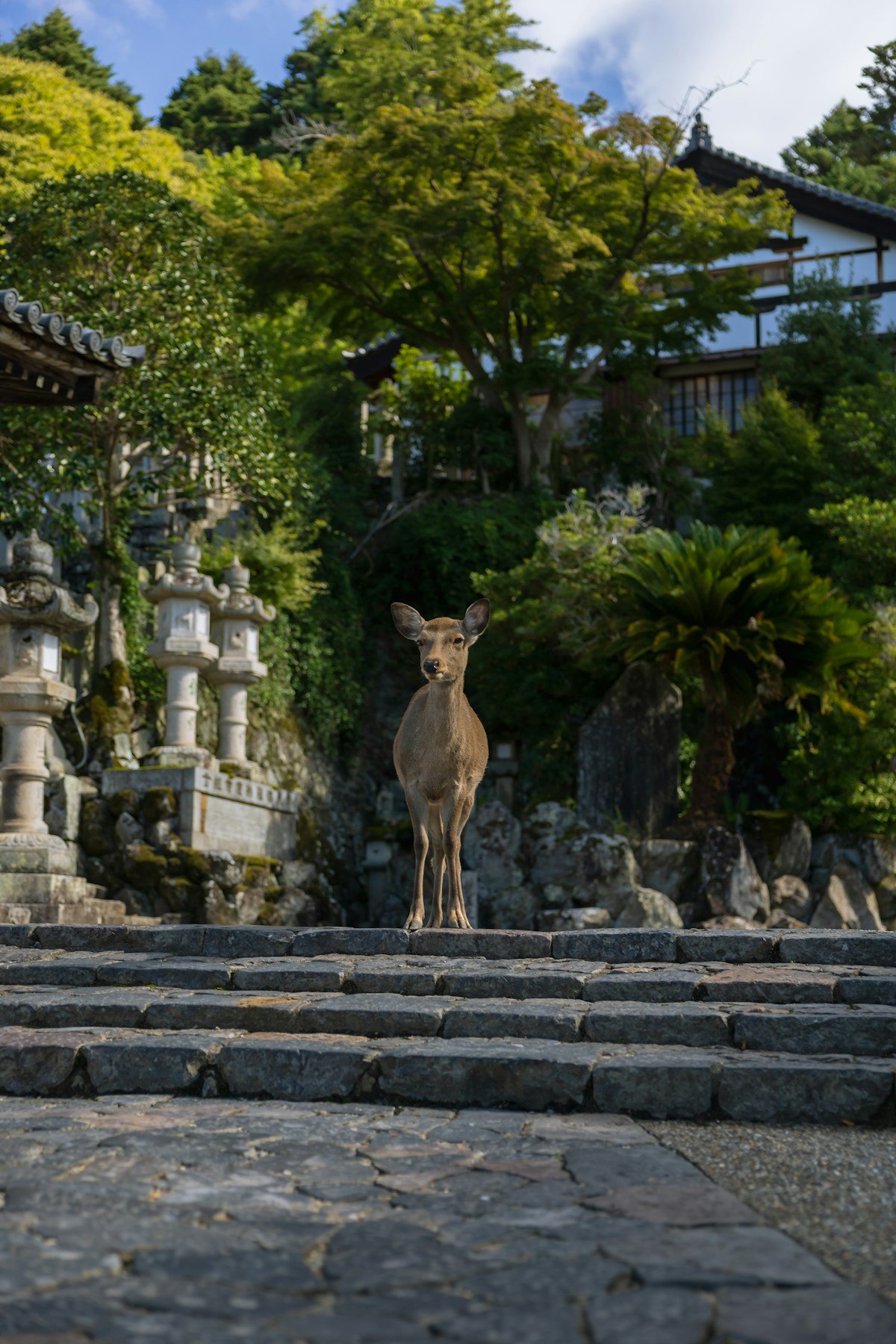
Approximately 700 deer live freely on Miyajima. They are smaller and lighter than the deer at Nara - a slightly different subspecies of sika deer - and considerably more relaxed. They typically stand or lie along the paths between the ferry terminal and the shrine, occasionally approaching for attention. They are accustomed to cameras and crowds, and can be observed at very close range without the shoving and head-butting behavior common at Nara. Do not feed them - deer fed by humans develop digestive problems and become aggressive.
11. Eat Fresh Oysters at Harbour Stalls
The oyster stalls along Omotesando shopping street (between the ferry terminal and the shrine) sell freshly grilled whole oysters directly over charcoal for ¥300 to ¥500 per shell. The oysters are from farms in Miyajima Bay, harvested and delivered in the morning. They are large, plump, and taste of cold clean seawater. Two or three is a standard snack serving. Eating one while watching the O-torii in the middle distance is about as Miyajima as it gets.
12. Anago Meshi (Eel Rice) at Ueno
Anago (conger eel, not the freshwater unagi eel) from the Seto Inland Sea is Miyajima’s other food speciality. Ueno restaurant, near the ferry terminal, braised conger eel in soy and sweet rice wine and serves it over rice in lacquered boxes. A set meal costs ¥2,000 to ¥2,300. The eel is soft, dark, slightly sweet - different in character from unagi. Ueno opens at 10am and typically sells out by early afternoon; arrive early or reserve.
13. Shopping for Momiji Manju
Momiji manju are maple-leaf shaped baked cakes, ¥150 each, sold from around a dozen shops along Omotesando. They are baked continuously in molds and best eaten fresh and slightly warm, the pastry softer in the first hour after baking. The traditional filling is tsubuan (chunky red bean paste); custard and matcha variants are reliably good; the chocolate and cheese versions are more variable. Buying 3 or 4 different varieties to compare is the recommended approach.
14. Staying Overnight for Dawn and Dusk Access
The ferry schedule means day-trippers typically arrive at the island between 9am and 11am and depart before 6pm. After the last afternoon ferry brings visitors back, the island becomes quiet - fewer than 2,000 people on 30 square kilometers of forested terrain. The deer return to the paths. The shrine lights up after dark. The torii gate at night, lit from below, is almost never photographed by day-trippers.
Staying on Miyajima costs ¥20,000+ per person at a ryokan (meals included). The experience - dawn light on an empty shrine at 6am, the tide table timing perfectly with breakfast - justifies the cost for visitors who can afford it.
Book ahead for popular experiences: Tours and activities in Miyajima include guided options, skip-the-line tickets, and immersive cultural experiences.
Photography by Tide and Time of Day
| Time | Tide | Best Shot | Notes |
|---|---|---|---|
| Sunrise (~6:30am) | Check table | Ferry approach shot of torii | Requires overnight or first ferry |
| Morning 7–9am | High tide ideal | Floating torii from beach | Best if high tide >2.5m |
| Mid-morning 9–11am | Depends on date | Shrine corridors over water | Most day-trippers arrive 10am+ |
| Midday | Often low tide | Walk to torii on tidal flats | Muddy footwear needed |
| Afternoon 2–4pm | Depends on date | Torii reflection if calm water | Check specific date tide |
| Sunset (~5–7pm) | Check table | Torii in evening light | Requires overnight stay or last ferry |
| After 8pm | Any | Torii lit from below, empty | Overnight guests only |
Where to stay: Search hotels in Miyajima on Booking.com
See also: Miyajima travel guide · Where to stay in Miyajima · Best restaurants in Miyajima · Hiroshima city guide · Chugoku region guide